


Linear equations are the foundation of algebra, providing a way to model relationships where one variable changes at a constant rate in relation to another. Whether you are tracking the amount of money saved each month or the distance a student travels from home, understanding how to write, convert, and graph these equations is essential for solving real-world problems.
Understanding Slope and Rate of Change
At the heart of every linear equation is the slope (), which is mathematically defined as the rate of change. The slope measures the steepness of a line and is calculated as the ratio of the change in to the change in , often referred to as "rise over run".
If the slope is positive, the line increases as it moves from left to right; if the slope is negative, the line decreases. In practical terms, the rate of change tells us how much one quantity changes for every single unit of another. For example, if a reservoir's volume decreases by 0.25 million gallons every day, the rate of change is .
To find the slope when given two specific points, and , use the following formula:
Exam Tip: When calculating slope, always be careful with negative signs. Subtracting a negative number is the same as adding a positive (e.g., becomes ).
Key Forms of Linear Equations
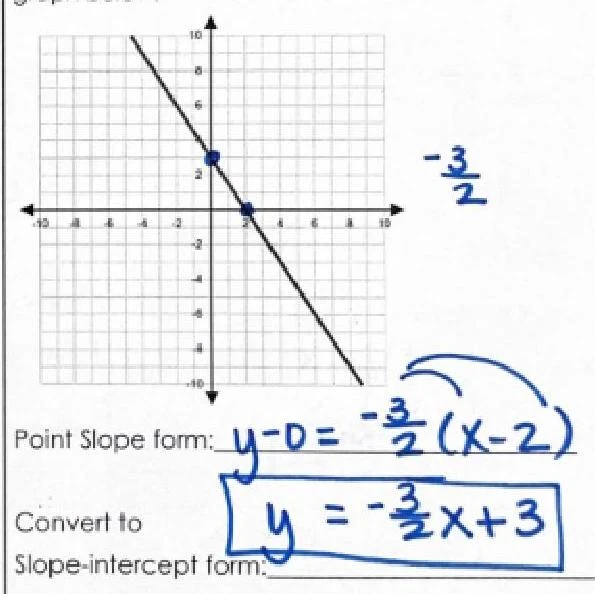
Depending on the information you are given, you will use different forms of a linear equation to represent a line.
Keep reading for free.
Create an account to finish this reading and make it part of your study routine.
Continue reading freeAlready have an account? Log in
Updated