Understanding Intermolecular Forces and Their Impact on Physical Properties
Explores the three main types of intermolecular forces: London dispersion forces, dipole-dipole forces, and hydrogen bonding. Explains how these forces influence physical properties such as boiling points and viscosity, with applications in material science and engineering.
When we think about the physical world, we often take for granted why water is a liquid at room temperature while oxygen is a gas, or why certain plastics are much stronger than others. The answer lies not in the bonds holding individual atoms together, but in the forces acting between those molecules. These are known as intermolecular forces (IMFs).
While chemical bonds (like covalent or ionic bonds) involve the sharing or transferring of electrons to create a molecule, intermolecular forces are the attractive forces that operate between separate molecules. Understanding these forces is essential for material science, as they dictate critical physical properties such as melting points, viscosities, solubilities, and boiling points.
The Hierarchy of Intermolecular Forces
Intermolecular forces are generally categorized into three main types, which increase in strength as follows: London dispersion forces, dipole forces, and hydrogen bonding.
1. London Dispersion Forces (LDF)
London dispersion forces are the weakest of the three and are present in all substances, whether they are polar or non-polar. These forces arise from the movement of electrons, which creates temporary imbalances in electron density.
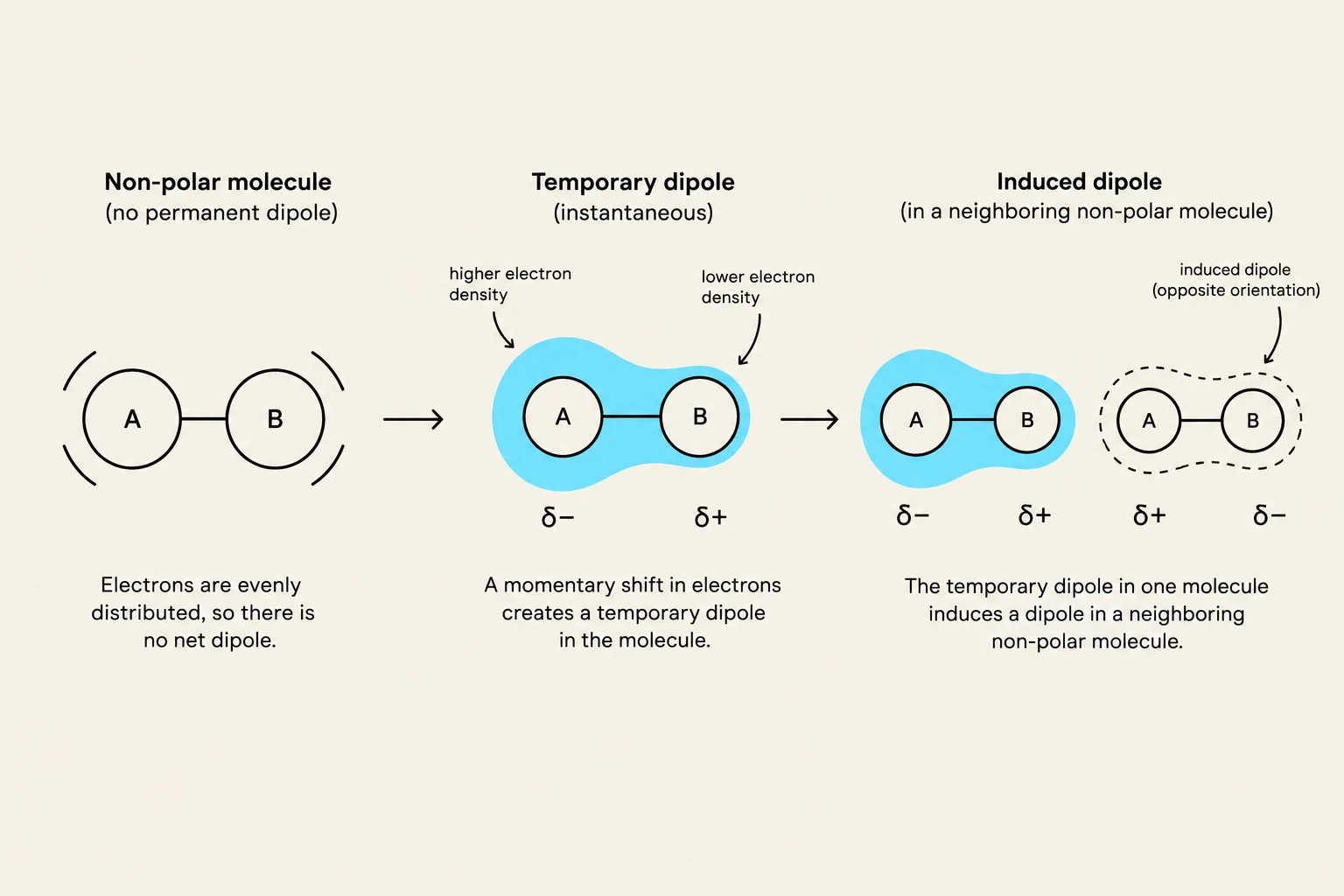
Because electrons are constantly in motion, at any given instant, they might happen to be more concentrated on one side of an atom or molecule than the other. This creates a temporary or instantaneous dipole. This temporary dipole can then exert an attractive force on a neighboring molecule, causing its electrons to shift as well. This second molecule then develops an induced dipole. The attraction between these temporary dipoles is what we call a London dispersion force.
Key Rule: The strength of London dispersion forces increases as the number of electrons in a molecule increases.
This diagram illustrates the process of induced dipoles in non-polar molecules. Initially, a non-polar molecule has evenly distributed electrons, resulting in no net dipole. However, a momentary shift in electron density can create a temporary dipole. This temporary dipole can then induce a dipole in a neighboring non-polar molecule, causing a separation of charge.
2. Dipole-Dipole Forces
While dispersion forces occur in everything, dipole forces (or dipole-dipole interactions) are specific to polar molecules.
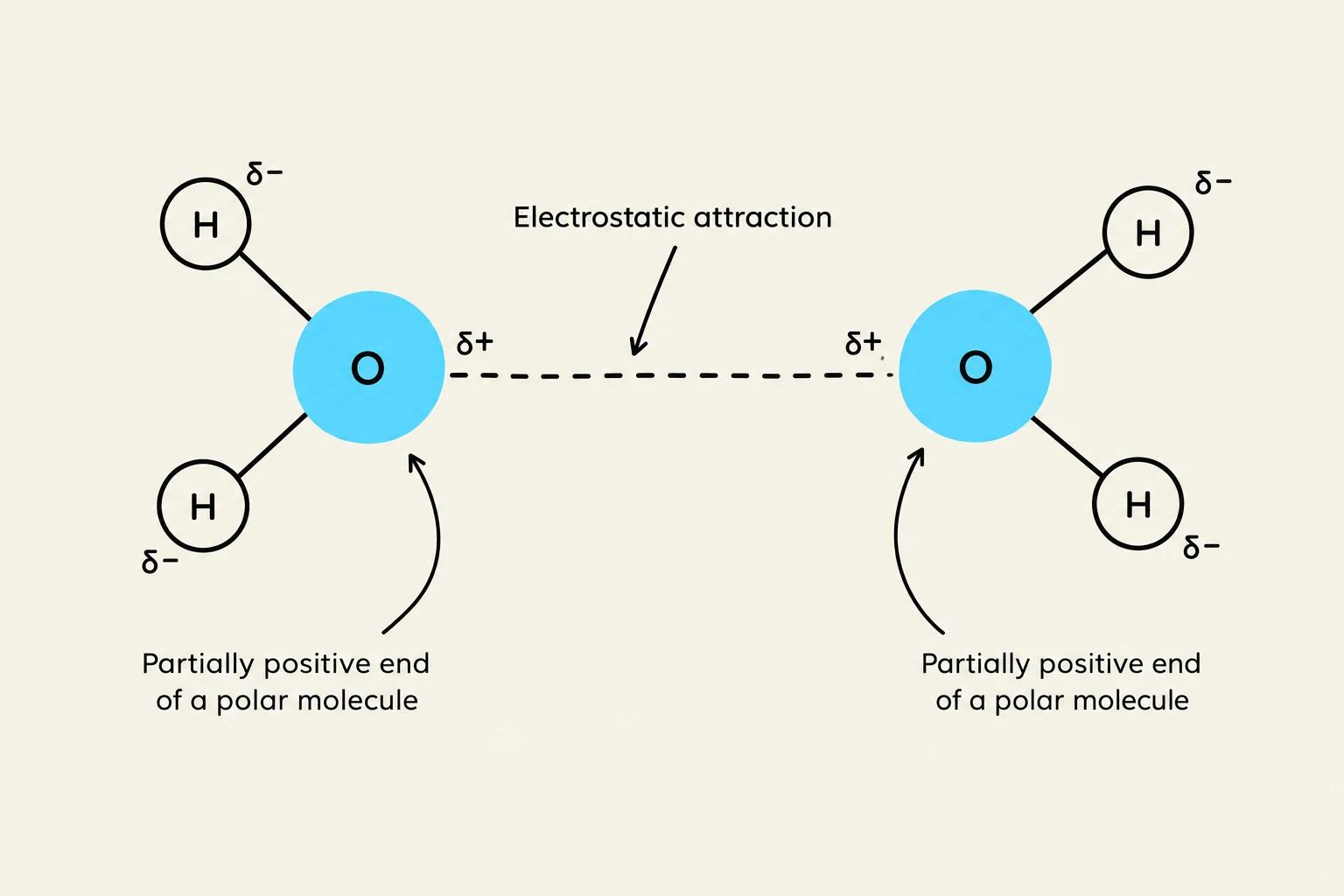
A polar molecule possesses a permanent dipole, meaning it has a constant uneven distribution of electron density due to differences in electronegativity between its atoms. This results in a partially positive end and a partially negative end of the molecule. Dipole forces occur when the partially positive end of one polar molecule is attracted to the partially negative end of another. Generally, when comparing substances of similar size, dipole forces are stronger than London dispersion forces.
This diagram illustrates the electrostatic attraction between two polar water molecules. The partially positive hydrogen atoms of one molecule are attracted to the partially negative oxygen atom of another molecule.
3. Hydrogen Bonding
Hydrogen bonding is a "special" and particularly strong type of dipole-dipole force. It does not occur in all polar molecules; rather, it requires a very specific molecular structure.
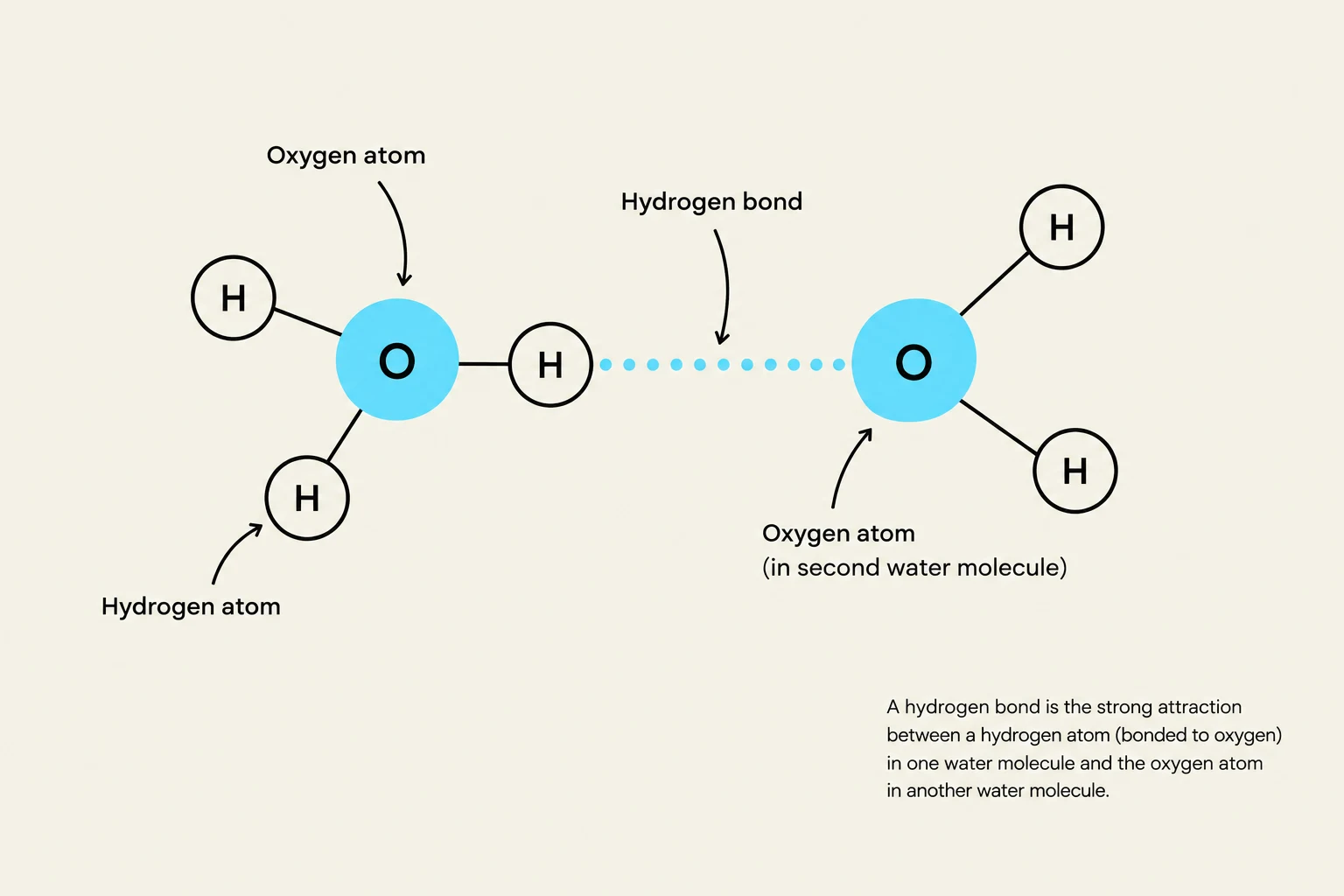
For hydrogen bonding to occur, a molecule must contain a hydrogen atom that is covalently bonded to a small, highly electronegative element—specifically Nitrogen (N), Oxygen (O), or Fluorine (F). These atoms pull the shared electrons so strongly toward themselves that the hydrogen atom is left with a significant partial positive charge, allowing it to form a strong attraction to the lone pair of electrons on a neighboring N, O, or F atom.
This diagram illustrates a hydrogen bond between two water molecules, showing the attraction between a hydrogen atom of one molecule and the oxygen atom of another.
Predicting Physical Properties: Boiling Points
One of the most practical applications of understanding IMFs is predicting the boiling point of a substance. Boiling occurs when enough thermal energy is added to overcome the intermolecular forces holding molecules together in a liquid state.
To compare the boiling points of two substances, you can follow a systematic two-step process:
Identify the types of IMFs present: Use the molecular structure (and Lewis structures) to determine if the molecule is non-polar (LDF only), polar (LDF + Dipole), or contains hydrogen bonding (LDF + Dipole + H-bonding).
Compare the forces:
If the substances have different types of IMFs, the substance with the stronger type of force will have the higher boiling point.
If the substances have the same type of IMFs, the substance with the greater number of electrons (and thus larger dispersion forces) will have the higher boiling point.
Worked Example: Comparing Halogens
Consider the following data for various substances:
Substance
Type of IMF
# of Electrons
Boiling Point (K)
H2
Dispersion only (non-polar)
2
20
N2
Dispersion only (non-polar)
14
77
O2
Dispersion only (non-polar)
16
90
HCl
Dipole + Dispersion (polar)
18
188
HBr
Dipole + Dispersion (polar)
36
206
HI
Dipole + Dispersion (polar)
54
238
Analysis:
Moving from H2 to O2: All are non-polar. As the number of electrons increases, the boiling point increases.
Moving from O2 to HCl: The type of IMF changes from dispersion only to dipole-dipole. Even though O2 has more electrons than HCl might suggest in other contexts, the addition of dipole forces causes a massive jump in boiling point.
Moving from HCl to HI: All are polar. Since the type of IMF is the same, we look at the electron count. As electrons increase, the boiling point increases.
Cautionary Note: While this method is highly effective, always check for "special cases." For example, HF has hydrogen bonding, making its boiling point significantly higher than other hydrogen halides like HCl, despite having fewer electrons.
Engineering and Material Science Applications
The ability to manipulate intermolecular forces is a cornerstone of modern engineering. By understanding how molecules interact, scientists can design materials with specific macroscopic properties:
Polymers and Plastics: Controlling the strength of forces between long molecular chains dictates the strength and flexibility of plastics.
Adhesives and Coatings: Designing glues requires understanding how the adhesive molecules will "stick" to a surface via IMFs.
Drug Delivery: In medicine, the solubility and movement of drugs through the body depend on how they interact with water and cellular membranes.
Fluid Dynamics: The viscosity (thickness) of a fluid is directly related to the strength of the attractions between its molecules.
Keep reading for free.
Create an account to finish this reading and make it part of your study routine.