Understanding Interdisciplinary Studies Through Metaphors
Explore the concept of interdisciplinary studies, which integrates insights from multiple fields to address complex problems. This explanation uses metaphors like boundary crossing, bridge building, and bilingualism to illustrate how different disciplines connect and synthesize knowledge.
In the modern academic landscape, complex problems—such as climate change, urban poverty, or public health crises—rarely yield to the narrow lens of a single field of study. While traditional disciplines (specialized branches of learning like biology or history) provide the essential foundation for knowledge, they often operate in silos. To address the complexities of the real world, scholars employ interdisciplinary studies, a cognitive process that draws on multiple disciplinary perspectives and integrates their insights to construct a more comprehensive understanding.
Because "interdisciplinarity" can be a difficult concept to grasp, scholars often use metaphors to visualize how different bodies of knowledge interact. By exploring the metaphors of boundary crossing, bridge building, and bilingualism, we can better understand the nuances of how knowledge is shared, connected, and synthesized.
Defining the Landscape: Disciplinarity vs. Interdisciplinarity
Before diving into metaphors, it is vital to distinguish between the different ways we organize knowledge. The academic world generally operates through four distinct modes:
Disciplinarity: Focusing on a problem through the narrow lens of a single discipline.
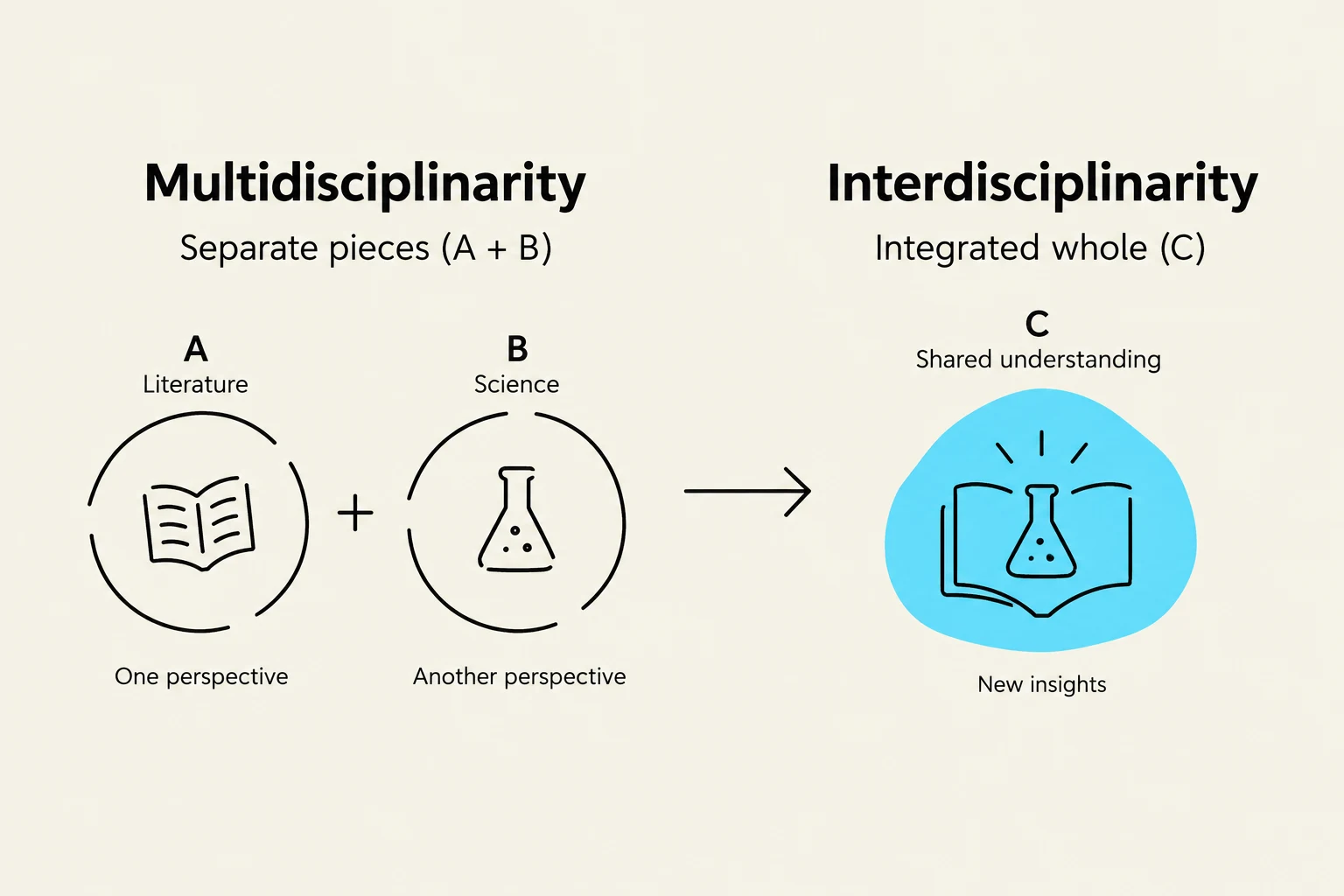
Multidisciplinarity: Placing insights from different disciplines side-by-side without attempting to integrate them—like a "bowl of fruit" where each fruit remains distinct.
Interdisciplinarity: Drawing on and integrating insights from two or more disciplines to create a new, more comprehensive understanding.
Transdisciplinarity: An approach that integrates academic research with nonacademic stakeholders (such as local citizens or policymakers) to solve societal problems.
Exam Tip: If a question asks for the "crux" of interdisciplinary studies, look for the word integration. Multidisciplinarity involves juxtaposition (placing side-by-side), while interdisciplinarity requires synthesis (blending to create something new).
This diagram illustrates the difference between multidisciplinarity, where separate disciplines (like literature and science) are combined, and interdisciplinarity, where these disciplines are integrated to create new insights and shared understanding.
The Metaphor of Boundary Crossing
The first metaphor compares disciplines to distinct territories or countries. In this view, each discipline has well-defined borders, its own laws, and its own specialized knowledge. An interdisciplinary researcher is like a traveler who must cross these borders to access the expertise needed to solve a problem.
For example, investigating human cloning requires "crossing" the boundaries between biology, religion, ethics, and law. This metaphor is highly effective at illustrating that disciplines are the essential sources of expertise and that moving between them requires active effort.
However, this metaphor has limitations. It can imply that disciplines are static, unchanging territories, whereas in reality, they are dynamic and constantly evolving. It also risks suggesting that the "language barrier" between disciplines is an insurmountable wall, rather than a manageable challenge.
The Metaphor of Bridge Building
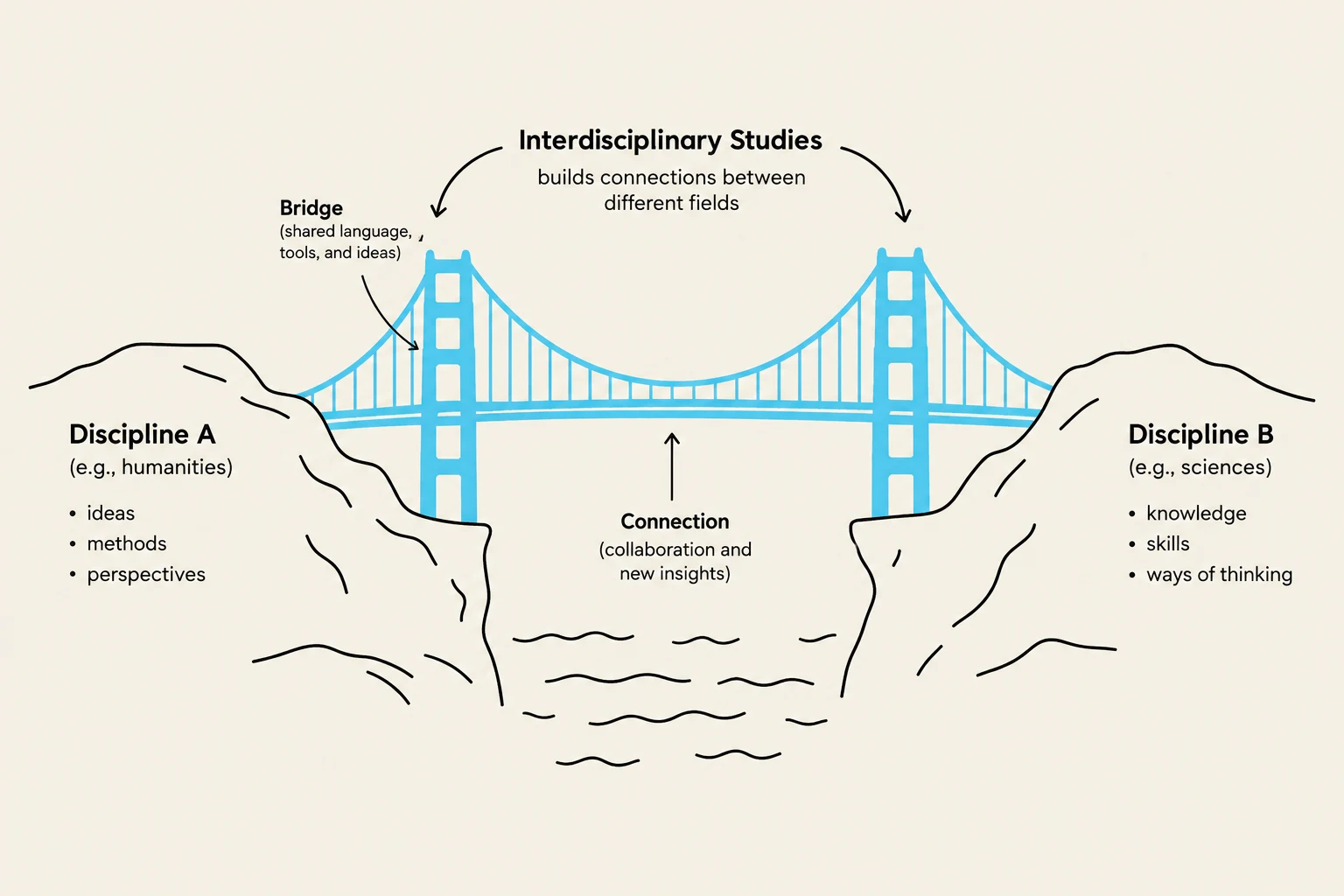
While boundary crossing focuses on the act of moving between fields, bridge building focuses on the connection created between them. In this metaphor, disciplines are the two points of land separated by an obstacle, such as a river. The interdisciplinary study is the bridge that makes communication and the flow of information possible.
This metaphor highlights two key aspects:
Connection: Interdisciplinarity happens between disciplines.
Application: It has an applied orientation; we build bridges to get somewhere or solve something, rather than just for the sake of the connection itself.
Despite its utility, bridge building lacks a component of critical reflection. A civil engineer builds a bridge based on a fixed blueprint, but an interdisciplinary scholar must constantly analyze, question, and reconsider their connections as they work. Unlike a physical bridge, an interdisciplinary "bridge" is often custom-built for a specific problem and may change as new insights emerge.
This diagram illustrates the concept of interdisciplinary studies, showing how a bridge connects two distinct disciplines (e.g., humanities and sciences) through shared language, tools, and ideas, fostering collaboration and new insights.
The Metaphor of Bilingualism
The most linguistically focused metaphor is bilingualism. This compares disciplines to foreign languages. Just as a person learning a new language must master a specific vocabulary and grammar to participate in a conversation, an interdisciplinary scholar must learn the "language" (the key terms, theories, and methods) of a discipline to understand its experts.
This metaphor is particularly strong because it recognizes that integration is an ongoing process of communication. However, it carries two main risks:
It might suggest that one must achieve total "fluency" (mastery) in a discipline before they can use it, whereas interdisciplinarians often only need "adequacy" to extract relevant insights.
It can oversimplify integration as mere "translation." In reality, integration is much harder than translation because different disciplines often hold conflicting views on the same facts.
Two Approaches: Instrumental vs. Critical
Regardless of the metaphor used, interdisciplinary work generally falls into two conceptual camps: instrumental and critical.
Instrumental Interdisciplinarity: This is a pragmatic, problem-solving approach. It focuses on finding common ground between conflicting insights to build a more comprehensive understanding of a problem.
Critical Interdisciplinarity: This approach goes a step further by asking why certain disciplinary perspectives exist in the first place. It examines the historical, social, and political biases—such as gender or ethnic biases—that may have shaped a discipline's way of seeing the world.
While they may seem different, they are often complementary. A critical analysis might question the very premise of a problem, while an instrumental analysis works to find the best possible solution within that framework.
Summary Table: Metaphor Comparison
Metaphor
Useful Aspect
Weakness
Boundary Crossing
Focuses on disciplines as sources of expertise.
Suggests disciplines are static/unchanging.
Bridge Building
Emphasizes the applied, connecting nature of the work.
Lacks the element of critical reflection.
Bilingualism
Recognizes the importance of disciplinary vocabulary.
Suggests integration is just "translation".
By using these metaphors, we can better navigate the complex process of drawing from diverse knowledge formations to tackle the most pressing challenges of our time.
Keep reading for free.
Create an account to finish this reading and make it part of your study routine.