Understanding Infection Processes and Pathogen Characteristics
An overview of infection, including pathogens, the body's defense mechanisms, classification of infections, diagnostic methods, complications like sepsis and antibiotic resistance, and infection control strategies.
Understanding the mechanisms of infection is fundamental to clinical practice. An infection is defined as the invasion and multiplication of microorganisms within body tissues. This process may be unapparent, or it may manifest as local cellular injury caused by competitive metabolism, toxins, intracellular replication, or the body's own antigen-antibody response.
The Players: Pathogens and Microflora
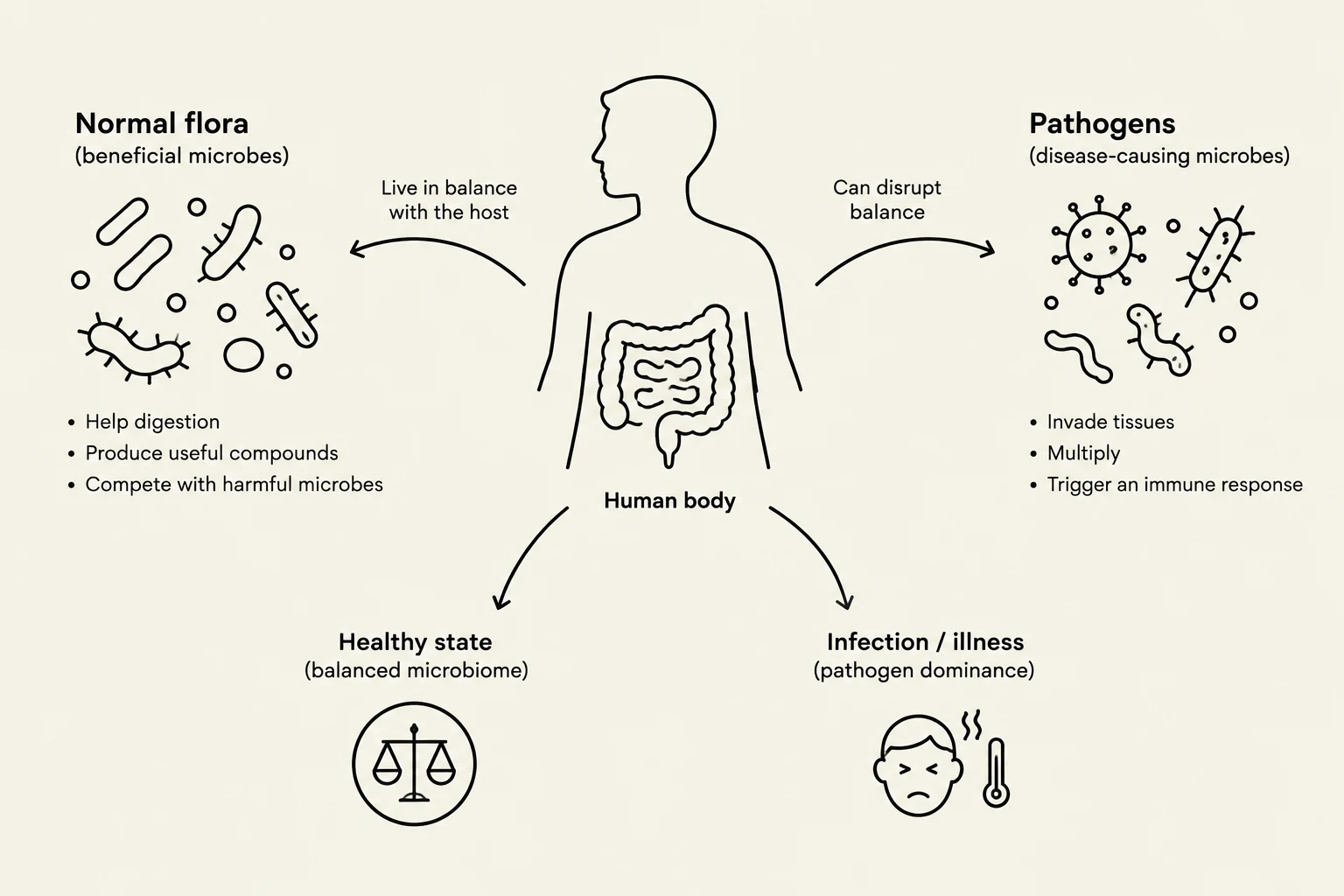
Not all microorganisms present in the human body are harmful. Our bodies are home to normal flora (or the microbiome), which are bacteria that are normally present and provide benefits to the host without causing harm.
In contrast, a pathogen is a microorganism capable of causing disease. The severity of a pathogen's impact is determined by its virulence, which refers to its degree of pathogenicity, potency, or severity. Some pathogens are opportunistic, meaning they take advantage of a host with a weakened immune system to cause infection. If an infection is capable of being transmitted from one person to another, it is described as communicable.
This diagram illustrates the balance between normal flora (beneficial microbes) and pathogens (disease-causing microbes) within the human body, and how this balance affects health states.
The Body's Defense and the Inflammatory Response
When a pathogen invades, the body initiates a complex immune response to combat the threat. This response involves several key components:
B lymphocytes: These cells are activated to produce antibodies, which help identify and neutralize foreign substances.
T lymphocytes: These cells are activated to facilitate phagocytosis (the process of engulfing and destroying pathogens).
The Complement System: This is a group of proteins that are activated to enhance the overall immune response, helping to remove bacteria from the system.
As the immune system fights back, the bacteria may release toxins. Exotoxins are released by bacteria and can be highly toxic to host cells. Endotoxins are components released from the cell membrane of Gram-negative bacteria, often during cell death, which can trigger systemic effects. This entire process triggers an inflammatory response, characterized by symptoms such as fever and chills.
Classifying Infections
In clinical settings, infections are categorized based on several factors to guide treatment and isolation protocols.
By Location and Spread
Localized infection: Confined to one specific area.
Disseminated infection: Starting to spread from the initial site.
Systemic infection: Affecting the entire body.
By Duration and Source
Acute versus Chronic: Acute infections have a rapid onset, while chronic infections persist over a long period.
Community-acquired versus Hospital-acquired (HAI): Infections acquired in the community are distinguished from those acquired in a healthcare facility. Note that HAIs are a significant concern, causing up to 99,000 deaths annually in the U.S..
Primary versus Secondary: A primary infection is the initial illness, whereas a secondary infection (such as a superinfection) occurs as a result of the initial infection.
Exam Tip: If a patient presents with a sudden change in mental status, especially in older adults, consider that confusion is a common symptom of infection in the gerontologic population.
Diagnostics and Risk Factors
Identifying an infection requires a combination of clinical observation and laboratory testing. Common risk factors for infection include being immunocompromised, environmental exposure, overcrowded living conditions, and lack of access to clean water.
Laboratory Diagnostics
To diagnose an infection, clinicians often order the following:
Complete Blood Count (CBC) with WBC differential: To look for an increase in white blood cells (leukocytes). An increase in "bands" (immature neutrophils) often indicates a bacterial infection as the body uses up its mature supply.
Culture and Sensitivity: This is critical to perform before starting antibiotics. It isolates the specific organism and determines which medication best kills it.
Inflammatory Markers: Tests like C-reactive protein (CRP) and Erythrocyte sedimentation rate (ESR) help identify systemic inflammation.
Serologic tests: Used to detect specific antibodies or viruses.
This diagram illustrates the process of diagnosing a suspected infection, starting with symptoms, followed by laboratory testing (CBC), analysis of results compared to normal ranges, and finally, diagnosis and treatment planning.
Complications: Sepsis and Resistance
If an infection is not controlled, it can lead to life-threatening consequences. When the body's compensatory mechanisms (such as the renal, respiratory, or cardiovascular systems) are overwhelmed, the patient may enter a state of sepsis.
Early indicators of systemic involvement include an increase in temperature from baseline and an increased pulse rate. If the infection progresses, it can lead to hypotension (low blood pressure), organ damage, and death.
The Challenge of Antibiotic Resistance
A major hurdle in modern medicine is the rise of antibiotic-resistant organisms, such as MRSA or VRE. Resistance is driven by:
Patient factors: Skipping doses, not completing prescriptions, or saving unused antibiotics.
Healthcare factors: Overprescribing antibiotics for viral infections or using broad-spectrum "big guns" when first-line meds would suffice.
Infection Control: Breaking the Chain
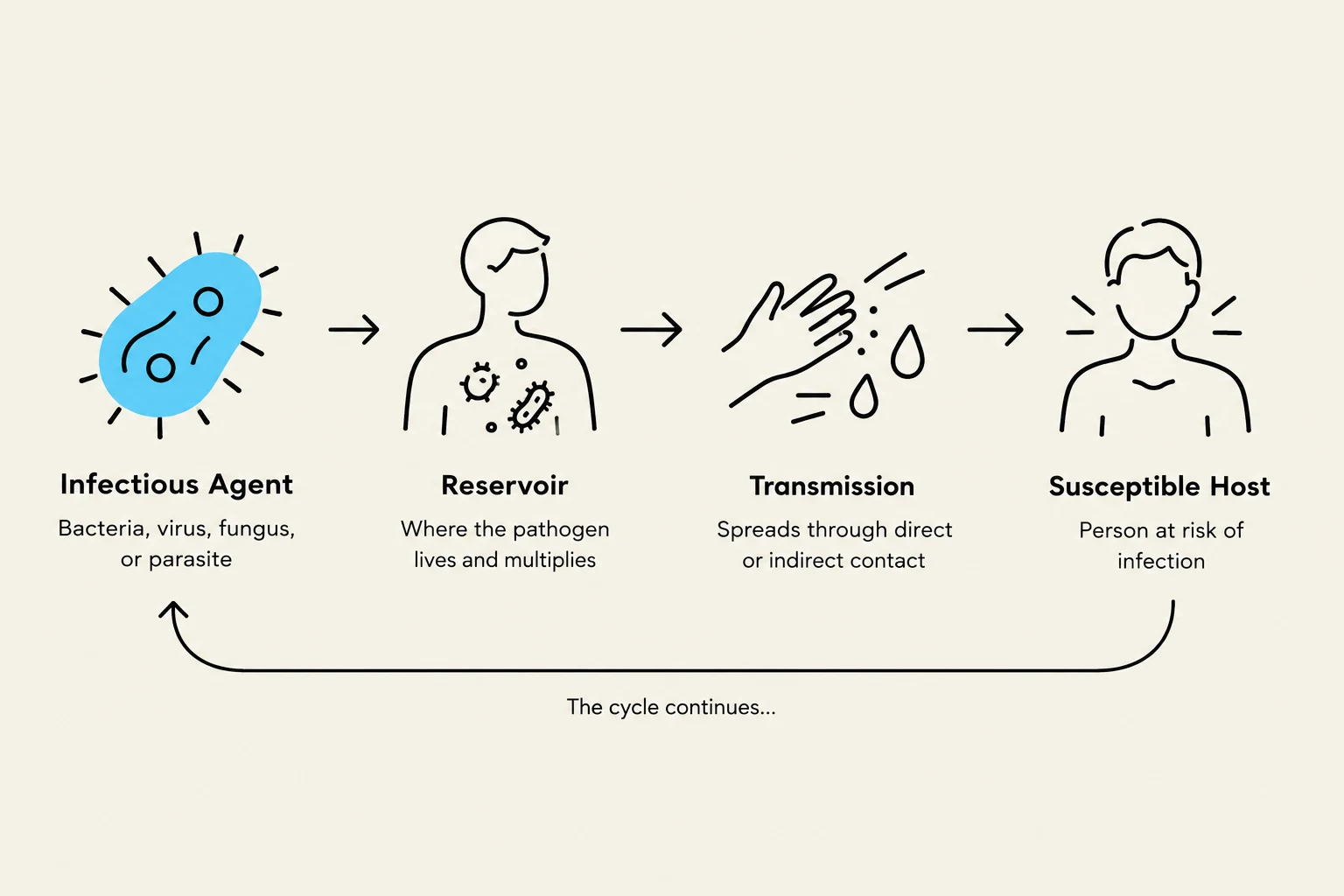
To prevent the spread of infection, healthcare professionals focus on "breaking the chain" of transmission. This involves addressing the infectious agent, the reservoir (where the germ lives), the portal of exit, the means of transmission, the portal of entry, and the susceptible host.
Standard precautions, such as handwashing and the use of personal protective equipment (PPE) like masks, gowns, and gloves, are essential for all patients. Transmission-based precautions are used for specific threats:
Contact: For organisms like MRSA.
Droplet: For illnesses like Influenza.
Airborne: For diseases like Tuberculosis (TB), requiring negative-pressure rooms.
This diagram illustrates the chain of infection, showing an infectious agent, a reservoir where it lives, transmission methods, and a susceptible host, with the cycle continuing.
Keep reading for free.
Create an account to finish this reading and make it part of your study routine.