Understanding Homelessness: Choice, Incapacity, and Social Structures
This analysis explores the complex nature of homelessness, moving beyond simplistic definitions to examine the housing continuum, the concept of 'choice' in relation to housing, and the impact of social structures, addiction, and mental illness. It also discusses the application of Mill's Harm Principle to public space
When we think of homelessness, we often conjure an image of a person sleeping on a park bench or under a flyover. However, the reality of housing instability is far more nuanced than a simple binary of "housed" versus "unhoused." To understand the social crisis of homelessness, we must first dismantle our simplistic definitions and look at the structural spectrum that leads individuals from stable homes to the streets.
Defining Homelessness and the Housing Continuum
Defining homelessness is an inherently political act rather than a neutral scientific one. Because definitions embody social purposes, they are often constructed to influence public concern and drive specific policy interventions. If a definition is too narrow, it only addresses the "homelessness of the moment," resulting in policies that are merely ameliorative (fixing the immediate symptom) rather than preventive (addressing the root cause of poverty). Conversely, if a definition is too broad, it risks becoming useless by including the entire population living in poverty.
To avoid these pitfalls, scholars often use a "continuum approach". Instead of a single category, homelessness is viewed as a spectrum of housing insecurity:
Rooflessness: The most extreme form, characterized by street sleeping or rough sleeping in places not intended for human habitation.
Houselessness: Living in temporary institutions or short-term "guest" accommodations.
Insecure Accommodation: Housing that is unstable or at risk of loss.
Substandard Housing: Living in "inferior" conditions, such as subdivided units, cage homes, or coffin homes.
Study Tip: When analyzing social phenomena, always ask: "Is this definition designed to make a problem visible for intervention, or is it designed to limit the scope of government responsibility?"
The Home-to-Homelessness Continuum illustrates different levels of housing stability within a city, ranging from stable housing to homelessness.
Choice and the Hong Kong Context
In Hong Kong, the concept of "choice" introduces a controversial layer to the debate. According to the Universal Declaration of Human Rights, freedom and liberty—the ability to choose among alternatives—are essential to human well-being. In the context of homelessness, some data suggests that a portion of the population makes decisions that appear to be "personal choices". For instance, some street sleepers report that sleeping on the street is "more convenient" or allows them to "save money".
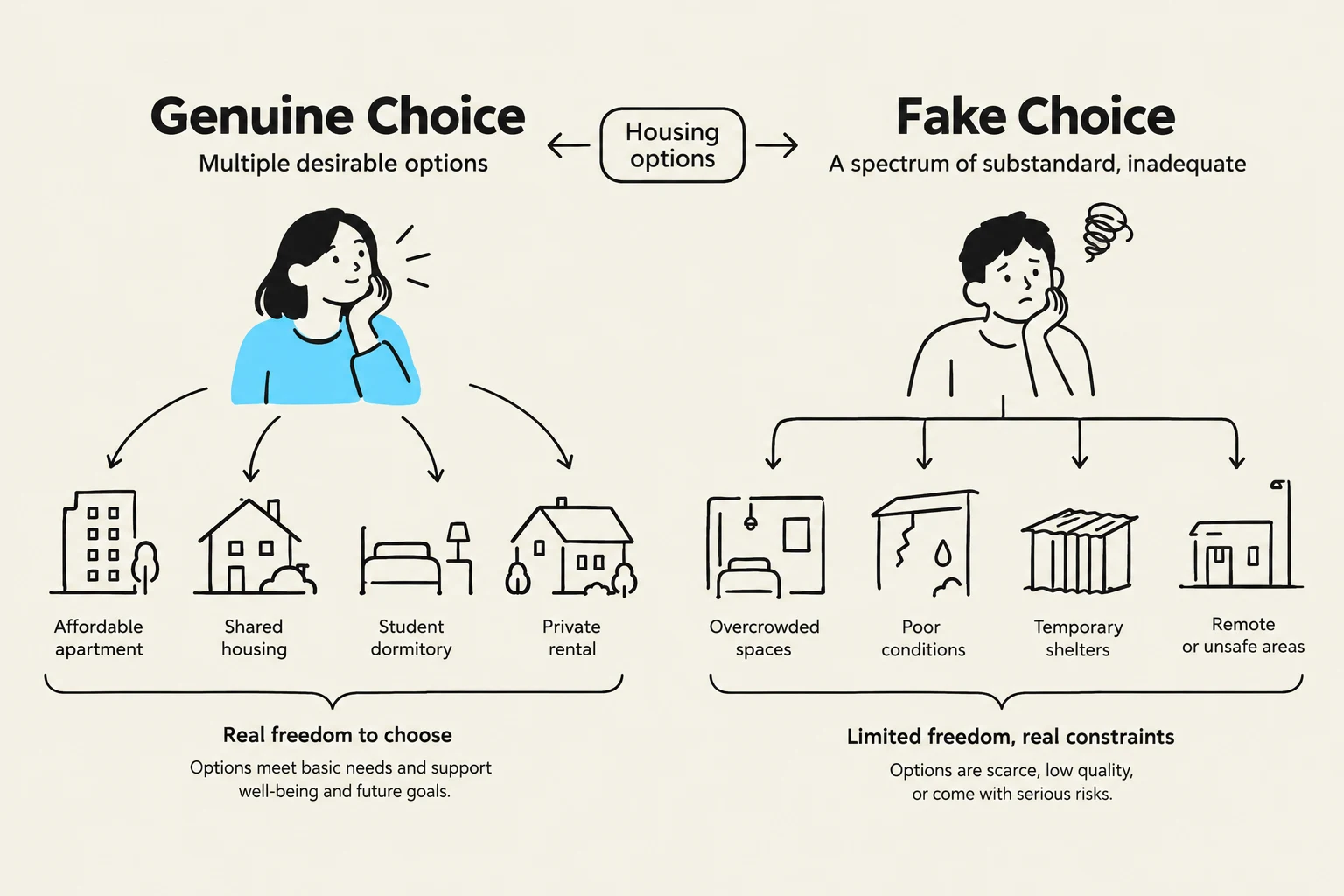
To many, this looks like a "deviant choice"—a decision that defies social norms because the perceived "pros" of street sleeping seem negligible compared to the overwhelming "cons". However, we must distinguish between genuine housing choice and fake housing choice.
Genuine Choice: Selecting between various desirable or acceptable options, weighing trade-offs (e.g., choosing a larger apartment in a more expensive district).
Fake Choice: A situation where no desirable options exist. The individual is merely picking the "lesser evil" among terrible alternatives.
In Hong Kong, the Public Rental Housing (PRH) policy often makes genuine choice impossible for many. The Quota and Points System (QPS) prioritizes families and elderly individuals, often leaving non-elderly singletons with waiting times as long as twenty years. Consequently, the "choice" to live in substandard informal housing (like squatter huts) or inadequate private housing (like cramped, bug-infested bedspaces) is often a "fake choice" driven by a lack of viable alternatives.
This diagram illustrates the difference between genuine and fake choices in housing, highlighting how genuine choices offer multiple desirable options that meet basic needs and support well-being, while fake choices present limited, substandard, or inadequate options.
Analyzing the Nature of the "Choice"
If an individual does appear to be choosing homelessness, we must ask: is it a free choice, a calculated choice, or a choice out of incapacity?
Calculated vs. Free Choice
Some individuals may engage in calculated choice, where homelessness is used as an instrumental means to an end. For example, a person struggling with addiction might "choose" to sleep on the street to avoid paying rent, thereby redirecting those funds toward drugs, alcohol, or gambling. While this might appear "rational" from a purely instrumental perspective (achieving the goal of maintaining an addiction), it is arguably not a free choice. An individual driven by the intense impulses of addiction is not truly free to act otherwise; they are being "forced" by their physiological and psychological dependencies.
Choice Out of Incapacity
The most complex cases involve choice out of incapacity. Research indicates a high prevalence of mental illness among Hong Kong's homeless population, with some studies suggesting that up to 56% of interviewed homeless individuals had a current diagnosis of mental illness.
When mental health is severely impaired, a "vicious cycle" emerges:
Extreme Housing Deprivation→Worsening Mental Health→Diminished Decision-making Capacity→Continued Homelessness
In these instances, a person might report that they "choose" to be on the street, but this decision may not be rational, reasonable, or sensible due to their impaired mental state.
A diagram illustrating the vicious cycle of poor mental health, homelessness, and poor housing decisions.
Homelessness in Public Space and the Harm Principle
The presence of street sleepers often leads to tension regarding the use of public land. This can be analyzed through Mill’s Harm Principle, which suggests that an individual's liberty should only be limited to prevent harm to others.
When homeless individuals occupy public spaces—such as parks, subways, or areas under flyovers—they may be engaging in the "privatization of public space". This can cause harm in several ways:
Unlawful Occupation: The use of government land for private residence.
Hygiene and Safety: Environmental hygiene issues or making the public feel unsafe due to the presence of drug or alcohol use.
Loss of Utility: Preventing the general public from utilizing common areas.
However, a critical distinction must be made between the "unlawful occupation" and the underlying cause. Most street sleepers are involuntary; research shows that 80.5% of respondents would quit street sleeping if given the chance. The "harm" caused by the privatization of space is often a symptom of the fact that these individuals have no private space of their own where they can legitimately exist.
Conclusion: From the Right to Choose to the Right to Exit
Ultimately, the debate over whether homelessness is a "choice" often misses the fundamental issue. For the vast majority of the homeless population, the struggle is not about the "right to choose to be homeless," but rather the "right to choose out of homelessness".
Whether a person is trapped by the "fake choices" of substandard housing, the "calculated" impulses of addiction, or the "incapacity" of mental illness, the solution requires more than just moving people off the streets. It requires a holistic, multi-pronged approach involving social work, psychiatric care, and structural housing reform to address the root causes of their predicament.
Exam Summary:
Homelessness is a continuum (Rooflessness → Substandard Housing).
Fake Choice occurs when all available options are "lesser evils."
Calculated Choice (addiction) is often not a "free" choice due to impulse control.
Incapacity refers to decisions made under the influence of mental illness.
Mill's Harm Principle is used to balance public space rights vs. individual survival.
Keep reading for free.
Create an account to finish this reading and make it part of your study routine.