


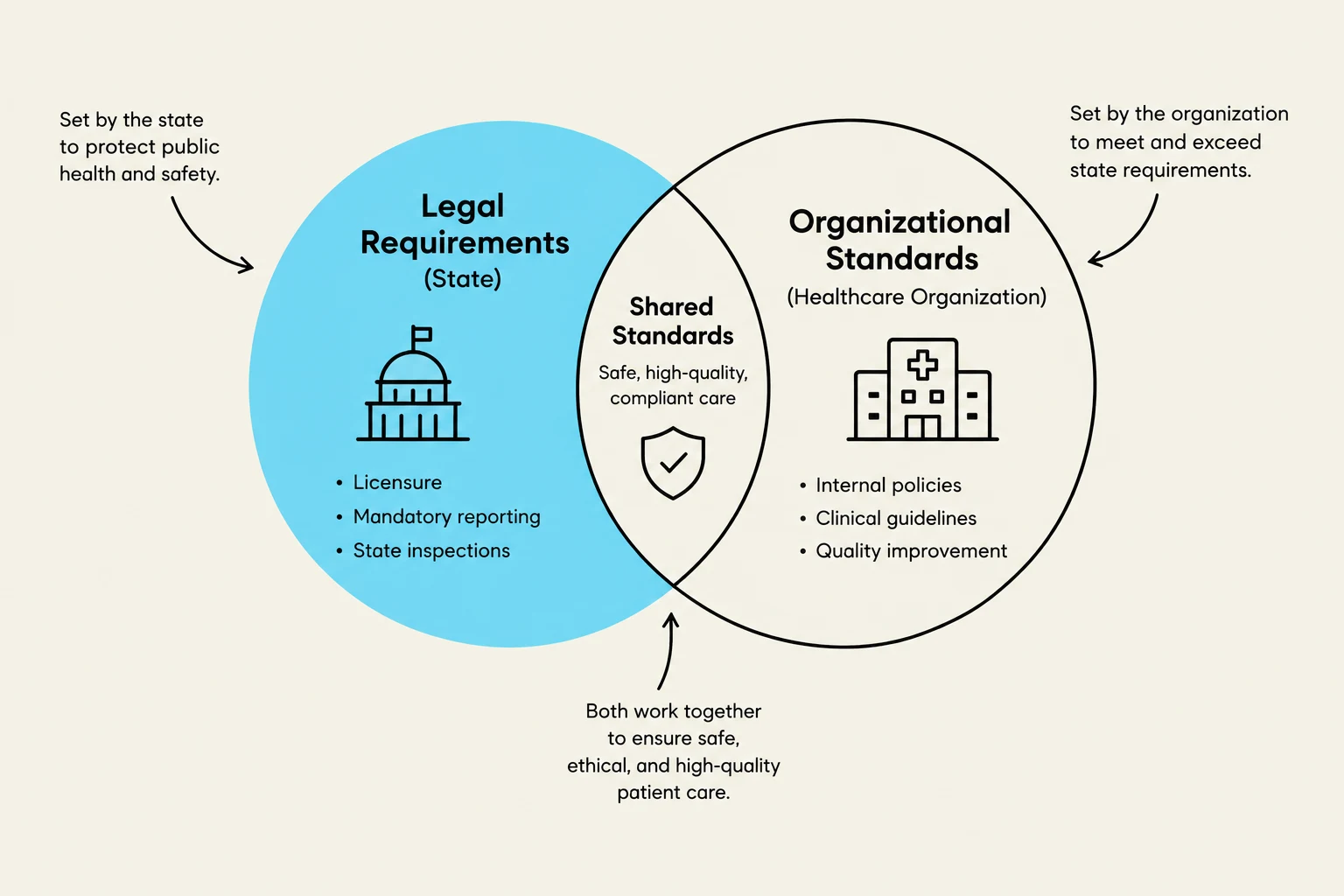
In the healthcare industry, professionals do not operate in a vacuum. Every action taken by a medical assistant, nurse, or physician is governed by a complex web of rules designed to ensure patient safety and professional accountability. A common point of confusion for students and new professionals is the distinction between what the law requires and what an employer demands. To navigate a clinical environment successfully, one must understand the relationship between state-mandated minimums and organizational-specific policies.
The Foundation: State Medical Boards and Scope of Practice
The primary authority in healthcare regulation is the state government, specifically through State Medical Boards. These boards are tasked with protecting the public by establishing the "floor" of professional conduct—the absolute minimum standards that must be met to practice medicine legally within that state.
The most critical concept governed by these boards is the Scope of Practice. This defines the specific procedures, actions, and processes that a healthcare professional is permitted to perform based on their licensure and certification. For example, while a physician has a broad scope of practice, a Medical Assistant (MA) has a much narrower scope, typically limited to administrative tasks and certain clinical duties under the direct supervision of a licensed provider.
Exam Tip: If a question asks about the legality of a procedure, always look to the state's scope of practice laws first. If a task is outside a professional's scope, it is illegal, regardless of whether an employer asks them to do it.
Because these regulations are legal mandates, violating them can lead to severe consequences, including the loss of professional certification, heavy fines, or even criminal charges.
Keep reading for free.
Create an account to finish this reading and make it part of your study routine.
Continue reading freeAlready have an account? Log in
Updated