Understanding Health Information Terminology and Standards
This content explains the critical role of standards in healthcare information technology, covering terminology, format, exchange, and security standards. It details key terminology standards like ICD-10-CM, SNOMED-CT, CPT, and LOINC, and discusses the importance of the UMLS and interoperability initiatives driven by t
In the modern healthcare landscape, data is generated at an unprecedented rate. However, this data is often siloed within different organizations, stored in varying formats, and described using different terms. To transform this raw information into actionable knowledge, we rely on standards. Standards serve three primary purposes: improving the content and structure of electronic records, enabling interoperability between different systems, and facilitating the secondary use of data for research and large-scale analytics.
The Framework of Standards
Standards in health information technology are not monolithic; they are categorized into several distinct types to address different aspects of data management:
Terminology Standards: Focus on the "what"—the specific names and codes used to describe clinical concepts.
Format and Content Standards: Define how data is structured (e.g., messages, documents, and APIs).
Exchange Standards: Govern how data moves between systems (e.g., RESTful services).
Security Standards: Ensure data integrity and privacy through authentication, encryption, and logging.
Terminology, Nomenclature, and Ontology
At the heart of clinical data is the need for a common language. This is achieved through three conceptual layers:
Nomenclature: The simple act of naming things.
Hierarchy: The ability to organize terms into levels, allowing clinicians to aggregate data (e.g., grouping specific types of asthma under a broader category) and generate statistics.
Ontology: A more complex layer that defines the rules and relationships between different concepts.
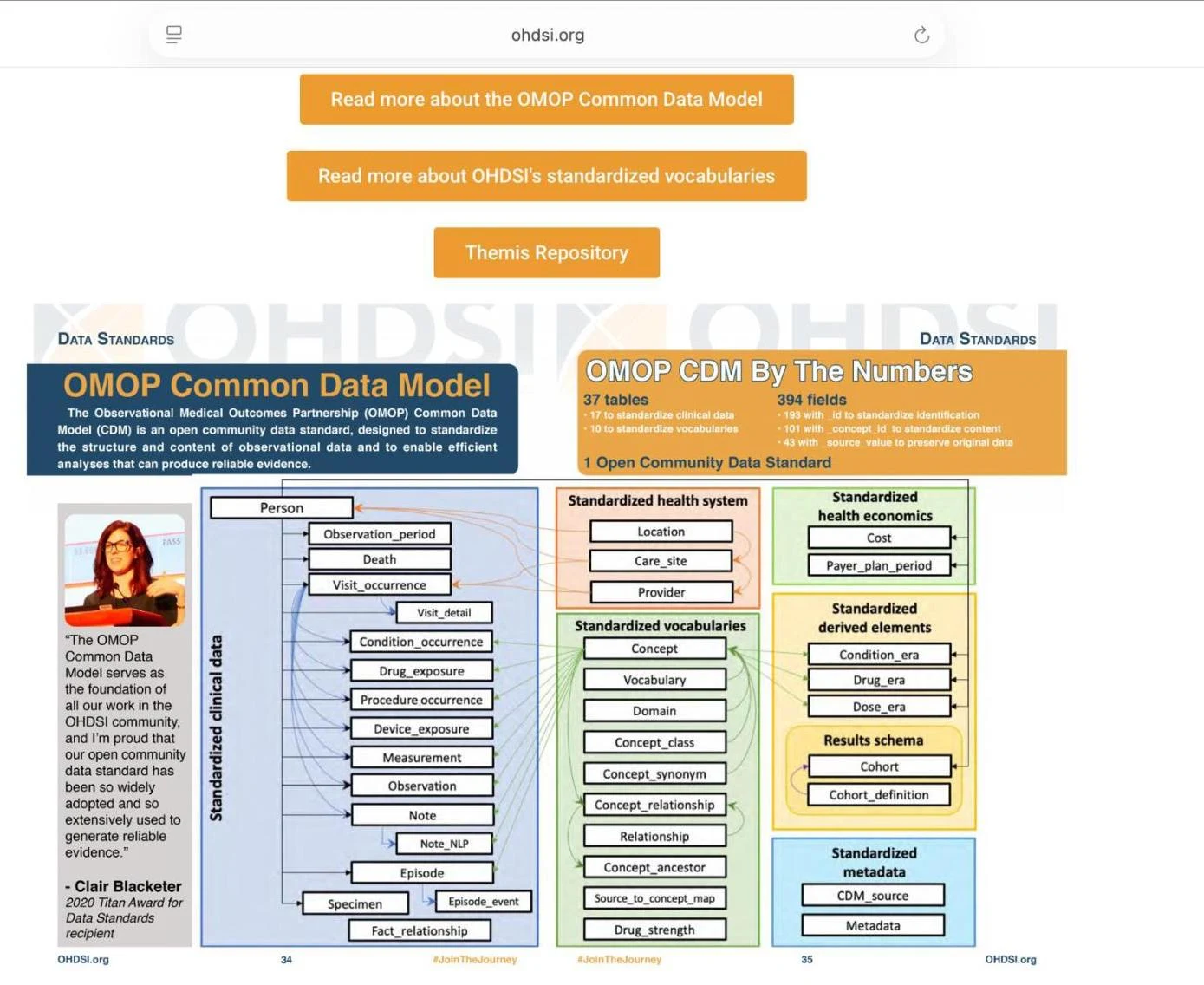
To make these terminologies useful, developers use Data Models to define the structure of the information. For example, the OMOP Common Data Model is used to standardize clinical and health system data for research.
This diagram illustrates the structure of the OMOP Common Data Model, a standard for observational health data, and its components including standardized clinical data, health systems, health economics, vocabularies, derived elements, results schema, and metadata.
Study Tip: Remember that terminology standards are not "one size fits all." Different standards are used for different purposes—some for billing, some for clinical documentation, and others for lab results.
Key Terminology Standards in Healthcare
Because different stakeholders (billing, clinical care, and research) have different needs, multiple standards often exist for the same type of data.
Diagnoses and Clinical Findings
ICD-10-CM: Used primarily for diagnoses and problems, often in the context of billing and classification.
SNOMED-CT: A comprehensive clinical terminology used for detailed documentation of diagnoses, symptoms, and clinical findings.
Procedures and Observations
CPT (Current Procedural Terminology): The standard for coding medical, surgical, and diagnostic procedures.
LOINC (Logical Observation Identifiers Names and Codes): The international standard for identifying health observations, measurements, and laboratory tests.
Medications and Vaccines
RxNorm: Provides normalized names for clinical drugs.
NDC (National Drug Code): A unique identifier for drug products in the United States, maintained by the FDA.
CVX: Used specifically for vaccine information.
Other Essential Standards
MeSH (Medical Subject Headings): Used for indexing and searching biomedical information.
UCUM (Unified Code for Units of Measure): Ensures that units (like mg/dL or mmol/L) are standardized across all systems.
The Unified Medical Language System (UMLS)
One of the greatest challenges in healthcare is that a single concept (such as "asthma") might be represented by different codes in different systems. The Unified Medical Language System (UMLS), managed by the National Library of Medicine, solves this by integrating and distributing various terminology, classification, and coding standards.
The UMLS acts as a "bridge." For example, a researcher can use the UMLS Metathesaurus Browser to see how a single concept like "Asthma" maps across different vocabularies, such as ICD-10-CM, SNOMED-CT, and CPT.
Interoperability and the Role of the ONC
Interoperability is the ability of different information systems, devices, and applications to access, exchange, integrate, and cooperatively use data. Without interoperability, a patient's record is trapped within a single hospital's database.
To drive this capability, the Office of the National Coordinator for Health Information Technology (ONC) plays a vital role. The ONC works to:
Recommend best available standards, such as the USCDI (United States Core Data for Interoperability).
Certify Electronic Health Records (EHRs) to force vendors to adopt these standards.
Provide incentives for organizations to use standardized data exchange methods.
Modern Exchange and Security
Today, interoperability is increasingly achieved through modern web technologies. The FHIR (Fast Healthcare Interoperability Resources) API uses RESTful architecture and OAuth2 to deliver data values to authorized and authenticated users. To keep this data safe, security standards like HTTPS are used for secure transmission, and encryption ensures that even if data is intercepted, it cannot be read without the proper key.
Summary of Standards Development Organizations
Standards are not created in a vacuum; they are maintained by specialized organizations:
Organization
Primary Standard/Focus
HL7 (Health Level Seven)
FHIR, C-CDA, HL7-V2 (Exchange/Format)
SNOMED International
SNOMED-CT (Clinical Terminology)
WHO (World Health Organization)
ICD (Global Disease Classification)
NLM (National Library of Medicine)
RxNorm, UMLS, MeSH
FDA (Food & Drug Administration)
NDC (Drug Identification)
CDC (Centers for Disease Control)
CVX (Vaccines)
NCPDP
SCRIPT (Prescription Drug Programs)
LOINC
Lab and Clinical Observations
Keep reading for free.
Create an account to finish this reading and make it part of your study routine.