Understanding GLP-1 Receptor Agonists and Incretin Mimetics for Type 2 Diabetes
An overview of GLP-1 receptor agonists and dual-acting incretin mimetics, detailing their mechanism of action, benefits in managing Type 2 Diabetes and weight, specific drug examples, and clinical considerations including side effects and access.
In the management of Type 2 Diabetes Mellitus (T2DM), the focus has shifted from simply lowering blood glucose to addressing the underlying pathophysiology of the disease. One of the most significant breakthroughs in recent years involves targeting the "incretin effect." Incretins are natural hormones—specifically Glucagon-Like Peptide-1 (GLP-1) and Glucose-Dependent Insulinotropic Polypeptide (GIP)—that are released by the gastrointestinal tract upon eating. These hormones strengthen the insulin response, decrease glucagon secretion, slow gastric emptying, and reduce appetite.
This diagram illustrates the physiological pathways triggered by natural incretin hormones, showing how food entering the gastrointestinal tract leads to the release of GLP-1 and GIP, which then affect the pancreas, liver, stomach, and brain.
However, natural incretins are broken down by the body within minutes. To combat this, a new class of medications known as Incretin Mimetics has been developed to mimic these hormones more effectively and for longer durations.
Mechanism of Action (MOA)
Diagram illustrating how GLP-1 receptor agonists (incretin mimetics) provide sustained receptor stimulation compared to natural GLP-1, leading to sustained insulin secretion.
The primary goal of these medications is to address the disruption of insulin homeostasis seen in T2DM. While traditional medications like DPP-4 inhibitors work by preventing the breakdown of existing natural incretins, GLP-1 Receptor Agonists (GLP-1 RAs) and dual-acting mimetics act as exogenous replacements that directly stimulate the receptors.
When these agents bind to their respective receptors, they trigger several physiological responses:
Increased Insulin Secretion: Stimulates pancreatic beta-cells in a glucose-dependent manner.
Decreased Glucagon Secretion: Reduces the amount of glucose produced by the liver.
Delayed Gastric Emptying: Slows the rate at which food leaves the stomach, which in turn slows the absorption of sugars by the small intestine.
Appetite Suppression: Acts on the brain to decrease hunger and promote weight loss.
GLP-1 RAs are a prominent class of medications that offer benefits beyond glycemic control, including cardiovascular protection and significant weight management.
Liraglutide (Victoza®, Saxenda®)
Liraglutide is administered via subcutaneous injection once daily. It is unique in its dual-indication availability:
Victoza®: Indicated for the management of T2DM.
Saxenda®: Indicated specifically for weight loss.
While it promotes weight loss (approximately 5% of body weight), it is generally not covered by ODB.
Dulaglutide (Trulicity®)
Trulicity is a once-weekly subcutaneous injection. It is highly effective for weight management, promoting a loss of 5–10% of body weight depending on the dose. Like most GLP-1 RAs, it is not covered by ODB.
Semaglutide (Ozempic®, Wegovy®, Rybelsus®)
Semaglutide represents a versatile segment of this class due to its different delivery methods and indications:
Ozempic®: A once-weekly subcutaneous injection indicated for T2DM. It is ODB covered with specific LU codes.
Wegovy®: A once-weekly subcutaneous injection approved specifically for weight loss.
Rybelsus®: A once-daily oral tablet formulation. It is also ODB covered for diabetes.
Clinical Note: Research suggests that GLP-1 RAs like Ozempic may provide cardiovascular protection, even in patients where changes in A1C are not the primary driver of the benefit.
Dual-Acting Incretin Mimetics: Tirzepatide
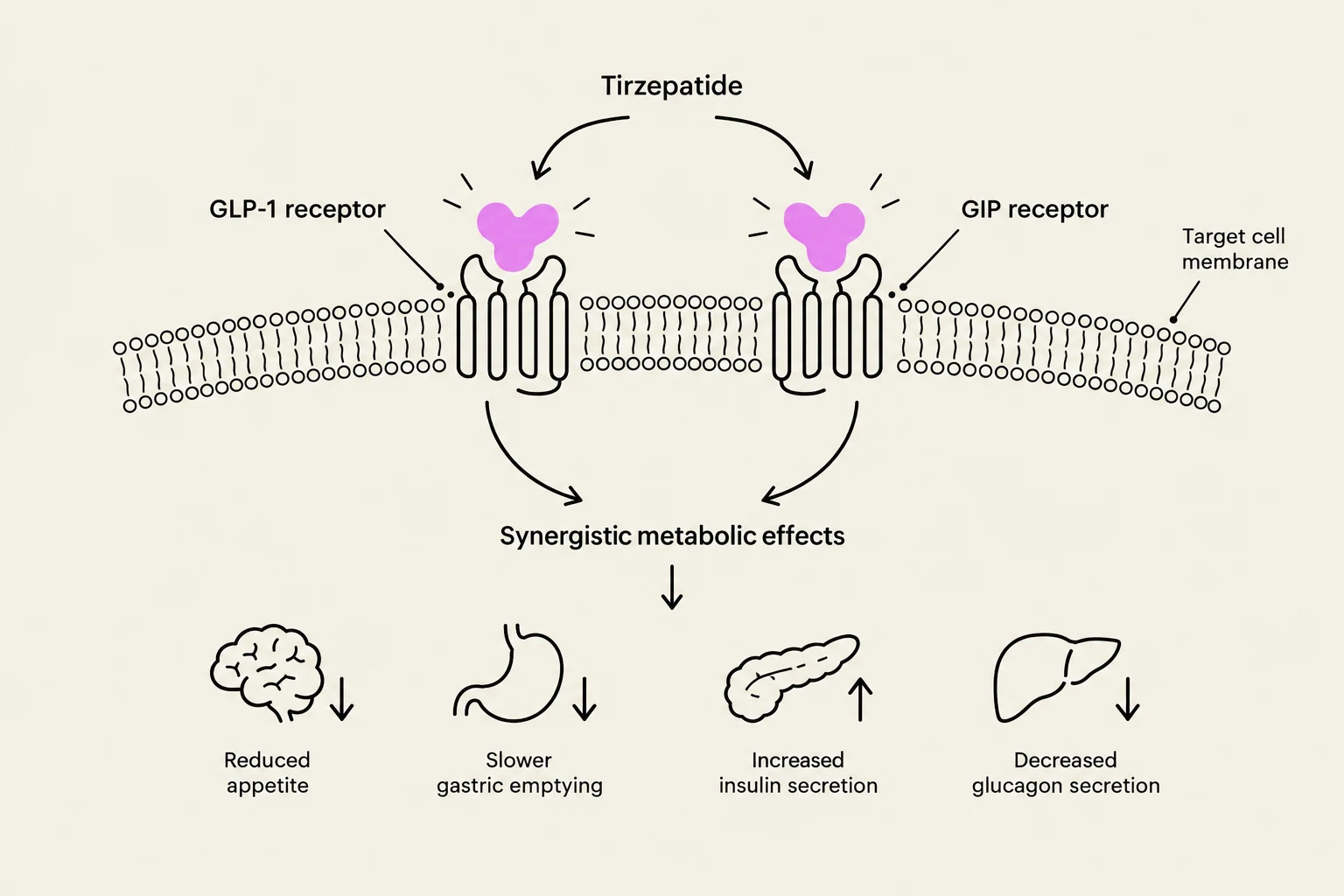
Diagram illustrating the synergistic metabolic effects of Tirzepatide, which acts on GLP-1 and GIP receptors to reduce appetite, slow gastric emptying, increase insulin secretion, and decrease glucagon secretion.
The next evolution in incretin therapy is the dual-acting agonist. Unlike standard GLP-1 RAs, these medications target two pathways: GLP-1 and Glucose-Dependent Insulinotropic Polypeptide (GIP).
Tirzepatide (Mounjaro®, Zepbound®) is the primary agent in this category. Administered via once-weekly subcutaneous injection, it has shown remarkable efficacy in weight management, with patients losing up to 21% of their body weight after 18 months of use.
Mounjaro® is Health Canada approved for Diabetes.
Zepbound® is Health Canada approved for Weight Loss.
Note that Tirzepatide is not covered by ODB, and many private insurers require specific approval for coverage.
Combination Products
To simplify treatment regimens, some medications combine a GLP-1 RA with other glucose-lowering agents:
Xultophy: Combines the long-acting insulin Insulin Degludec with Liraglutide in a single prefilled pen.
Soliqua: Combines Insulin Glargine with Lixisenatide.
Clinical Considerations: Safety and Side Effects
While these medications are highly effective, they are not without side effects.
Common Side Effects
The most frequent adverse effects are gastrointestinal in nature, occurring as the body adjusts to delayed gastric emptying:
Nausea and vomiting
Diarrhea and constipation
Dyspepsia (indigestion)
Injection site reactions
For dual-acting agents like Tirzepatide, a less common side effect to monitor is an increased heart rate.
Safety Profile
Hypoglycemia Risk: One of the major advantages of GLP-1 RAs and Tirzepatide is their low risk of hypoglycemia. This is because their insulin-stimulating effect is glucose-dependent.
Contraindications: These medications are strictly contraindicated in patients with a personal or family history of Medullary Thyroid cancer.
Economic Impact and Access
The cost of incretin-based therapies can be a significant barrier to adherence.
Medication
Estimated Monthly Cost
ODB Coverage Status
Ozempic®
~$300
Covered (with LU codes)
Mounjaro®
~$600 (high doses)
Not Covered
Because of these high costs, many manufacturers offer Patient Assistance Programs. These programs can help offset the total cost by approximately 5–10%.
Exam Tip: When comparing drug classes, remember that while GLP-1 RAs and SGLT2 inhibitors are generally weight-loss promoting, Sulfonylureas and Insulins are typically associated with weight gain.
Keep reading for free.
Create an account to finish this reading and make it part of your study routine.