Understanding Genetic Predisposition: Pedigrees and Twin Studies
Explore how family pedigrees and twin studies are used to estimate heritability, understand genetic predisposition for traits and diseases, and differentiate between genetic and environmental influences.
When we observe certain traits—ranging from eye color to complex psychological conditions—appearing repeatedly across generations, we are witnessing the influence of genetic predisposition. Genetic predisposition refers to an increased likelihood of developing a particular disease or trait based on an individual's genetic makeup. However, determining exactly how much of a trait is "written in the DNA" versus how much is shaped by the environment is one of the most complex challenges in modern biology and psychology.
To untangle this web, researchers rely on two primary methodologies: the analysis of family pedigrees and the comparative study of twins. These tools allow scientists to estimate heritability, which is the proportion of variation in a trait within a population that can be attributed to genetic differences.
Family Pedigrees: Mapping the Lineage
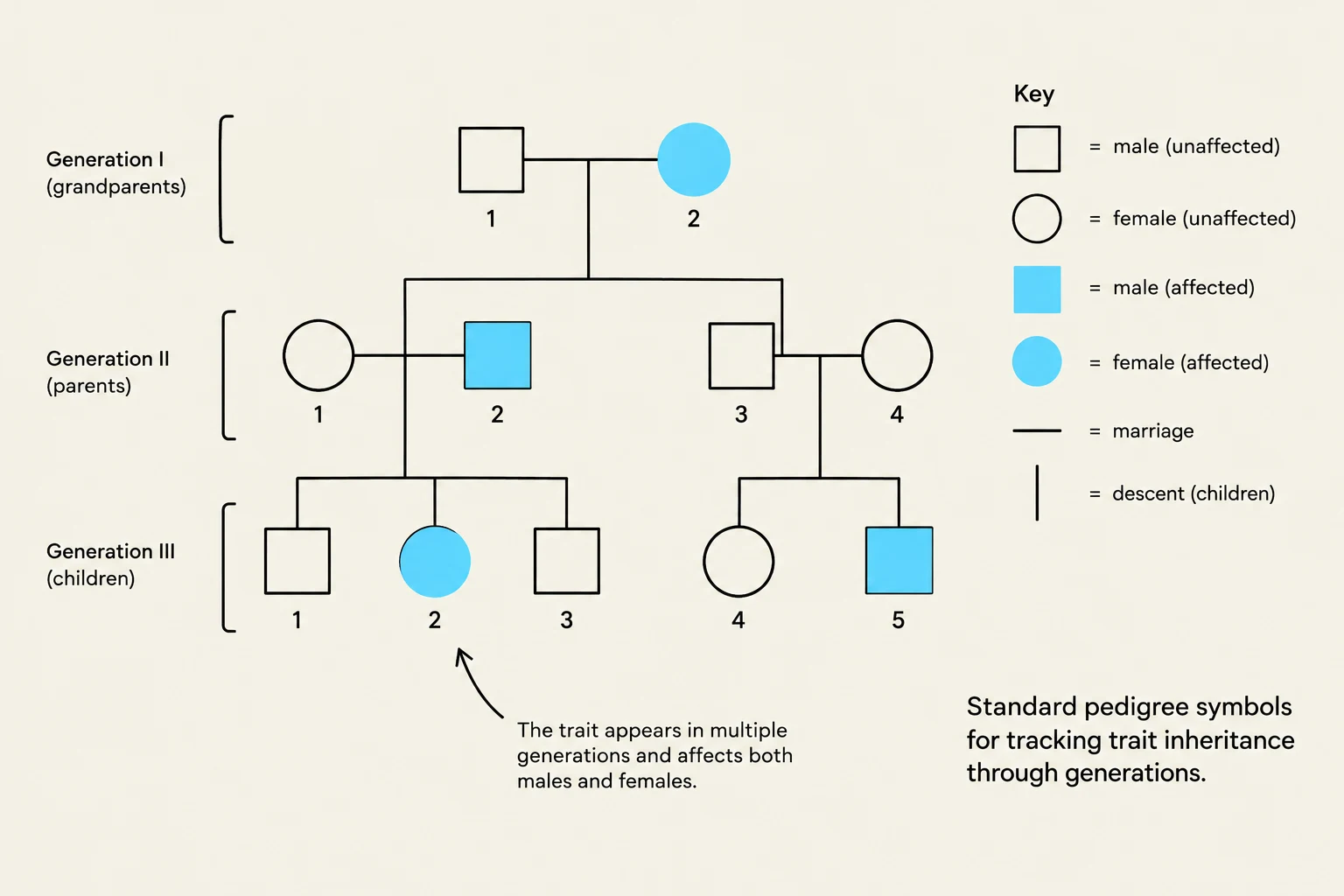
This pedigree chart illustrates standard symbols used to track trait inheritance across generations, showing affected and unaffected males and females.
A pedigree is a visual representation of a family tree that tracks the inheritance of specific traits or diseases through multiple generations. By using standardized symbols (such as squares for males and circles for females), geneticists can map out how a phenotype moves through a lineage.
Analyzing Patterns of Inheritance
Pedigree analysis helps distinguish between different modes of inheritance. For example, if a trait appears in every generation and affects both sexes equally, it may follow an autosomal dominant pattern. Conversely, if a trait skips generations or appears more frequently in males, it might suggest a recessive or X-linked pattern.
In the context of complex disorders, such as unipolar depression, pedigree analysis is vital for identifying clusters of vulnerability within families. While a single gene rarely causes a complex mental health condition, seeing a high frequency of a diagnosis within a family tree suggests a strong genetic component that predisposes members to the disorder.
Study Tip: When analyzing a pedigree on an exam, always look for "skipping." If two unaffected parents have an affected child, the trait is almost certainly recessive.
Twin Studies: The Gold Standard for Heritability
Comparison of concordance rates between monozygotic and dizygotic twins, illustrating genetic similarity and its impact on trait concordance.
While pedigrees show how a trait moves, twin studies are designed to show how much of a trait is due to genetics. This is achieved by comparing the "concordance rates" between two types of twins:
Monozygotic (MZ) Twins: Identical twins who share 100% of their genetic material.
Dizygotic (DZ) Twins: Fraternal twins who share, on average, 50% of their segregating genes, similar to regular siblings.
The Logic of Concordance
Concordance refers to the probability that if one twin has a certain trait, the other twin will also have it. The logic follows a simple comparative principle: if a trait is highly heritable, identical twins should show much higher concordance rates than fraternal twins.
Consider the following conceptual example:
If a trait is purely environmental, the concordance rate for both MZ and DZ twins should be roughly equal.
If a trait is purely genetic, the concordance rate for MZ twins should be near 100%, while DZ twins would be significantly lower.
Calculating Heritability
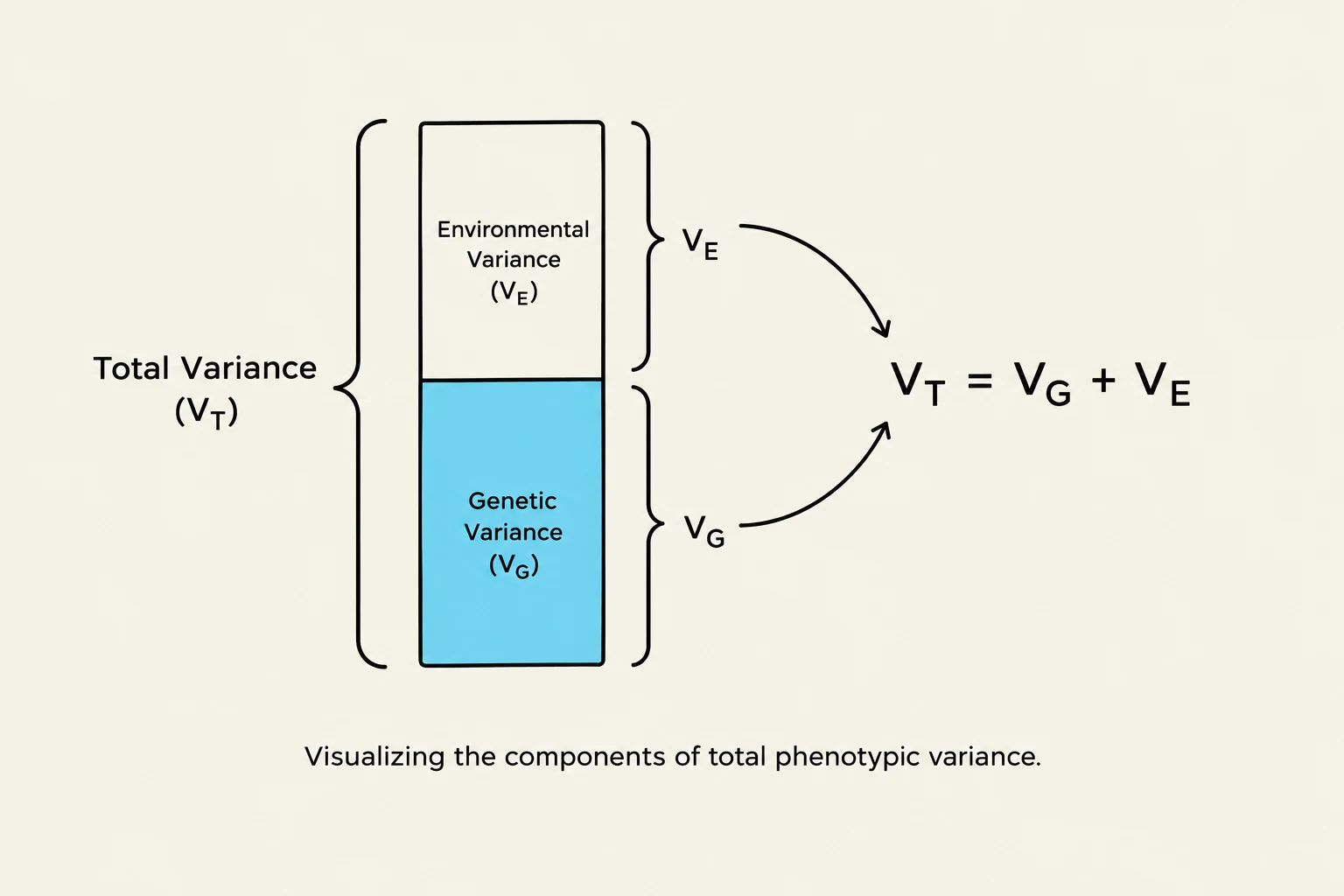
Visualizing the components of total phenotypic variance.
Researchers use these rates to estimate heritability (H2). A simplified way to conceptualize the relationship between the variance of a trait caused by genetics (VG) and the total variance (VT) is:
H2=VTVG
Where VT is the sum of genetic variance (VG) and environmental variance (VE):
VT=VG+VE
If twin studies show that MZ twins are significantly more similar than DZ twins for a specific condition, such as unipolar depression, it provides strong evidence that VG is a significant contributor to the total variance of that condition.
Challenges and Limitations
Neither method is without its flaws. It is important to maintain a balanced view when interpreting these results.
The "Equal Environments" Assumption
A major critique of twin studies is the assumption that MZ and DZ twins experience similar levels of environmental similarity. Critics argue that because identical twins look more alike, parents and society may treat them more similarly than fraternal twins, potentially inflating the perceived genetic influence.
Complexity of Polygenic Traits
Most human traits are not "Mendelian" (controlled by a single gene). Instead, they are polygenic, meaning they result from the interaction of hundreds or thousands of small genetic variations. This complexity means that even with a high heritability estimate, we cannot always predict with certainty whether an individual will manifest a trait; they may possess the predisposition without ever triggering the condition.
Exam Note: Remember that "heritability" describes a population, not an individual. Saying a trait has 70% heritability does not mean that 70% of your specific trait comes from your genes; it means that 70% of the differences between people in a group are due to their genes.
Summary Table: Comparing Methodologies
Feature
Family Pedigree
Twin Studies
Primary Goal
Track inheritance patterns
Estimate heritability (H2)
Key Data
Lineage/Generations
Concordance rates
Best Used For
Single-gene (Mendelian) disorders
Complex/Polygenic traits
Main Limitation
Small sample sizes/Incomplete data
Environmental confounding
By combining the structural insights of pedigrees with the statistical power of twin studies, researchers continue to peel back the layers of human biology, moving closer to understanding the delicate dance between our DNA and our environment.
Keep reading for free.
Create an account to finish this reading and make it part of your study routine.