This content explains how enhancers and transcription factors regulate gene expression, and how reporter genes like GFP and LacZ are used experimentally to visualize and study this process, including applications in understanding genetic disorders.
In every cell of the human body, the same approximately 20,000 genes are present. However, a neuron looks and functions very differently from a muscle cell because they express different sets of genes. This phenomenon, known as differential gene expression, is governed by complex transcriptional regulation. To understand how specific genes are turned "on" or "off" in specific tissues, scientists study regulatory DNA sequences—specifically enhancers—using molecular tools called reporter genes.
The Architecture of Transcriptional Regulation
This diagram illustrates how enhancers and transcription factors regulate gene expression through DNA looping, involving Tissue-Specific Transcription Factor (TSTF) and RNA Polymerase II.
To understand how reporter genes work, we must first understand the "machinery" of a gene. A gene is not just a coding sequence; it is a collection of regulatory elements that dictate when and where a protein is made.
Promoters and Transcription Factors
Every gene possesses a promoter region located directly upstream of the coding sequence. The promoter serves as the docking station for the transcription initiation complex, which includes RNA Polymerase II and General Transcription Factors (often called TFIIs). Without these components, transcription cannot occur.
Enhancers: The Precision Controllers
While promoters are essential for starting transcription, enhancer sequences are responsible for the "fine-tuning" of gene expression. Enhancers are regulatory DNA sequences that can be located far away from the gene they regulate—sometimes up to 1,000,000 base pairs away, or even tucked within the gene's own introns.
Enhancers function by binding to Tissue-Specific Transcription Factors (TSTFs). Because different TSTFs are only present in specific cell types (for example, a neuron-specific factor like CUX2), enhancers allow genes to be expressed only in the appropriate biological context. When a TSTF binds to an enhancer, it helps stabilize the transcription initiation complex at the promoter, effectively "recruiting" RNA Polymerase II to begin making RNA.
Key Concept: Stability and Efficiency
The strength of the interaction between an enhancer and a TSTF determines the stability of the transcription initiation complex. A more stable complex leads to more RNA Polymerase II recruitment, resulting in higher transcription efficiency and more mRNA produced.
Using Reporter Genes to Visualize Activity
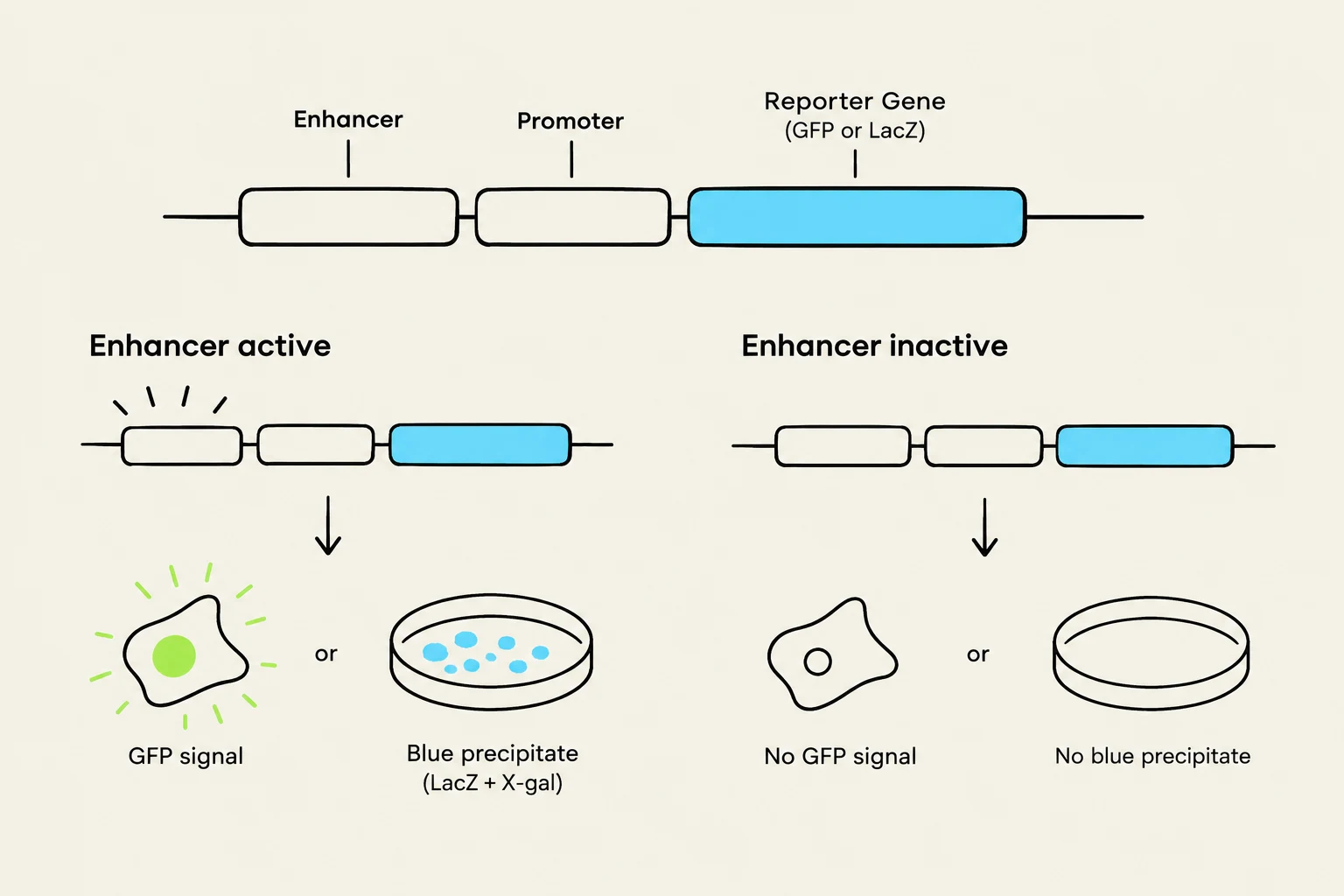
Diagram illustrating the function of an enhancer and promoter in gene expression, showing the outcomes of an active enhancer (GFP signal or blue precipitate) versus an inactive enhancer (no GFP signal or no blue precipitate).
Because enhancers are just sequences of DNA, they are invisible to the naked eye. Researchers use reporter genes to "report" on whether an enhancer is active. In this experimental setup, the enhancer of interest is linked to a promoter and a reporter gene, creating a "reporter construct".
Common Reporter Systems
There are two primary types of reporter genes used in molecular biology:
GFP (Green Fluorescent Protein): The GFP gene encodes a protein that fluoresces green under specific light. This is ideal for real-time visualization of gene activity in living organisms.
LacZ: The LacZ gene encodes the enzyme β-galactosidase. When a researcher introduces a substrate called X-gal to the sample, the enzyme reacts with it to produce a visible blue-colored precipitate.
Experimental Implementation
To study these elements in a whole organism, the reporter construct is often transgenically introduced into a zygote (a fertilized egg). This ensures that as the organism develops, every single cell contains the reporter DNA. For example, a researcher might use a LacZ construct in a mouse embryo to map out exactly which cells express a specific muscle-related enhancer.
This diagram illustrates how reporter assays can be used to differentiate between defects in enhancers and transcription factors within cells. It shows a wild-type cell and a patient cell with a mutated enhancer, and how introducing a reporter construct with GFP can lead to different outcomes depending on the cellular defect, resulting in either no GFP expression or GFP expression indicating fluorescence.
Reporter genes are not just for basic research; they are vital tools for troubleshooting human genetic diseases.
Consider a scenario involving the gene Neuroligin, which is essential for proper brain function. If a patient presents with a neurological disorder because Neuroligin is not being expressed in their neurons, researchers must determine why the gene is silent.
The problem could be one of two things:
The transcription factors in the patient's cells are defective.
The enhancer sequence itself has a mutation that prevents transcription factors from binding.
To test this, scientists can build a reporter construct using the patient's suspected diseased enhancer driving a GFP gene. They then introduce this construct into a "wild-type" (normal) cell that possesses healthy, functional transcription factors.
Result
Interpretation
GFP is NOT expressed
The problem lies within the enhancer (the mutation prevents TF binding).
GFP IS expressed
The enhancer is functional; the defect likely lies in the transcription factors or other cellular machinery.
Exam Tip: When analyzing a reporter assay, always identify what is being "tested" (the enhancer) and what is being "provided" (the transcription factors). If you provide healthy TFs and the reporter still doesn't work, the DNA sequence itself is the culprit!
Summary Table: Components of a Reporter Construct
Component
Function
Enhancer
The "switch" being studied; determines timing and location.
Promoter
The "engine" that recruits RNA Polymerase II.
Reporter Gene
The "signal" (e.g., GFP or LacZ) that makes the activity visible.
Keep reading for free.
Create an account to finish this reading and make it part of your study routine.