Understanding Gas Properties: Density, Motion, and Pressure
Explore the fundamental characteristics of gases, including their constant molecular motion, how this motion influences density, and the mechanics of pressure. Learn about atmospheric pressure, its relation to altitude, and the proportionality rules governing gas laws, such as the Combined Gas Law. This guide also cove
Gases are unique states of matter characterized by their lack of a fixed shape or volume. Unlike solids, which maintain a rigid structure, gases are highly dynamic systems. To understand how gases behave in everything from a small balloon to the vast Earth's atmosphere, we must look at the microscopic level—specifically at how individual molecules move and interact with their surroundings.
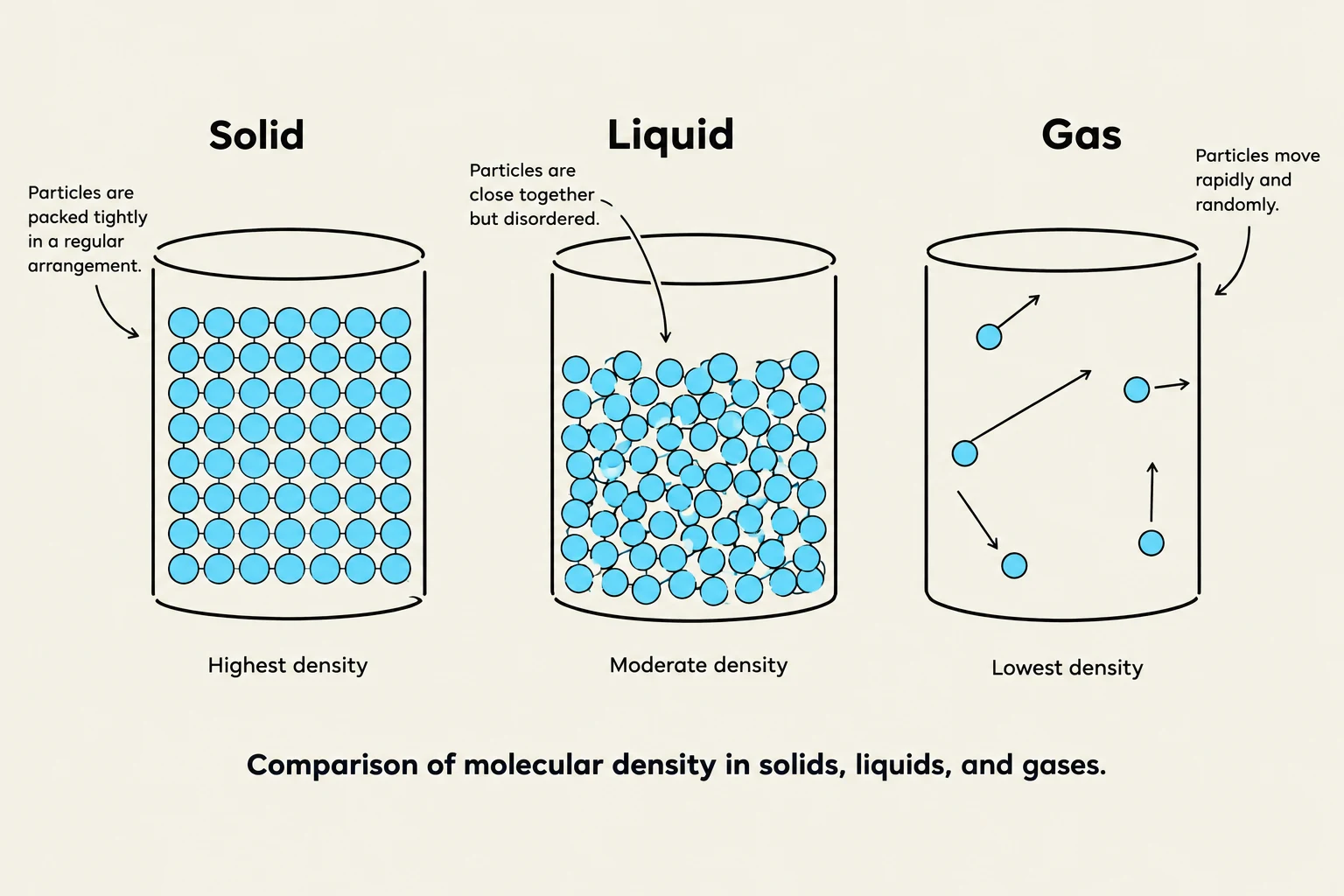
Comparison of molecular density in solids, liquids, and gases.
Molecular Motion and Gas Density
The defining characteristic of a gas is constant motion. Gas molecules are never still; they move rapidly and randomly throughout whatever container they occupy. This continuous movement is why gases expand to fill their entire available space; if you open a container, the molecules will spread out until they are mixed throughout the new environment.
This motion directly influences gas density. Density is defined as the mass of a substance per unit of volume. In solids, molecules are packed tightly, resulting in high density. In gases, however, the molecules are spread far apart due to their constant motion, which typically results in much lower density compared to solids or liquids.
The Mechanics of Pressure
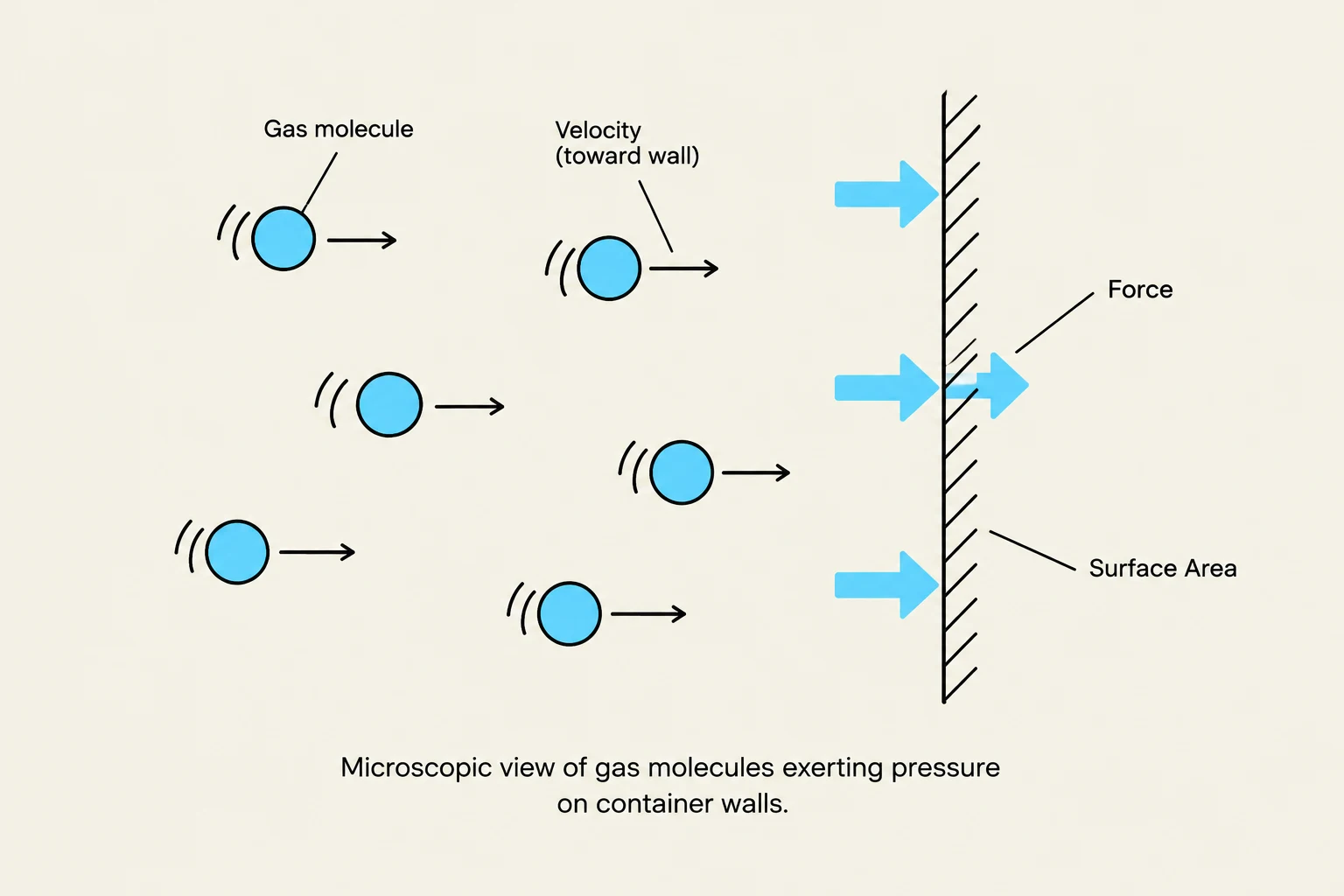
Microscopic view of gas molecules exerting pressure on container walls.
While we often think of pressure as a single value on a gauge, it is actually the macroscopic result of trillions of microscopic collisions. As gas molecules move through a container, they frequently strike the walls. Each time a molecule hits a surface, it exerts a tiny amount of force.
Pressure is the cumulative effect of these countless collisions exerted over a specific surface area. Mathematically, this relationship is expressed as:
Pressure=AreaForce
Atmospheric Pressure and Altitude
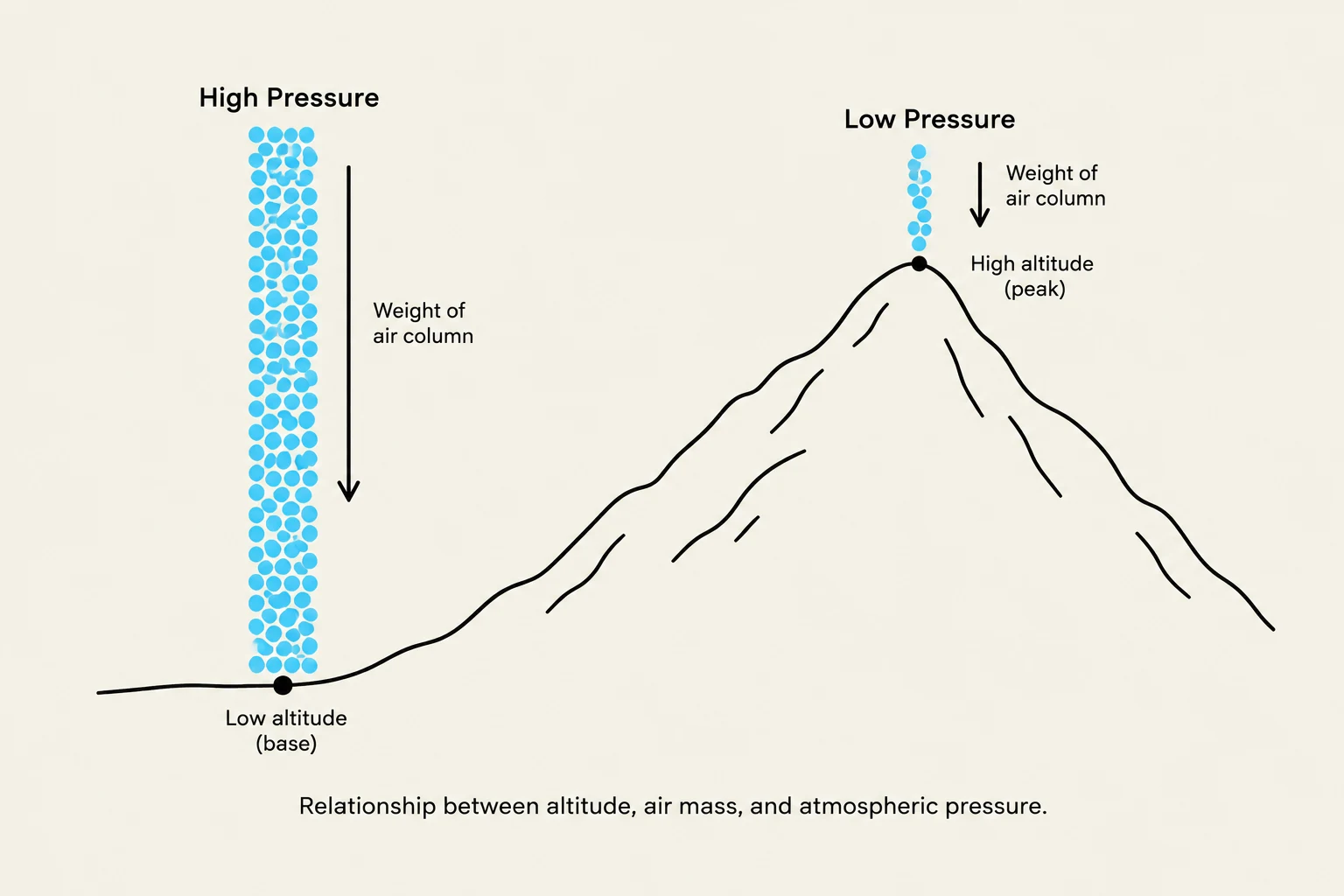
This diagram illustrates the relationship between altitude, air mass, and atmospheric pressure, showing that pressure decreases with increasing altitude due to a shorter air column.
We live at the bottom of a "sea" of air known as the atmosphere. The weight of all the air molecules above us exerts a force downward, known as atmospheric pressure.
A critical concept in atmospheric science is the relationship between altitude and pressure: as altitude increases, atmospheric pressure decreases. As you climb a mountain or fly in an airplane, there is less air mass above you, resulting in lower external pressure.
Real-World Application: Ear Discomfort
Have you ever felt your ears "pop" or felt discomfort during a flight? This is caused by the pressure differential between the air inside your body (middle ear) and the decreasing atmospheric pressure outside. As the external pressure drops, the pressure inside your ear becomes higher than the outside, causing the eardrum to stretch until the pressure equalizes.
Proportionality Relations in Gas Laws
To predict how a gas will behave when its environment changes, scientists use mathematical relationships involving three main variables: Pressure (P), Volume (V), and Temperature (T).
CRITICAL RULE: The Kelvin Scale
When performing any gas law calculations, temperature must always be expressed in Kelvin (K). Using Celsius will result in incorrect calculations because the mathematical relationships rely on absolute zero.
The behavior of these variables can be categorized into two types of proportionality:
1. Direct Proportionality
In a direct relationship, the variables move in the same direction. If one increases, the other increases; if one decreases, the other decreases. For example, in certain conditions, increasing the temperature of a gas will cause its pressure to increase.
2. Inverse Proportionality
In an inverse relationship, the variables move in opposite directions. If one increases, the other must decrease. A classic example is the relationship between pressure and volume: if you compress a gas into a smaller volume, the pressure increases.
3. The Combined Gas Law
When multiple variables are changing simultaneously, we use the Combined Gas Law. This allows us to relate the initial state of a gas to its final state:
T1P1V1=T2P2V2
Study Tip: Analyzing Problems
To solve gas law problems successfully, do not just plug numbers into formulas. First, identify which variables are changing and which are staying constant. This will tell you whether you should use a simple proportionality rule or the full Combined Gas Law.
Summary Table of Gas Variables
Variable
Symbol
Unit (Standard)
Effect of Increase
Pressure
P
Atmosphere (atm)
Increases collision frequency
Volume
V
Liters (L)
Increases space between molecules
Temperature
T
Kelvin (K)
Increases molecular speed/motion
Note on Units: When using the Ideal Gas Law ($PV = nRT$), ensure your pressure is in atmospheres (atm) and your volume is in liters (L) to maintain consistency with the gas constant (R).
Keep reading for free.
Create an account to finish this reading and make it part of your study routine.