This content explains the fundamental gas laws (Boyle's, Charles's, and Avogadro's) and combines them into the Ideal Gas Law. It covers pressure units, absolute temperature, and applications like calculating gas density and molar mass, with worked examples.
In the study of matter, gases represent a unique state characterized by particles that are largely free to move. Unlike solids or liquids, where intermolecular forces restrict movement, gas particles expand to occupy the entire volume of their container. This constant, random motion leads to frequent collisions between particles and the container walls, which collectively exert what we define as pressure.
By understanding how pressure, volume, temperature, and the amount of gas interact, we can use mathematical models to predict how a gas will behave under changing environmental conditions.
Understanding Pressure
Pressure (P) is defined as the force exerted per unit area (1 Pa=1 N m−2). Because gas particles are in constant motion at any temperature above absolute zero, they are always colliding with their surroundings.
Common units for measuring pressure include:
Pascal (Pa): The SI unit.
Atmosphere (atm): A standard unit where 1 atm=1.013×10⁵ Pa.
Torr or mm Hg: Often used in laboratory settings, where 1 atm=760 torr=760 mm Hg.
Bar:1 bar=1×10⁵ Pa.
The Fundamental Gas Laws
Several scientists identified specific relationships between the variables of state. These are often categorized by whether the variables are directly or inversely proportional.
Boyle's Law: Pressure and Volume
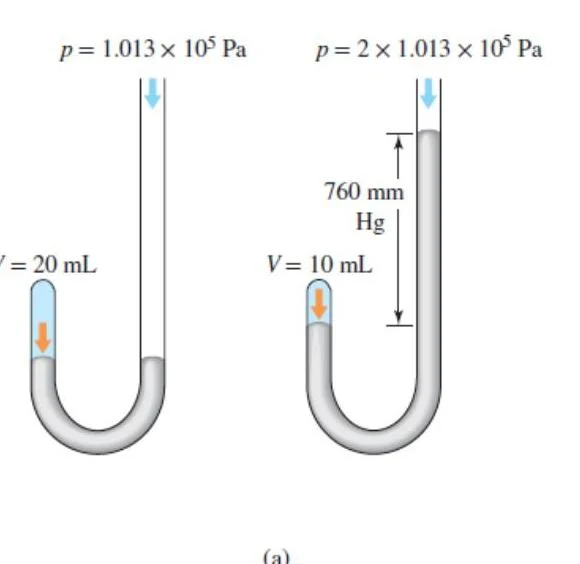
Boyle's Law describes the relationship between pressure and volume when the temperature (T) and the number of moles (n) remain constant. He discovered that volume is inversely proportional to pressure. This means that if you increase the pressure on a gas, its volume will decrease proportionally (and vice versa).
Diagram illustrating the effect of pressure on the volume of a gas in a U-tube manometer.
The mathematical expression is:
P1V1=P2V2
Charles's Law: Volume and Temperature
Charles's Law states that gas volume is directly proportional to its absolute temperature, provided pressure and amount remain constant.
Important Note on Temperature: When working with gas laws, you must always use the absolute temperature scale, known as Kelvin (K). Temperature in Celsius must be converted using the relationship: T(K)=T(∘C)+273.15.
The concept of absolute zero (0 K=−273.15∘C) represents the theoretical temperature at which the volume of an ideal gas would become zero.
The mathematical expression is:
T1V1=T2V2
Avogadro's Law: Volume and Moles
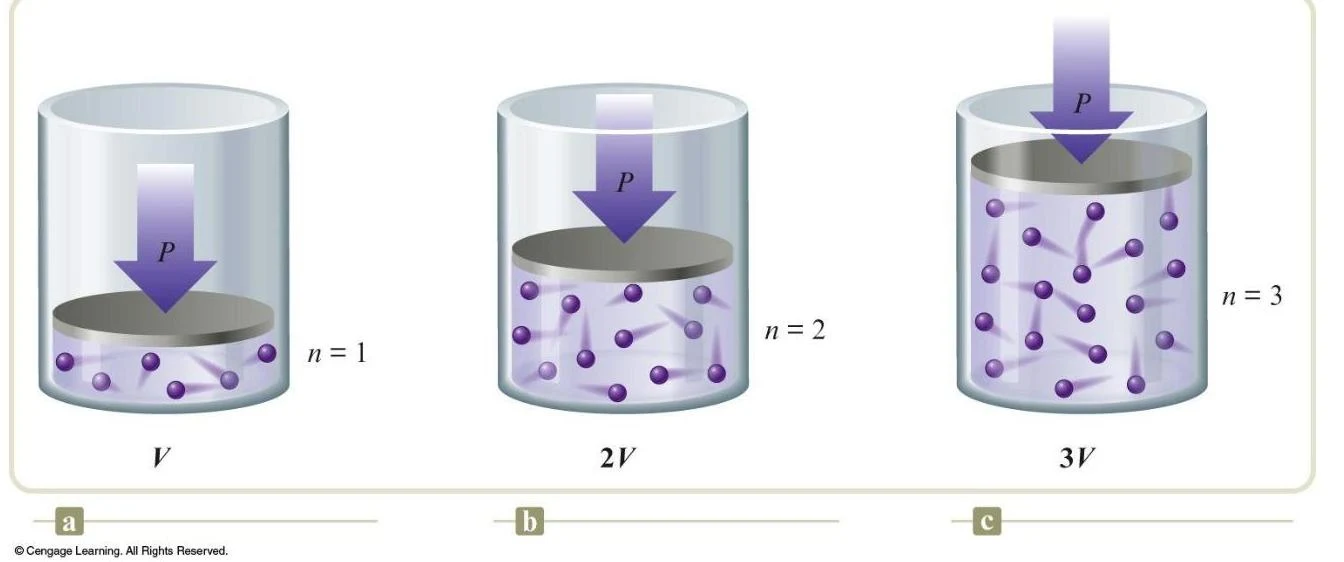
Avogadro's Law establishes that the volume of a gas is directly proportional to the amount of gas (the number of moles, n) at constant temperature and pressure. Essentially, if you add more particles to a container, the gas will expand to accommodate them.
This illustration shows three cylinders with pistons. Each cylinder contains gas particles. In the first cylinder, labeled V, there are few particles and the piston is at the top. In the second cylinder, labeled 2V, the piston is lower, compressing the gas, and there are more particles. In the third cylinder, labeled 3V, the piston is even lower, further compressing the gas, and there are the most particles. The letter P indicates pressure applied by the piston.
The mathematical expression is:
n1V1=n2V2
The Ideal Gas Law
While the individual laws are useful, we can combine them into a single, comprehensive equation known as the Ideal Gas Law. This equation relates all four variables—pressure (P), volume (V), temperature (T), and amount (n)—using a single constant called the gas constant (R).
PV=nRT
The value of the gas constant R depends on the units being used:
Using Liters and Atmospheres: R=0.08206 L⋅atm/(mol⋅K)
Using SI Units: R=8.314 J/(mol⋅K)
Exam Tip: Always check your units before plugging numbers into the Ideal Gas Law. If your pressure is in kPa, you must use the corresponding R value or convert your pressure to atm first!
Worked Example: Finding Moles
Question: An automobile tire at 23∘C with an internal volume of 25.0 L is filled with air to a total pressure of 3.18 atm. Determine the number of moles of air in the tire.
Solution:
Convert Temperature to Kelvin: $23 + 273 = 296 \text{ K}$
We can extend the Ideal Gas Law to understand the physical properties of a gas, such as its density (ρ). Density is defined as mass (m) divided by volume (V). By substituting the relationship between moles and mass (n=m/M, where M is the molar mass) into the Ideal Gas Law, we derive:
PV=(Mm)RT
Rearranging for density (ρ=m/V):
ρgas=RTPM
From this formula, we can observe three critical relationships regarding gas density:
Pressure: Density is directly proportional to pressure (higher pressure = denser gas).
Temperature: Density is inversely proportional to temperature (higher temperature = less dense gas).
Molar Mass: Density is directly proportional to molar mass (heavier molecules = denser gas).
A collection of hot air balloons ascend into a clear blue sky.
Keep reading for free.
Create an account to finish this reading and make it part of your study routine.