Understanding Gas Density, Molecular Motion, and Pressure
Explore the fundamental principles of gases, including their molecular motion, how it generates pressure, and the concept of gas density. This guide also covers atmospheric pressure, altitude effects, and the proportionality relationships that govern gas behavior, such as the Combined Gas Law and Ideal Gas Law.
Gases are unique states of matter characterized by their lack of a fixed shape or volume. Unlike solids, which maintain a rigid structure, gases are highly dynamic and will expand to fill whatever container they occupy. This behavior is driven by the microscopic activity of their constituent particles, which are in a state of perpetual, rapid movement. By understanding the relationship between this motion, the density of the gas, and the pressure it exerts, we can model how gases respond to changes in their environment.
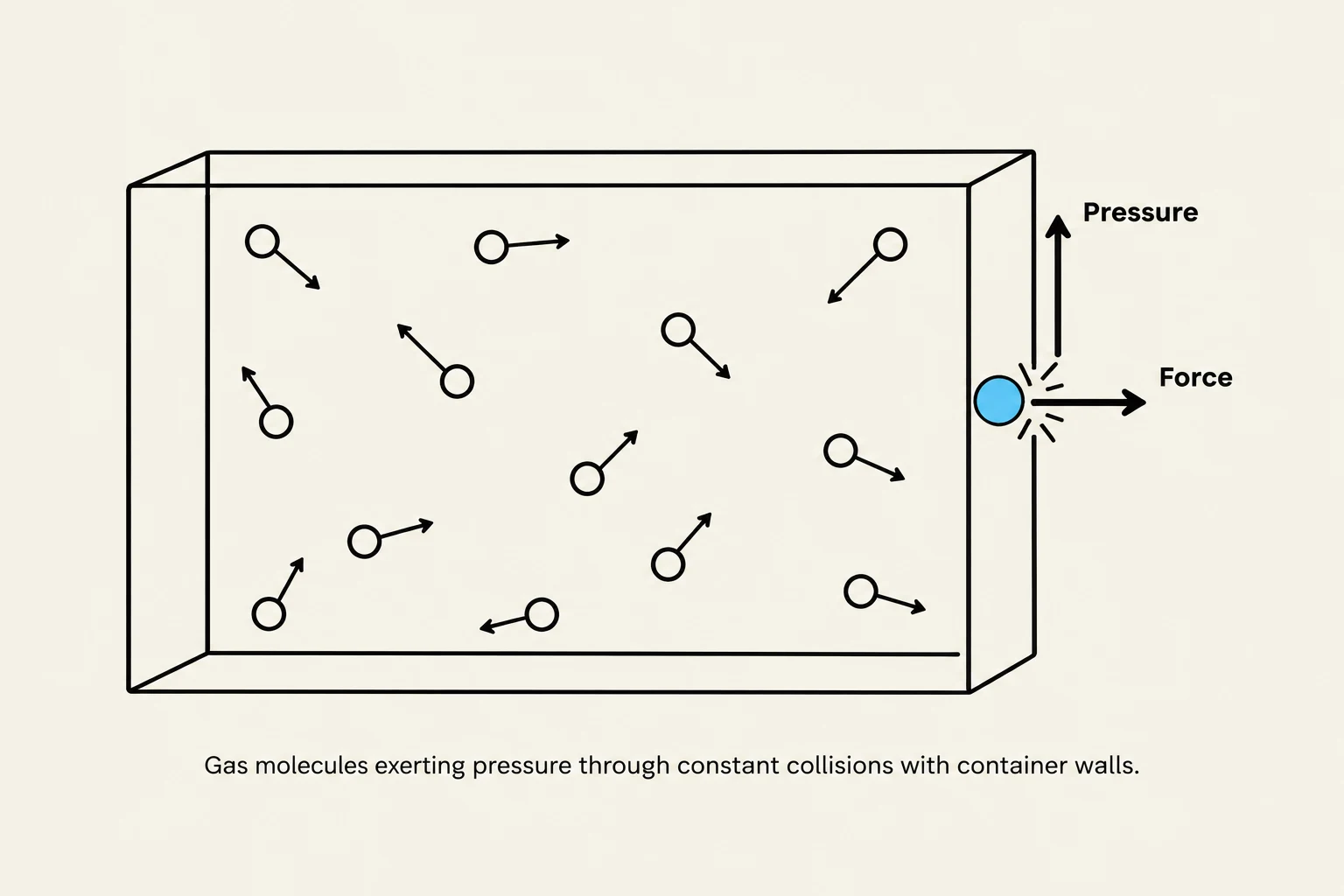
Gas molecules exerting pressure through constant collisions with container walls.
Molecular Motion and Pressure
At the microscopic level, gas molecules are in constant motion. They do not sit still; instead, they zip through the available space, colliding with one another and, most importantly, with the internal walls of their container.
Every time a molecule strikes a surface, it exerts a tiny amount of force. When you consider the sum of all these billions of microscopic collisions occurring every second across the entire surface area of a container, the result is what we macroscopically define as pressure. In essence, pressure is simply the force exerted by molecular kinetic activity against a surface.
Gas Density
Density is defined as the mass of a substance per unit of volume (D=Vm). While the density of a solid is relatively easy to define because its volume is fixed and measurable, gas density is more complex. Because gases expand to fill their containers, their density is highly dependent on the volume of the container and the conditions (pressure and temperature) acting upon them.
Atmospheric Pressure and Altitude
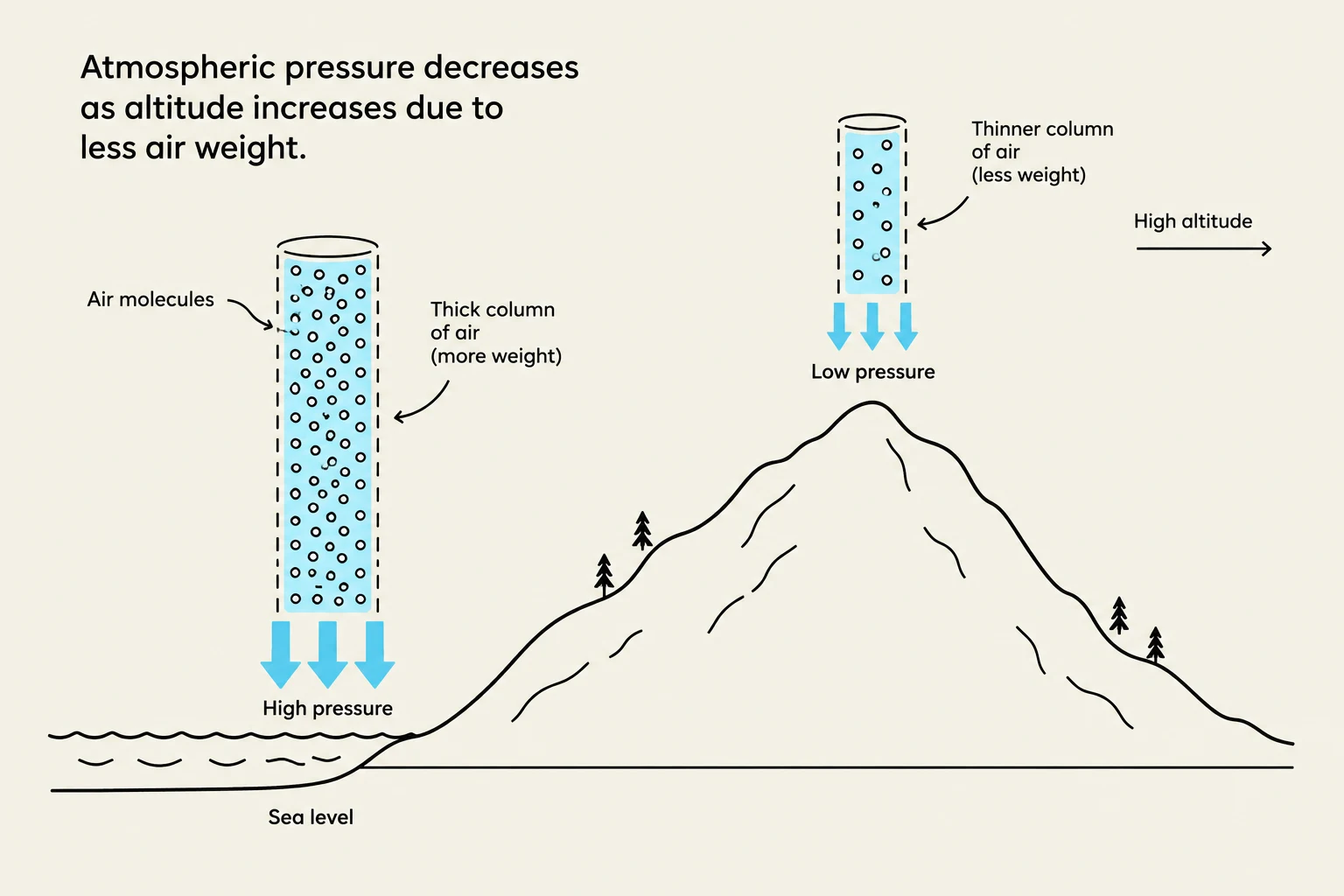
Atmospheric pressure decreases as altitude increases due to less air weight. At sea level, a thick column of air exerts high pressure, while at high altitudes, a thinner column of air exerts low pressure.
We live at the bottom of a "sea" of air. Atmospheric pressure is the pressure exerted by the weight of all the air in the atmosphere above a given point.
There is a critical relationship between altitude and pressure: as altitude increases, atmospheric pressure decreases. When you climb a mountain or fly in an airplane, there is less air pressing down on you than there is at sea level. This change in pressure has several noticeable effects:
Physiological Effects: When flying, you may experience the sensation of your ears "popping." This occurs because your body is attempting to equalize the internal pressure of your middle ear with the decreasing external atmospheric pressure.
Physical Processes: Lower atmospheric pressure affects the boiling point of liquids. For example, at higher altitudes, it may take longer for water to reach a boiling point under certain conditions, or the boiling point itself may decrease.
Proportionality Relations and Gas Laws
The behavior of gases is governed by mathematical relationships between pressure (P), volume (V), and temperature (T). These are often categorized by how the variables change in relation to one another.
Direct vs. Inverse Proportionality
Visualizing direct and inverse relationships between gas variables, illustrating how temperature affects pressure and how volume affects pressure.
Direct Proportionality: This occurs when an increase in one variable leads to an increase in another. For example, if you increase the temperature of a gas in a fixed container, the pressure will increase because the molecules move faster and strike the walls more forcefully.
Inverse Proportionality: This occurs when an increase in one variable leads to a decrease in another. A classic example is the relationship between pressure and volume: if you compress a gas into a smaller volume, the pressure increases.
The Combined Gas Law and Ideal Gas Law
To solve complex problems where multiple variables change, we use the Combined Gas Law, which relates the initial and final states of a gas:
T1P1V1=T2P2V2
For more advanced calculations involving the amount of gas (moles), we use the Ideal Gas Law:
$PV = nRT$
In this equation, R represents the Gas Constant.
💡 Study Tip: Unit Consistency
When solving gas law equations, you must be extremely careful with your units. To ensure mathematical accuracy:
Pressure should typically be in atmospheres (atm).
Volume should be in liters (L).
Temperature must ALWAYS be converted to the absolute scale, Kelvin (K).
Worked Example: Temperature Conversion
If a problem provides a temperature in Celsius, you cannot plug it directly into the Ideal Gas Law. You must convert it to Kelvin first.
Example: If the temperature is 25∘C, the calculation is:
T(K)=25+273=298 K
⚠️ Exam Alert: The Absolute Scale
Always remember that temperature in gas laws is handled through absolute scales. If you use Celsius instead of Kelvin, your proportionality calculations will be incorrect because Celsius allows for zero or negative values, which would break the mathematical relationship of the gas laws.
Summary Table of Gas Relationships
Relationship Type
Variable A ↑
Variable B ↑
Example
Direct
Temperature
Pressure
Heating a sealed canister
Inverse
Volume
Pressure
Compressing air in a syringe
To master these concepts, it is recommended to practice identifying which variables are changing and which are remaining constant in a given scenario.
Keep reading for free.
Create an account to finish this reading and make it part of your study routine.