Understanding Friction, Drag, and Propulsion in Physics
Explore the fundamental concepts of friction (static, kinetic, rolling), drag force, terminal velocity, and propulsion, all explained through Newton's laws of motion with practical examples and a worked problem.
In the study of physics, understanding why objects move—or why they stop—requires a deep dive into the forces that govern their behavior. While we often focus on the forces that cause motion, such as pushes or pulls, we must also account for the resistive forces that oppose it. This article explores the complex dynamics of friction, the fluid resistance known as drag, and the fascinating way Newton's laws allow for propulsion.
The Nature of Friction
Friction is a resistive force that occurs when two surfaces rub against each other. It acts in the direction opposite to the applied force (Fapp) or the direction of potential motion. Because objects lose energy to compensate for the work done by friction, they will eventually come to a stop if no other forces are applied.
At a microscopic level, even surfaces that appear smooth possess "hills" and "valleys". Friction occurs because these microscopic irregularities interlock or "get hold of each other" when surfaces are pressed together. The intensity of this resistance depends on how well the two surfaces lock together: surfaces that lock together more effectively produce more resistance, while those that lock less effectively produce less resistance.
The Components of Friction
The magnitude of the friction force is determined by two primary factors: the physical contact pressure and the material properties of the surfaces.
The Normal Force (N): Friction is directly proportional to the normal force, which is the perpendicular force exerted by the surfaces. For an object resting on a horizontal plane, the normal force is often related to the gravitational force and can be expressed as N=(M+madded)g.
The Coefficient of Friction (μ): This dimensionless value represents the nature of the materials in contact and serves as a measure of the roughness of the surfaces. A higher μ indicates greater resistance between the materials.
The general relationship is expressed as:
Ff=μN
Static vs. Kinetic Friction
Friction is categorized into two distinct types based on whether the object is stationary or in motion.
Static Friction (fs): This force acts when there is no motion between the objects. Static friction is a "responsive" force; it increases to be equal and opposite to whatever force is exerted, up to its maximum limit. This maximum value is defined by the coefficient of static friction (μs):
fs≤μsNfs(max)=μsN
To get an object moving, you must apply a force that exceeds this maximum static friction threshold.
Kinetic Friction (fk): Once an object starts sliding, it experiences kinetic friction. Unlike static friction, the magnitude of kinetic friction is generally constant and independent of the applied force. It is calculated using the coefficient of kinetic friction (μk):
fk=μkN
Notably, the coefficient of kinetic friction is almost always smaller than the coefficient of static friction (μk<μs).
Exam Tip: If a question asks for the maximum force required to start an object moving, use the static friction formula (fs(max)=μsN). If the object is already sliding, use the kinetic friction formula (fk=μkN).
Rolling Friction
While sliding friction is common, objects that roll (like wheels or balls) are subject to rolling friction. This force results from microscopic deformations of the tire and the road. The more a surface deforms, the higher the rolling friction. For example, riding a bike on asphalt is easier than on sand because sand deforms significantly, increasing the rolling friction coefficient (μr).
μr
System
∼0.001
Railroad
∼0.005
Bicycle
∼0.01
Car
∼0.3
Car on sand
Drag Force and Terminal Velocity
When an object moves through a fluid (a gas or a liquid), it encounters a resistive force known as drag force (FD). Like friction, drag always opposes motion, but unlike simple friction, it depends on the velocity of the object.
For most large objects, such as cars or bicyclists, the drag force is proportional to the square of the speed (v2). The full relationship is:
FD=21CρAv2
Where:
C is the drag coefficient (representing aerodynamic properties).
ρ is the density of the fluid.
A is the cross-sectional area of the object facing the fluid.
Reaching Terminal Velocity
As an object falls (like a skydiver), gravity pulls it down with a constant force (mg), while drag increases as the object speeds up. Eventually, the upward drag force becomes equal to the downward gravitational force. At this point, the net force is zero, acceleration ceases, and the object continues to fall at a constant speed called terminal velocity.
To find the terminal velocity (v), we set the forces equal:
mg=21CρAv2
Solving for v:
v=CρA2mg
Propulsion and Newton's 3rd Law
While friction is often seen as a hindrance, it is actually essential for propulsion—the act of moving forward. This is explained by Newton's 3rd Law, which states that for every action, there is an equal and opposite reaction.
How We Move
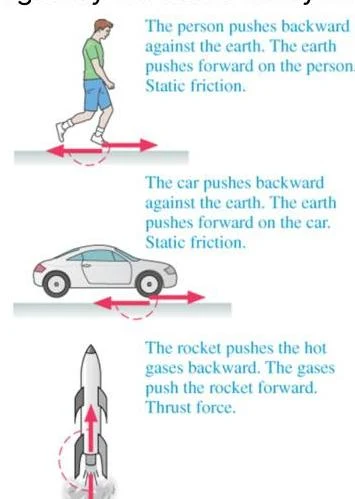
When you walk, your leg applies a backward force against the ground. Because your foot is held in place by static friction, the ground reacts by pushing your body forward. Without this static friction, your foot would simply slide backward, and you would not move forward.
This illustration demonstrates Newton's third law of motion, illustrating action-reaction forces in scenarios involving a person walking, a car moving, and a rocket launching.
This principle applies to many forms of motion:
Vehicles: A car's tires push backward on the road; the road pushes the car forward via static friction.
Rockets: A rocket expels gas backward at high speeds. The force of the rocket on the gas is the "action," and the force of the gas pushing the rocket forward is the "reaction" (often called thrust).
Worked Example: The Sliding Brother
Problem: A 35 kg person wearing socks slides on a hardwood floor. The coefficient of static friction is μs=0.15 and the coefficient of kinetic friction is μk=0.10. If the person slides a maximum distance of 2.0 m before stopping, what was their initial velocity (Vi)?
Solution:
Identify Forces: In the vertical direction, the normal force $N = mg$. In the horizontal direction, the only force is kinetic friction fk=μkN=μkmg.
Find Acceleration (a):
Using Newton's 2nd Law (Fnet=ma):
−μkmg=maa=−μkg=−(0.10)(9.8 m/s2)=−0.98 m/s2
Use Kinematics:
We know the final velocity Vf=0, the distance Δx=2.0 m, and a=−0.98 m/s2.
Vf2=Vi2+2aΔx0=Vi2+2(−0.98)(2.0)Vi2=3.92Vi≈1.98 m/s
Keep reading for free.
Create an account to finish this reading and make it part of your study routine.