Understanding Forces and Motion on Inclined Planes
Explore the fundamental principles of classical mechanics, including free body diagrams, net force, acceleration, and the physics of friction on inclined planes. Learn to resolve forces and calculate motion on slopes.
Understanding how objects move—or stay still—is the cornerstone of classical mechanics. Whether you are calculating how a car stays parked on a steep hill or how a skier accelerates down a mountain, the underlying principles remain the same: forces are acting on the object, and the balance (or imbalance) of those forces determines its motion. This article explores the fundamental tools used to solve these problems, from drawing diagrams to calculating acceleration on an incline.
The Foundation: Free Body Diagrams
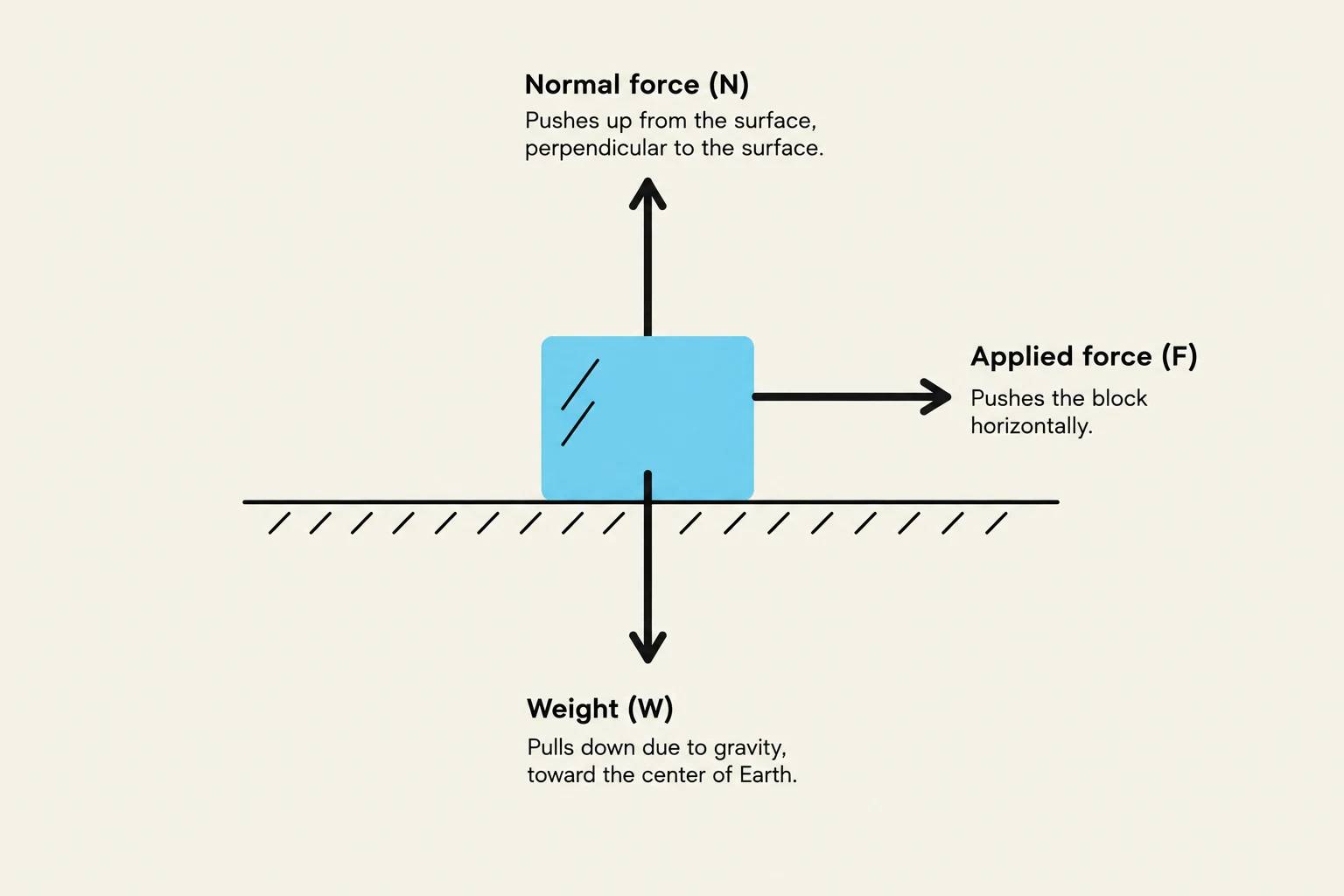
Before you can solve any physics problem involving motion, you must identify all the forces acting on an object. The most effective way to do this is by constructing a Free Body Diagram (FBD). An FBD is a simplified sketch where the object is represented by a dot or a box, and all external forces are drawn as vectors (arrows) originating from that center point.
When drawing an FBD, you must account for several key types of forces:
Weight (mg): The force of gravity pulling the object straight down toward the center of the Earth.
Normal Force (N): The support force exerted by a surface perpendicular to the object.
Applied Force (F): A force applied to the object by an external agent, such as a person pushing or a rope pulling.
Tension (T): A specific type of applied force transmitted through a string, rope, or cable.
Friction Force (f): A force that opposes the relative motion (or intended motion) between two surfaces.
A diagram illustrating the forces acting on a block: normal force, applied force, and weight.
Exam Tip: Always ensure your force vectors are drawn in the correct direction. For example, the Normal force is always perpendicular to the surface, while Weight always points straight down, regardless of the angle of the surface.
Understanding Net Force and Acceleration
Once you have identified the forces, you can determine the Net Force (∑F). The net force is the vector sum of all individual forces acting on the object. According to Newton's Second Law, the net force is directly proportional to the object's Acceleration (a) and its mass (m):
∑F=m⋅a
If the forces are perfectly balanced, the net force is zero, and the object is in equilibrium (either at rest or moving at a constant velocity). If the forces are unbalanced, the object will accelerate in the direction of the net force.
Friction: Static vs. Kinetic
Friction is a complex force that depends on the nature of the surfaces in contact. It is generally categorized into two types:
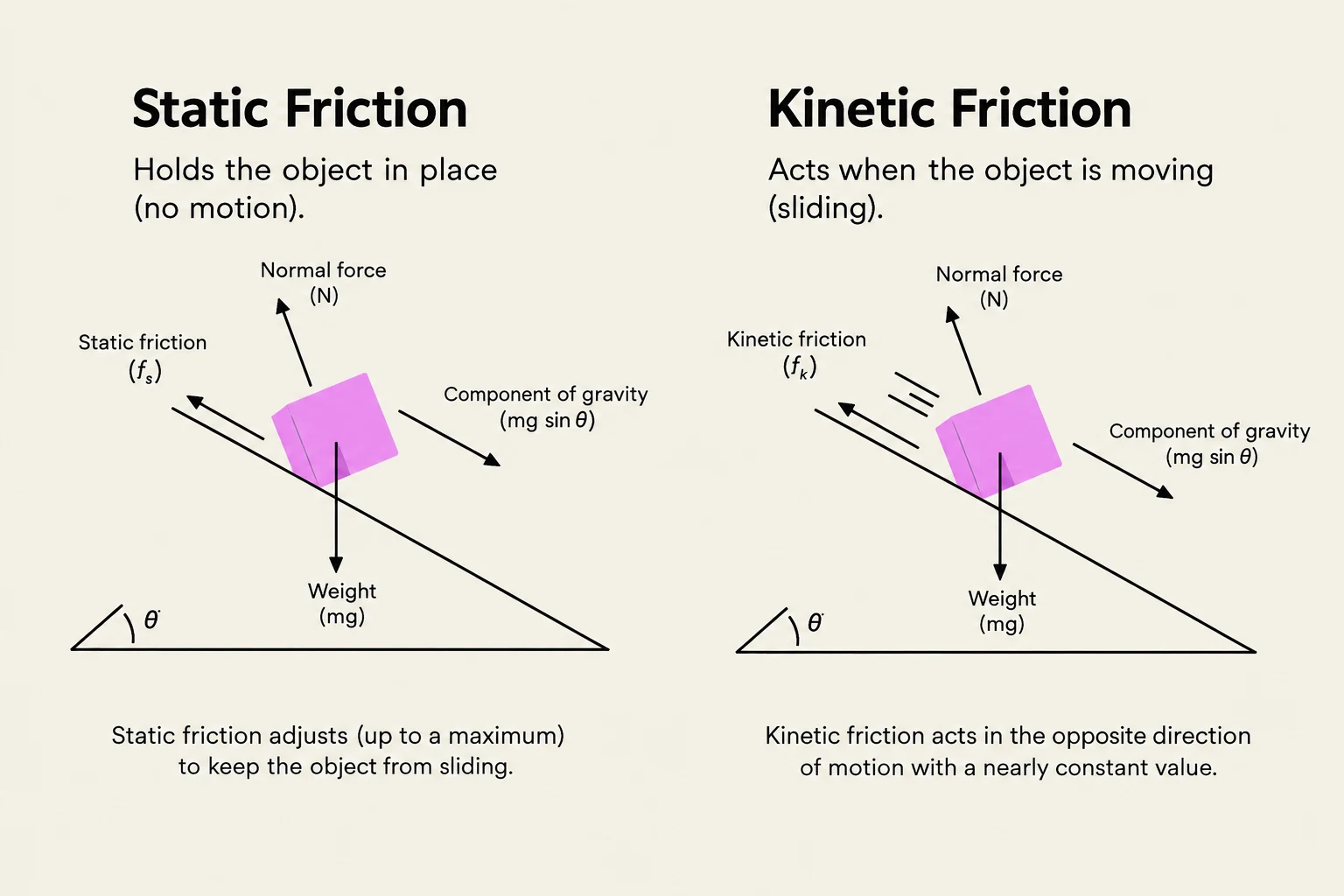
Static Friction (fs): This force acts on objects that are not yet moving. It resists the tendency of an object to slide. The maximum value of static friction is determined by the static coefficient of friction (μs) and the normal force:
fs,max=μs⋅N
Kinetic Friction (fk): Once an object starts sliding, it is resisted by kinetic friction. This is typically modeled using the kinetic coefficient of friction (μk). Usually, μk<μs, meaning it is harder to start an object moving than it is to keep it moving.
For a car parked on an incline, the static friction must be strong enough to counteract the component of weight pulling the car down the slope. If the slope becomes too steep, the required friction exceeds fs,max, and the car will slide.
Diagrams illustrating static and kinetic friction acting on a block on an inclined plane.
Physics of the Inclined Plane
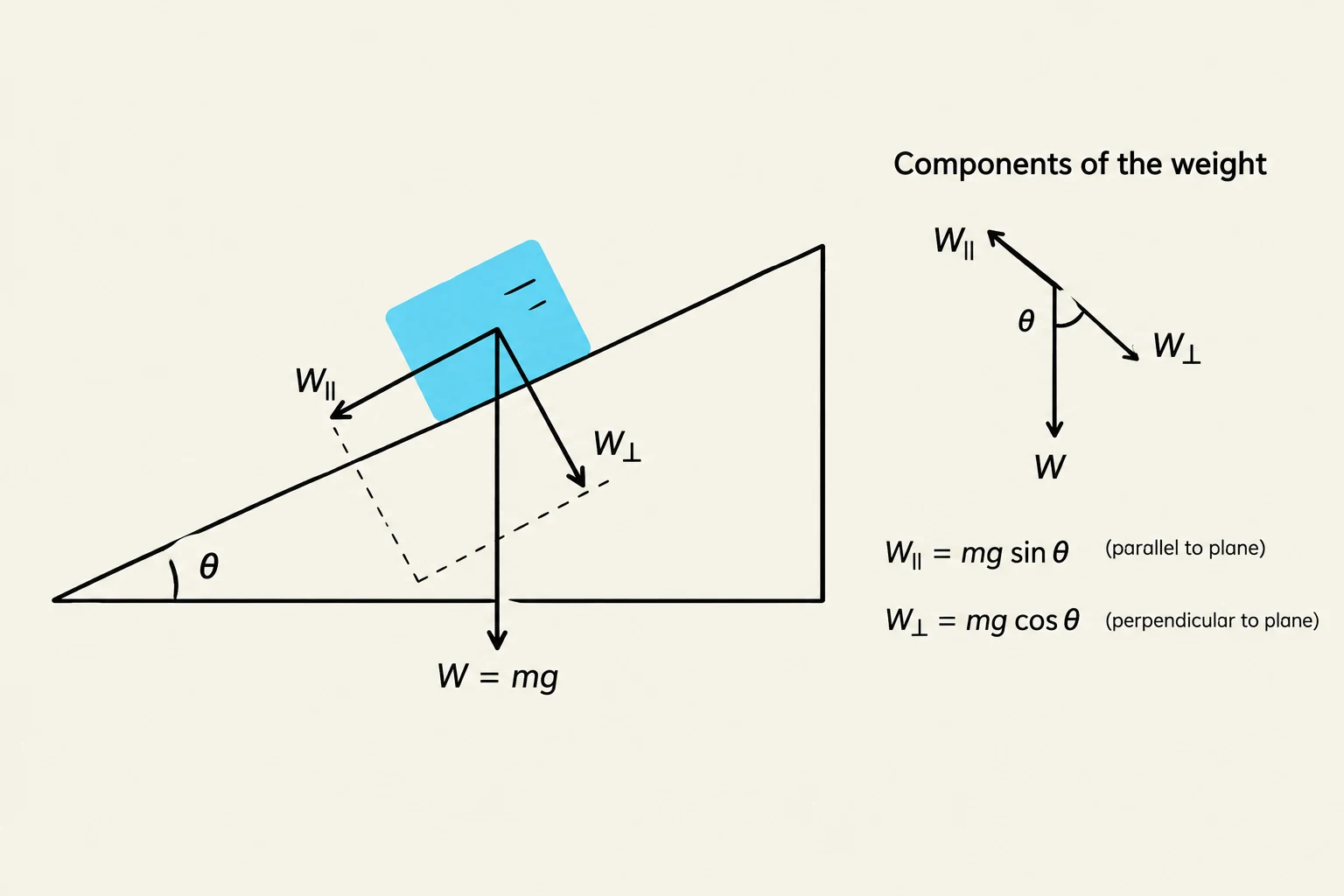
The inclined plane is a classic physics scenario where an object sits on a slope at an angle θ. When an object is on an incline, gravity no longer acts purely perpendicular to the surface. Instead, we must "resolve" the weight into two components:
Perpendicular component (mgcosθ): This component presses the object into the surface and is balanced by the Normal force (N=mgcosθ) if there are no other vertical forces.
Parallel component (mgsinθ): This component pulls the object down the slope.
Calculating Acceleration
To find the acceleration of an object sliding down a frictionless incline, we look at the net force acting parallel to the slope:
∑Fparallelmaa=mgsinθ=mgsinθ=gsinθ
Interestingly, in a frictionless environment, the mass of the object cancels out, meaning a heavy block and a light block will accelerate down the same slope at the same rate.
When friction is present, such as a skier on snow, the equation becomes more complex. The net force is the difference between the gravitational pull down the slope and the kinetic friction resisting it:
This diagram illustrates the components of weight acting on an object placed on an inclined plane. The weight (W) is resolved into two components: W parallel to the plane (W|| = mg sin θ) and W perpendicular to the plane (W⊥ = mg cos θ).
Problem Solving Strategy: When dealing with inclined planes, always tilt your coordinate system. Make the x-axis parallel to the slope and the y-axis perpendicular to it. This simplifies your math significantly by aligning your axes with the direction of motion.
Summary Table of Incline Scenarios
Scenario
Net Force Equation (Parallel)
Acceleration (a)
Frictionless Incline
Fnet=mgsinθ
a=gsinθ
Incline with Friction
Fnet=mgsinθ−μkmgcosθ
a=g(sinθ−μkcosθ)
Constant Velocity
Fnet=0
a=0
By mastering these components—resolving forces, applying the correct coefficients of friction, and using Free Body Diagrams—you can solve almost any problem involving motion on a slope.
Keep reading for free.
Create an account to finish this reading and make it part of your study routine.