Explore the physics behind the sensations experienced in an elevator using Newton's Laws. Learn about free-body diagrams, weight, normal force, and how acceleration affects apparent weight.
Have you ever felt a sudden "heaviness" in your legs when an elevator starts moving upward, or a momentary feeling of weightlessness when it descends? This sensation is not an illusion; it is a direct consequence of the changing forces acting on your body. To understand why this happens, we must look beyond our sense of weight and analyze the actual physics of motion through Newton's Laws.
The Foundation: Newton's Laws and Net Force
To analyze any moving system, we must start with the fundamental principles of dynamics. Newton's Second Law is the cornerstone of this analysis, stating that the net force acting on an object is proportional to its mass and its acceleration. Mathematically, this is expressed as:
Fnet=ma
In the context of an elevator, the "net force" (Fnet) is the vector sum of all external forces acting on the person inside. When an object is at rest or moving at a constant velocity, the acceleration is zero, meaning the net force must also be zero. However, the moment the elevator begins to speed up or slow down, an acceleration is introduced, requiring a non-zero net force to change the person's state of motion.
Furthermore, Newton's Third Law reminds us that forces always exist in pairs. If you push against a scale, the scale pushes back on you with an equal and opposite force. This interaction is critical when determining what a scale actually measures.
Visualizing Forces: The Free-Body Diagram
Before performing any calculations, physicists use a tool called a free-body diagram (FBD). An FBD is a simplified sketch that represents an object as a single point and uses arrows to show all the external forces acting upon it.
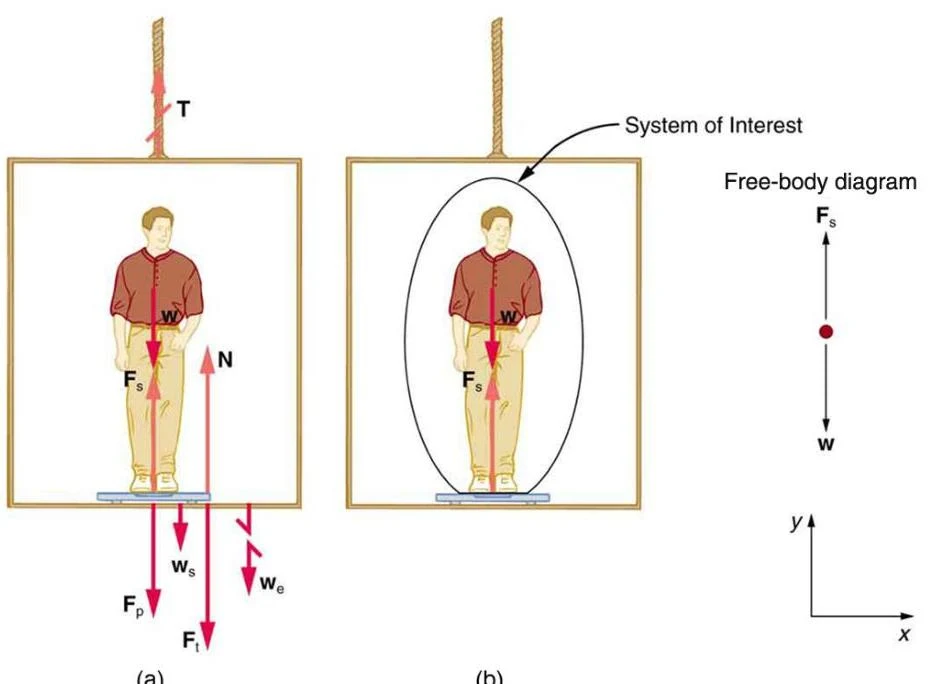
When analyzing a person in an elevator, we choose the person as our "system of interest." For this person, there are typically two primary vertical forces:
Weight (w): The force of gravity pulling the person downward, calculated as $w = mg$.
Force of the scale (Fs): The upward normal force exerted by the scale on the person.
Diagrams illustrating forces acting on a person in a box, including a free-body diagram.
Fig 4.30: (b) The free-body diagram shows only the external forces acting on the designated system of interest—the person.
By focusing only on the person, we ignore the complex forces acting on the elevator car itself (like the tension in the cables or the weight of the car) and simplify the problem into a one-dimensional analysis.
Exam Tip: When drawing a free-body diagram, only include forces acting on the object you are studying. Do not include forces the object exerts on its surroundings.
Calculating Scale Readings
A common misconception is that a scale measures your actual weight (mg). In reality, a scale measures the normal force it must exert upward to support you. If the elevator is accelerating, the scale must push harder (or softer) than usual to satisfy Newton's Second Law.
Case 1: Upward Acceleration
If the elevator accelerates upward, the net force must be directed upward. Using our FBD, where upward is positive:
Fnet=Fs−w=ma
Solving for the scale reading (Fs):
Fs=ma+mg
Because ma is positive, the scale reading Fs will be greater than your actual weight. This explains why you feel "heavier" when the elevator starts its ascent.
Case 2: Constant Velocity
When the elevator moves at a constant speed (whether upward or downward), the acceleration a is exactly zero. Substituting this into our equation:
Fs=m(0)+mg=mg
In this state, the scale reading is exactly equal to your weight. You will feel "normal" during any period of constant motion.
Case 3: Downward Acceleration
If the elevator accelerates downward, the acceleration a is negative relative to our upward-positive coordinate system.
Fs=m(−a)+mg
Here, the scale reading is less than your actual weight. In the extreme case of free-fall (where a=g), the scale reading becomes zero, and you would experience weightlessness.
Worked Example: The 75 kg Passenger
To solidify these concepts, let's apply the formulas to a specific scenario.
Problem: A 75.0 kg man stands on a scale in an elevator. Calculate the scale reading if:
(a) The elevator accelerates upward at 1.20 m/s2.
(b) The elevator moves upward at a constant speed of 1 m/s.