Understanding Extractive vs. Inclusive Institutions
This content explains the fundamental differences between extractive and inclusive institutions, detailing why transitioning from extractive systems to inclusive ones is challenging due to elite resistance and other socio-economic barriers. It explores the mechanics of resistance, the risk of new extraction, and the co
In the study of political economy, the distinction between prosperous and failing nations often boils down to the nature of their institutions. While inclusive institutions distribute power and economic opportunity broadly, extractive institutions are designed to concentrate wealth and power in the hands of a small elite.
On paper, transitioning from an extractive system to an inclusive one sounds like a logical progression toward development. In practice, however, this transformation is one of the most difficult political feats a society can attempt. The primary reason is simple yet devastating: those who benefit most from the current extractive system are often the very people with the power to prevent it from changing.
Understanding the Institutional Divide
To understand why transformation is difficult, we must first define the two opposing institutional frameworks.
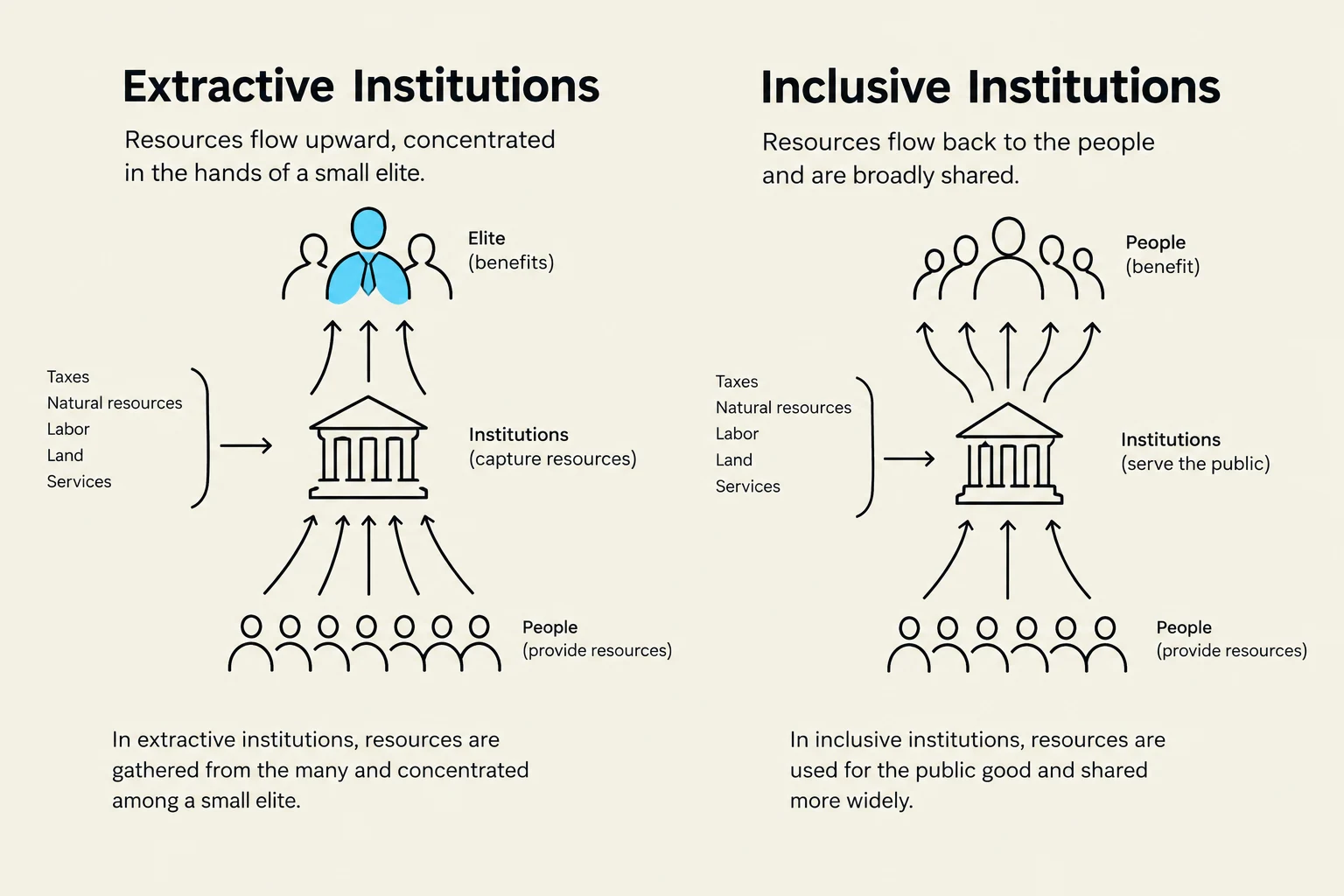
Extractive institutions are characterized by a concentration of political power that allows a small group to extract resources from the rest of society. These institutions serve the interests of the elite, often at the expense of innovation, competition, and the rule of law.
Inclusive institutions, conversely, are designed to spread both economic opportunities and political power. They feature checks and balances, protect property rights for all citizens, and allow for broad participation in the political process.
Study Tip: Think of institutions as the "rules of the game." Extractive institutions are a game designed for one player to win every time, while inclusive institutions are a game where the rules apply equally to everyone.
This diagram illustrates the difference between extractive and inclusive institutions, showing how resources are distributed within each system.
The Mechanics of Resistance
Why don't these systems simply evolve? The resistance from the ruling class is not merely a matter of preference; it is a matter of survival for their status and wealth.
1. The Concentration of Power
Elites facing a transition to inclusive institutions often resist because they face the imminent loss of "rents"—unearned income derived from their control over resources. This resistance is bolstered by a massive imbalance in resources. Elites typically possess a heavy concentration of:
Money: The ability to fund political campaigns and influence policy.
Organization: Established networks and political machines.
Coercive Means: Control over the military, police, or other state apparatuses used to enforce their will.
2. Economic and Social Barriers
Even when people want change, they are often held back by economic dependence. If the majority of the population relies on the elite for their livelihoods, the cost of political rebellion becomes too high. Furthermore, even if new laws are passed, a lack of state capacity—the ability of the government to actually enforce laws—means that rights may exist on paper but remain meaningless in practice.
This diagram illustrates how a loss of rents can lead to the mobilization of coercive means by a ruling group to maintain power, which in turn can result in increased resistance.
3. Informal Practices
Transformation is often undermined by "shadow" systems. Even in a reforming state, informal practices of intimidation and favoritism can persist. When decisions are made based on who you know rather than what the law says, the extractive nature of the old system survives under a new name.
The Risk of "New" Extraction
A common misconception is that a change in leadership automatically leads to inclusive institutions. This is rarely the case.
The Capture of Transition
A major risk in any period of upheaval is the capture of the transition by new leaders. A new group may overthrow an old dictator only to establish their own extractive regime. This is often seen in:
Privatization traps: A state might privatize industries to "open" the economy, but if it maintains a protected monopoly for a few favored individuals, it has merely preserved extraction through a different mechanism.
Electoral facades: An election may be held, but if the opposition is prevented from competing freely, the institution remains extractive.
Warning: A constitution can recognize rights, but if the population lacks the capacity to exercise them or the state lacks the strength to protect them, the document is merely "parchment barriers".
Breaking the Vicious Circle
If the obstacles are so significant, how does change actually occur? The answer lies in critical junctures.
A critical juncture is a period of significant change—such as a war, a revolution, or a massive economic collapse—that opens up possibilities for new institutional arrangements. However, there is no guaranteed sequence of events that leads to success.
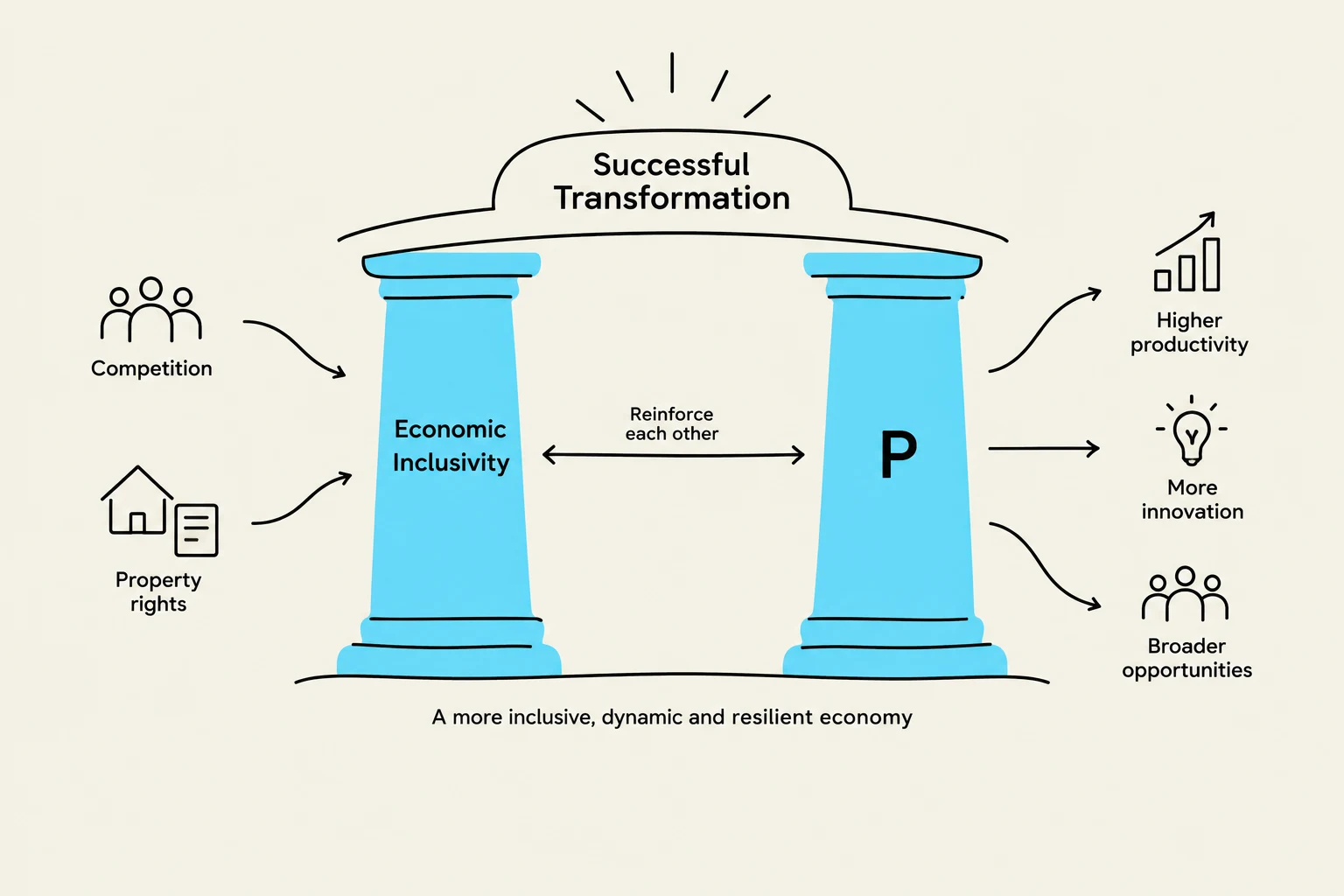
To successfully break the "vicious circle" of extraction, a transformation must address two dimensions simultaneously:
Economic Opportunities: Breaking up monopolies and ensuring fair competition.
Political Power Distribution: Creating constraints on rulers and allowing for broader, lasting participation.
A diagram illustrating the pillars of successful economic transformation, including competition, property rights, economic inclusivity, and factors like higher productivity, innovation, and broader opportunities.
In summary, transforming extractive institutions requires more than just changing the people in charge; it requires building institutions that constrain new rulers and ensure that power cannot easily be concentrated once again.
Keep reading for free.
Create an account to finish this reading and make it part of your study routine.