Understanding Extractive Economies and Their Impact
Explores the concept of extractive economies, where nature is viewed as a source of commodities rather than an interconnected system. It details the logic of extraction, commodification, ownership, and the disconnect between extraction and consumption sites, while also presenting critiques and alternative models like c
In the study of environmental geography and political ecology, one of the most fundamental frameworks for understanding human-environment interaction is the concept of the extractive economy. At its core, an extractive economy is a model of production and consumption that treats the natural environment not as a living, interconnected system, but as a vast warehouse of discrete commodities. In this view, nature is something to be taken, owned, and sold for profit.
The Logic of Extraction
The logic of an extractive economy relies on a specific ontological shift: the transformation of "nature" into "resources." When a forest is viewed as an ecosystem, it is defined by its biodiversity, its role in carbon sequestration, and its cultural significance. However, when that same forest is viewed through an extractive lens, it is redefined as "board feet of timber."
This process of commodification involves several key steps:
Identification: Locating a natural element (minerals, oil, timber, water) that has market value.
Quantification: Measuring that element in units that can be traded (tons, barrels, cubic meters).
Extraction: Using technology and labor to remove the element from its original context.
Exchange: Selling the element within a global or local market to generate capital.
This diagram illustrates the process of transforming natural resources from an ecosystem into commodities. It outlines four key stages: Identification of valuable resources, Quantification through measurement and assessment, Extraction from the ecosystem, and finally, the Commodity stage where the resource becomes a marketable good with economic value.
Exam Tip: If asked to differentiate between "nature" and "resources," remember that "nature" refers to the biological and physical reality, while "resources" is a human-centric term applied only when that reality has potential economic utility.
Commodification and Ownership
A central pillar of extractive models is the concept of property rights. For a commodity to be sold effectively in a global market, it must be "owned." This necessitates the legal and physical enclosure of land and resources. In many historical and contemporary contexts, this leads to the displacement of indigenous or local communities who may have managed the land through communal or non-ownership-based systems.
In an extractive economy, the value of a landscape is often calculated using a linear formula of input versus output. For example, the profitability of a mining operation might be simplified as:
Profit=Market Value of Extracted Material−(Cost of Extraction+Labor+Infrastructure)
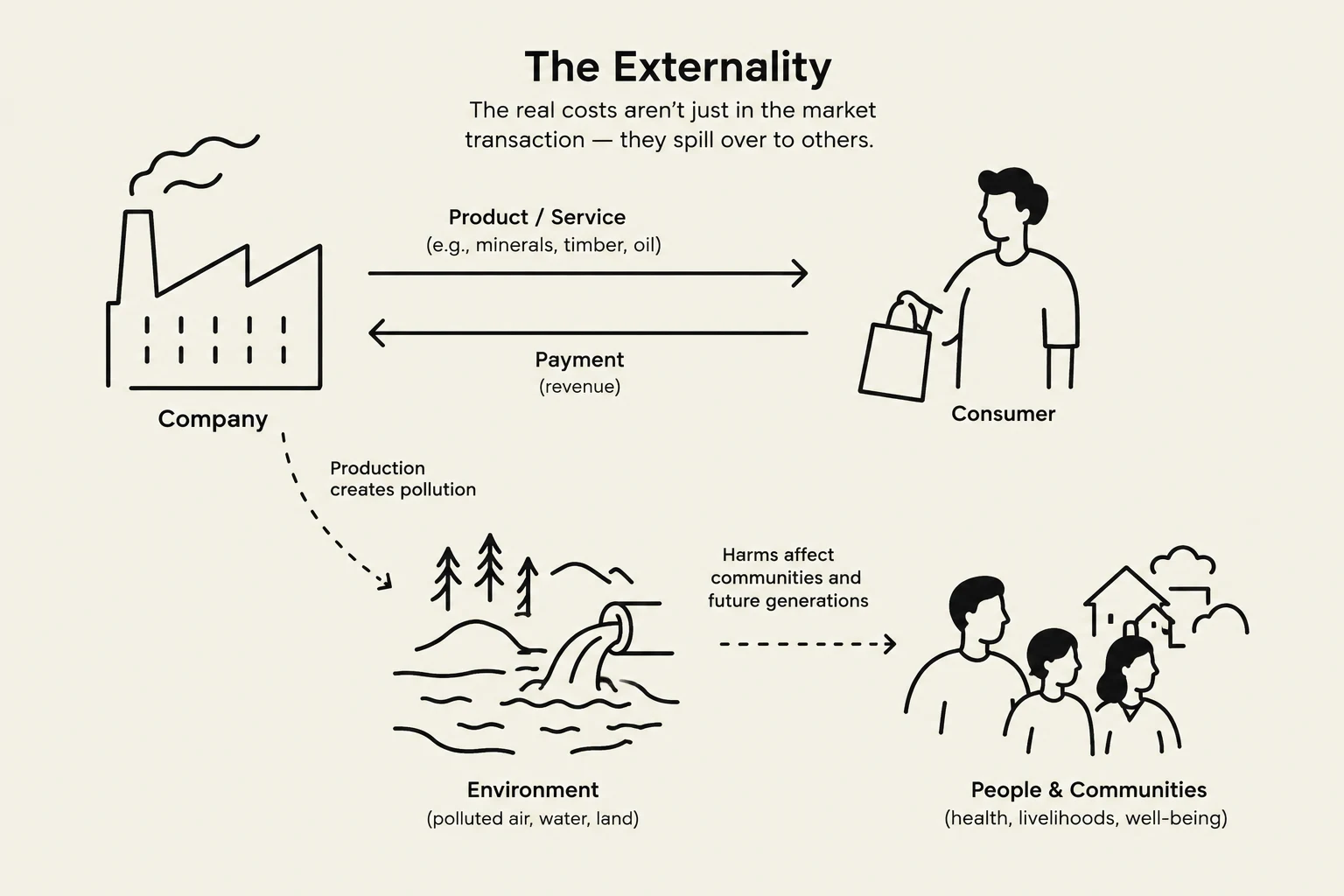
This mathematical approach often fails to account for "externalities"—the environmental or social costs (like water pollution or loss of biodiversity) that are not captured in the immediate transaction price.
This diagram illustrates the concept of externalities in economics, showing how a company's production can negatively impact the environment and communities, with costs not reflected in the market transaction between the company and consumer.
The Scale of Extraction: Local vs. Global
Extractive economies often create a profound disconnect between the site of extraction and the site of consumption. This is frequently characterized by a "center-periphery" relationship:
The Periphery (Extraction Sites): Often located in rural, remote, or developing regions. These areas experience the direct environmental degradation and social upheaval caused by extraction.
The Center (Consumption Sites): Often urbanized, wealthy hubs where the processed commodities are used to fuel industry, technology, and lifestyle.
This spatial separation allows the consumers in the "center" to remain largely insulated from the ecological consequences of the extraction process. The commodity arrives in a clean, packaged form, masking the scarred landscapes and depleted aquifers from which it originated.
Critiques and Alternatives
The primary critique of the extractive model is its inherent unsustainability. Because it treats nature as a collection of finite commodities to be "taken," it often ignores the regenerative capacities of biological systems. Once a non-renewable resource (like oil) is extracted, it is gone; even with renewable resources (like timber), the rate of extraction often exceeds the rate of natural regrowth.
Scholars in environmental studies often propose alternative models, such as:
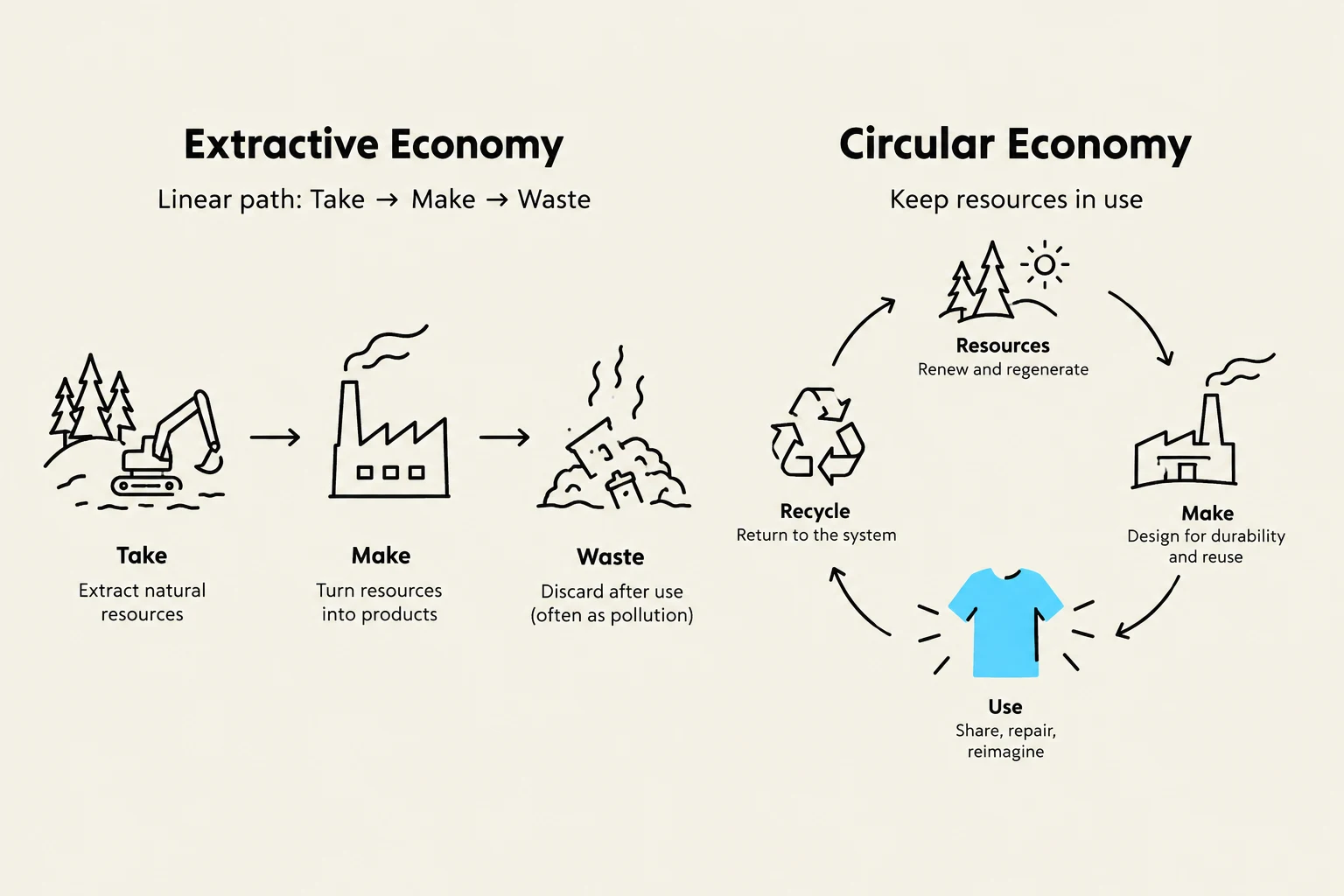
Circular Economies: Models designed to minimize waste by keeping materials in use for as long as possible through recycling and repurposing.
Regenerative Models: Systems that aim to improve the health of the ecosystem through human activity, rather than merely depleting it.
Commons-Based Management: Systems where resources are managed collectively by communities rather than being privatized for individual profit.
Comparison of extractive and circular economies, illustrating linear versus cyclical resource management.
Study Summary: To master this topic, ensure you can explain how the transition from "ecosystem" to "commodity" changes the way humans interact with the physical world. Focus on the roles of property rights, market value, and the spatial gap between extraction and consumption.
Keep reading for free.
Create an account to finish this reading and make it part of your study routine.