Understanding Externalities and Market Failure in Economics
This content explains externalities, which are side effects of economic transactions that impact bystanders. It details how negative and positive externalities lead to market failure, causing overproduction or underproduction relative to the socially optimal quantity. The text also explores various solutions to interna
In an ideal market, the forces of supply and demand lead to efficient outcomes where the interests of buyers and sellers align with the best interests of society. However, real-world markets often encounter "side effects" that impact people who are not part of the transaction. These side effects are known as externalities. When these externalities exist, the market fails to reach an efficient outcome, leading to a state known as market failure.
Understanding Externalities
An externality occurs when a decision made by a buyer or seller affects a bystander whose interests are ignored or underweighted in the decision-making process. There are two primary types:
Negative Externalities
A negative externality is a side effect that harms bystanders. Because the person performing the action does not pay for the harm caused, they tend to do more of that activity than is socially desirable. For example, burning fossil fuels creates pollution that affects the health of the entire community.
Positive Externalities
A positive externality is a side effect that benefits bystanders. Because the person performing the action does not receive full compensation for the benefits they provide to others, they tend to do less of that activity than is socially desirable. A classic example is receiving a vaccine; while you benefit from protection, your neighbors also benefit because you are less likely to spread the disease to them.
The Economics of Marginal Costs and Benefits
To understand why externalities cause market failure, we must distinguish between private interests and social interests.
Negative Externalities: The Cost Gap
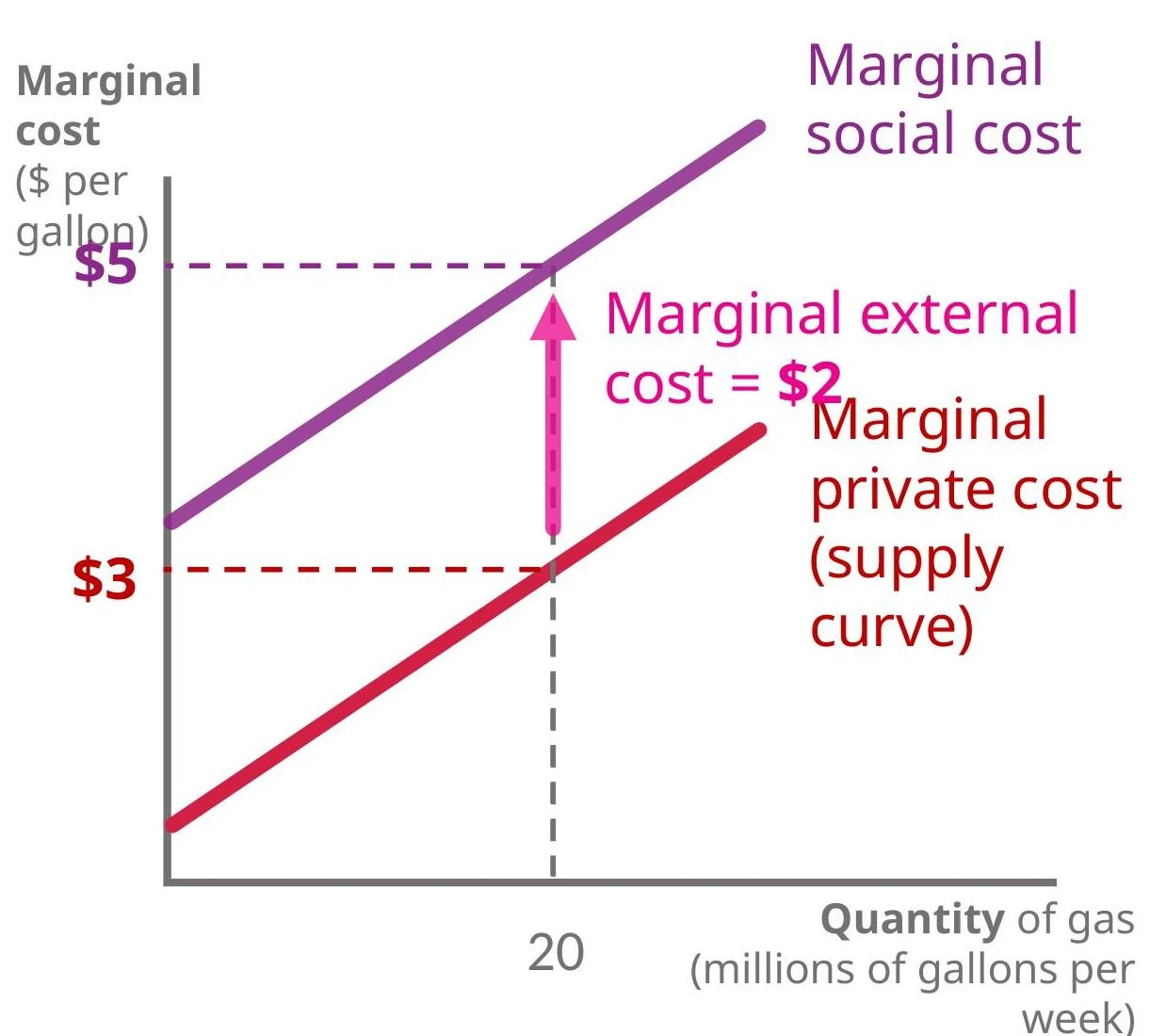
When a firm produces a good, it considers its Marginal Private Cost (MPC)—the extra cost paid by the seller to produce one more unit. However, if production causes pollution, there is also a Marginal External Cost (MEC)—the extra cost imposed on bystanders.
The Marginal Social Cost (MSC) is the total cost to society, calculated as:
MSC=MPC+MEC
This graph illustrates the concept of marginal cost in economics, showing the marginal private cost (supply curve) and the marginal social cost, with the difference representing the marginal external cost.
In a market with a negative externality, the equilibrium quantity is determined by where supply (MPC) meets demand. Because the producer ignores the MEC, the market results in overproduction.
Positive Externalities: The Benefit Gap
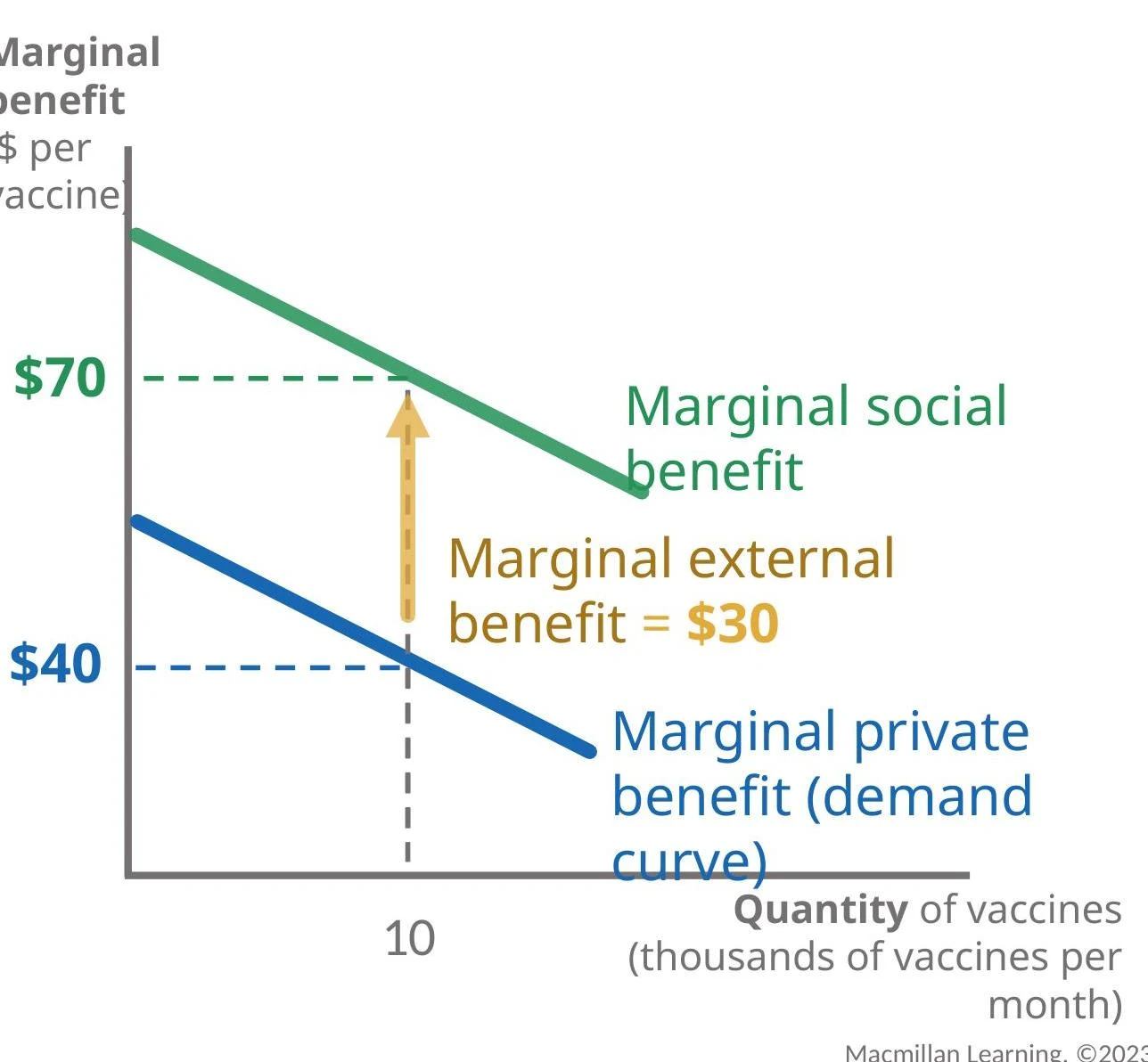
Similarly, for positive externalities, we look at benefits. The Marginal Private Benefit (MPB) is the extra enjoyment a buyer gets from a unit. The Marginal External Benefit (MEB) is the extra benefit enjoyed by bystanders.
The Marginal Social Benefit (MSB) is the total benefit to society:
MSB=MPB+MEB
This graph illustrates the concept of marginal social benefit, which is the sum of marginal private benefit and marginal external benefit. The graph shows that the marginal social benefit is higher than the marginal private benefit, indicating a positive externality.
Because buyers only consider their MPB, they will purchase less of the good than is socially optimal, leading to underproduction.
Exam Tip: To find the socially optimal quantity, always look for the point where the "social" curves intersect: where Marginal Social Benefit = Marginal Social Cost.
Solutions to Externality Problems
The goal of solving an externality is to internalize the externality—essentially forcing people to take account of the effects of their actions on bystanders.
1. Private Bargaining and the Coase Theorem
The Coase Theorem suggests that if bargaining is costless and property rights are clearly defined, private parties can negotiate to reach a socially optimal outcome without government intervention.
This often involves side payments:
To reduce a negative externality: You might pay a neighbor to stop playing loud music.
To increase a positive externality: An insurance company might pay you (a side payment) to exercise, because your health reduces their costs.
However, private bargaining is difficult when there are too many parties involved, such as in the case of global climate change.
2. Corrective Taxes and Subsidies
When private bargaining fails, governments can use market-based tools:
Corrective Taxes: To fix a negative externality, the government sets a tax equal to the Marginal External Cost. This makes the producer "feel" the cost of the pollution, shifting production toward the socially optimal level.
Corrective Subsidies: To fix a positive externality, the government provides a subsidy equal to the Marginal External Benefit. Examples include Pell Grants for education or gift cards for vaccinations.
3. Cap and Trade
For negative externalities like pollution, governments can implement a quantity cap (a limit on total emissions) and then issue permits. This is known as Cap and Trade.
In this system, firms that can reduce pollution cheaply will do so and sell their extra permits to firms that find it more expensive to reduce pollution. This ensures that pollution reduction happens where it is most efficient.
4. Laws, Rules, and Regulations
The most direct approach is through command-and-control methods. Governments can pass laws to prohibit or limit certain behaviors, such as noise restrictions, speeding laws, or fuel efficiency regulations for automakers.
Special Cases: Nonexcludable Goods
Externalities are particularly problematic when goods are nonexcludable (meaning you cannot easily prevent people from using them).
Public Goods (Nonrival & Nonexcludable): Because people can enjoy the benefits without paying (the free-rider problem), the market tends to underproduce these goods. Governments often solve this by providing the goods directly using tax revenue, such as national defense or public education.
Common Resources (Rival & Nonexcludable): These lead to the Tragedy of the Commons, where individuals overconsume a resource (like fish in the ocean) because they reap the private benefits but share the costs with everyone else. A common solution is to assign ownership rights, giving someone an incentive to manage the resource sustainably.
Keep reading for free.
Create an account to finish this reading and make it part of your study routine.