Understanding Externalities and Market Failure in Economics
This content explains externalities, a key concept in economics, detailing how they arise from activities affecting bystanders and lead to market failure. It covers negative and positive externalities, their impact on production and consumption, and various solutions including private bargaining, government interventio
In a perfect market, the decisions made by buyers and sellers reflect the true costs and benefits of their actions. However, real-world markets often face a phenomenon known as an externality: a side effect of an activity that affects bystanders whose interests are not taken into account. Because these bystanders are ignored in the decision-making process, the market fails to reach an efficient outcome, leading to what economists call market failure.
Understanding the Mechanics of Externalities
To understand why markets fail, we must distinguish between private interests and social interests. Private interests consist of the costs and benefits personally incurred by the decision-maker. In contrast, society's interest includes all costs and benefits, whether they fall on the individual or on bystanders.
Negative Externalities
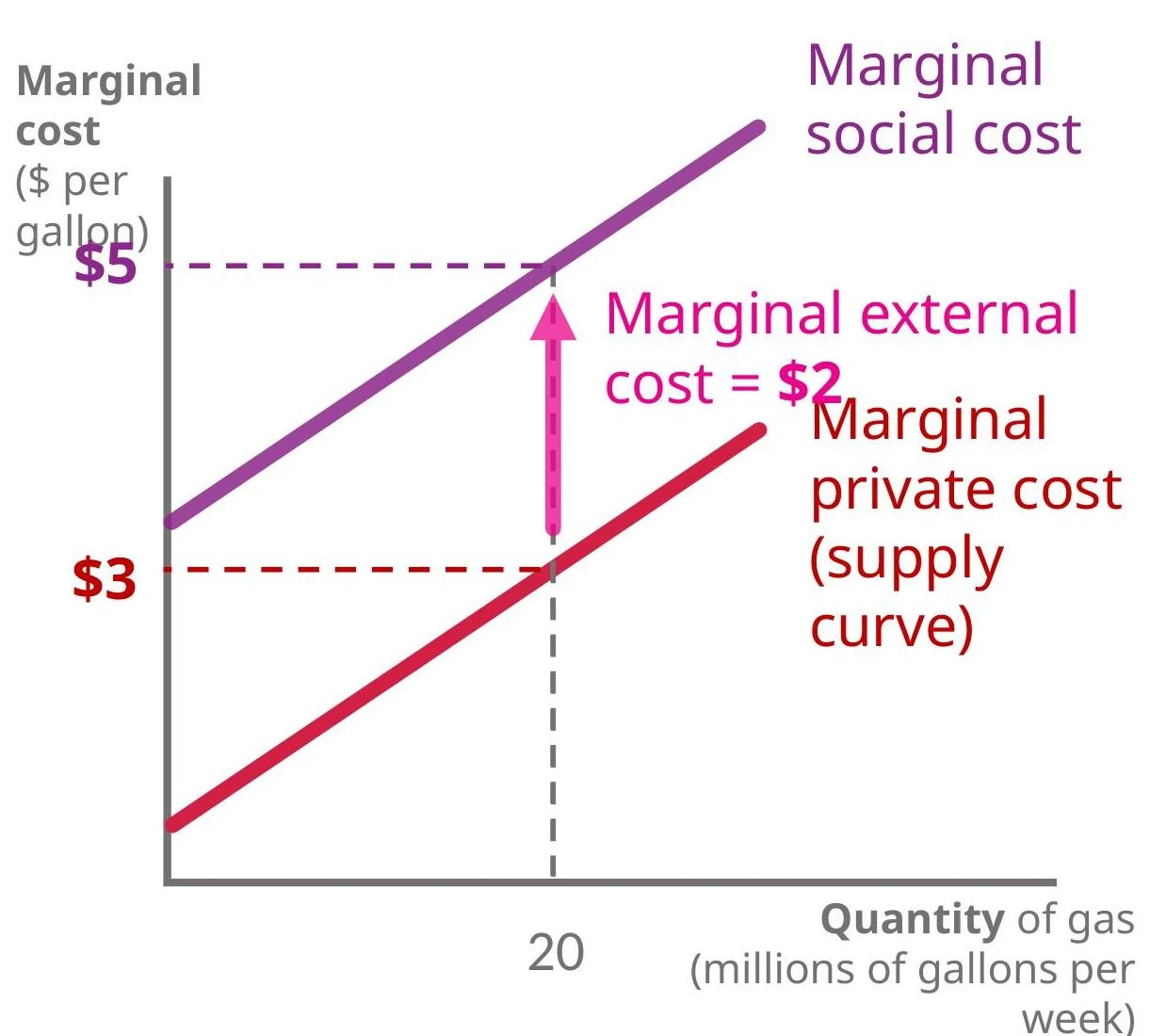
A negative externality occurs when a choice imposes a cost on others. For example, burning fossil fuels creates pollution that affects everyone's well-being. To analyze this, we use three specific terms:
Marginal Private Cost (MPC): The extra cost paid by the seller to produce one more unit.
Marginal External Cost (MEC): The extra cost imposed on bystanders from producing that extra unit.
Marginal Social Cost (MSC): The total cost to society, calculated as:
MSC=MPC+MEC
This graph illustrates the concept of marginal cost in economics, showing the marginal private cost (supply curve) and the marginal social cost, with the difference representing the marginal external cost.
Positive Externalities
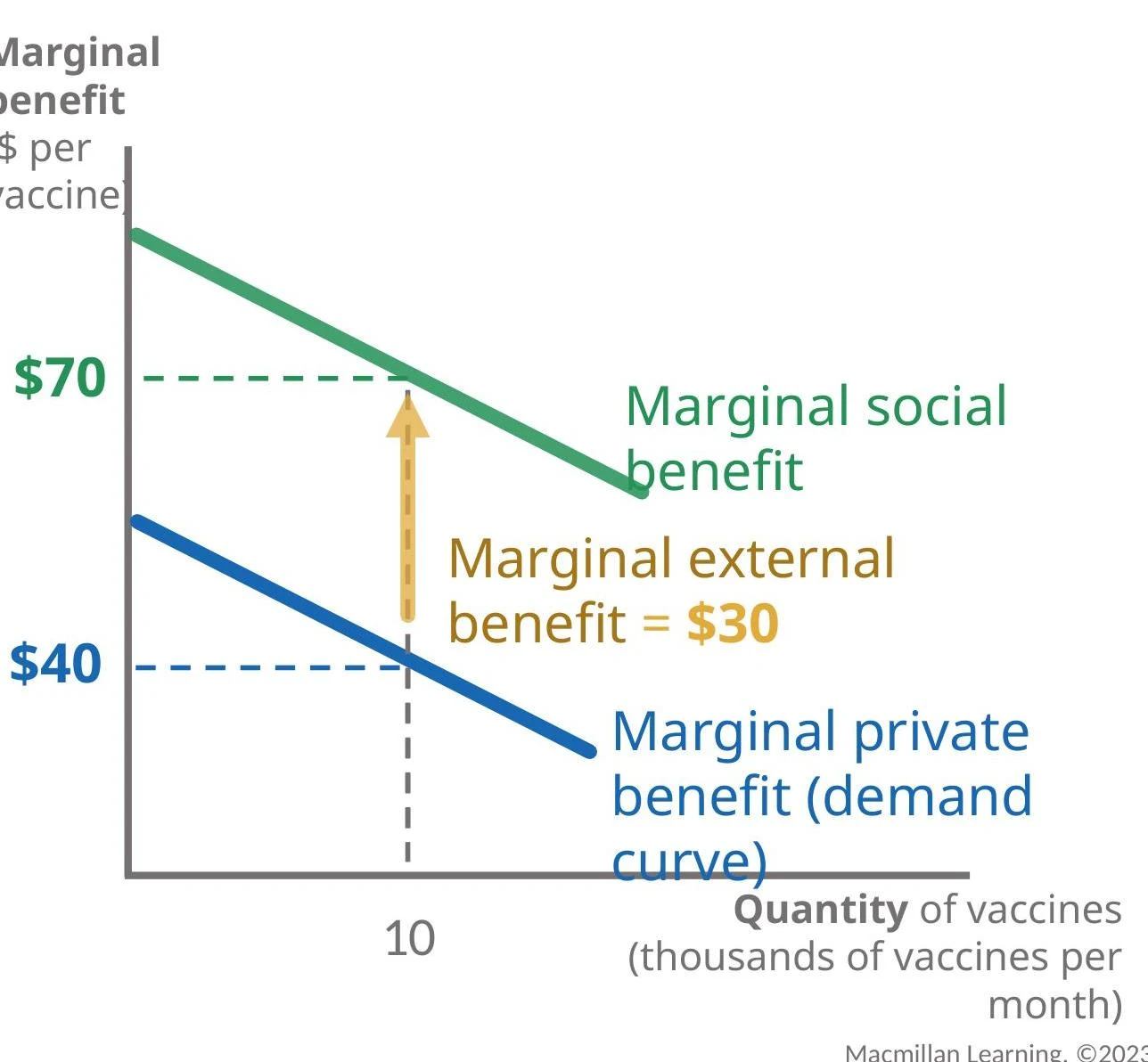
A positive externality occurs when a choice generates a benefit for others. For instance, when you get a vaccine, you protect yourself, but you also reduce the risk of spreading the virus to your community. We analyze these using:
Marginal Private Benefit (MPB): The extra enjoyment or value received by the buyer.
Marginal External Benefit (MEB): The extra benefit accruing to bystanders.
Marginal Social Benefit (MSB): The total benefit to society, calculated as:
MSB=MPB+MEB
This graph illustrates the concept of marginal social benefit, which is the sum of marginal private benefit and marginal external benefit. The graph shows that the marginal social benefit is higher than the marginal private benefit, indicating a positive externality.
Market Failure: Overproduction vs. Underproduction
The core problem of externalities is that they create a "wedge" between private decisions and social welfare.
Negative Externalities lead to Overproduction. Because sellers do not have to pay the marginal external cost (like pollution), they produce more than is socially optimal. In the market for gasoline, the equilibrium quantity is higher than the socially optimal quantity—the level where MSB=MSC.
Positive Externalities lead to Underproduction. Because buyers do not receive the marginal external benefit (like the community health benefit of a vaccine), they consume less than is socially optimal. People do "too little" of these beneficial activities because they ignore the value they provide to others.
Exam Tip: To find the socially optimal quantity, always look for the point where the "social" curves intersect (MSB=MSC), rather than where the private supply and demand curves meet.
Solutions to Externality Problems
The goal of any solution is to internalize the externality, ensuring that people take the effects of their actions on bystanders into account.
1. Private Bargaining (The Coase Theorem)
If bargaining is costless and property rights are clearly defined, private parties can negotiate to reach the socially optimal outcome. This can involve "side payments." For example, a neighbor might pay you to turn down loud music, or a health insurer might pay you to exercise. However, this is difficult for large-scale problems like climate change.
2. Corrective Taxes and Subsidies
When private bargaining fails, the government can intervene:
Corrective Taxes: To fix a negative externality, the government can set a tax equal to the MEC. This forces the producer to "feel" the full cost of their actions.
Corrective Subsidies: To fix a positive externality, the government can provide a subsidy equal to the MEB. Examples include Pell Grants for education or incentives for vaccinations.
3. Cap and Trade
For negative externalities like pollution, the government can implement a cap (a limit on the total quantity allowed) and allow firms to trade permits. This allows efficient firms to buy permits from less efficient ones, concentrating production among those with cleaner technology.
4. Laws, Rules, and Regulations
Governments often use direct mandates, such as noise restrictions, speeding laws, or fuel efficiency regulations, to limit harmful behaviors.
Nonexcludable Goods: Public Goods and Common Resources
Externalities are particularly problematic when goods are nonexcludable (meaning you cannot easily prevent people from using them).
Public Goods and the Free-Rider Problem
Public goods are both nonexcludable and nonrival (one person's use doesn't diminish another's), such as national defense or public broadcasting. Because people can enjoy these benefits without paying, they become "free riders". This leads to underproduction because private businesses cannot capture the value of the good. The solution is often direct government provision using tax money.
Common Resources and the Tragedy of the Commons
Common resources are nonexcludable but rival (one person's use does reduce what is available to others), such as fish in the ocean or public highways. This leads to the Tragedy of the Commons: the tendency for individuals to overconsume a resource because they reap the private benefits while the costs are shared by everyone. A common solution is to assign ownership rights, giving an owner an incentive to manage the resource sustainably.
Keep reading for free.
Create an account to finish this reading and make it part of your study routine.