Understanding Explicit Memory: Episodic and Semantic Recall
This content explains explicit memory, also known as declarative memory, which involves the conscious recollection of factual information and past experiences. It details the two main types: episodic memory (personal events) and semantic memory (general knowledge), and discusses their characteristics, distinctions, and
Have you ever wondered how you can vividly remember the smell of rain during a summer vacation from five years ago, or how you simply know that Paris is the capital of France? These two types of memories feel different, yet they belong to the same cognitive family. This family is known as explicit memory.
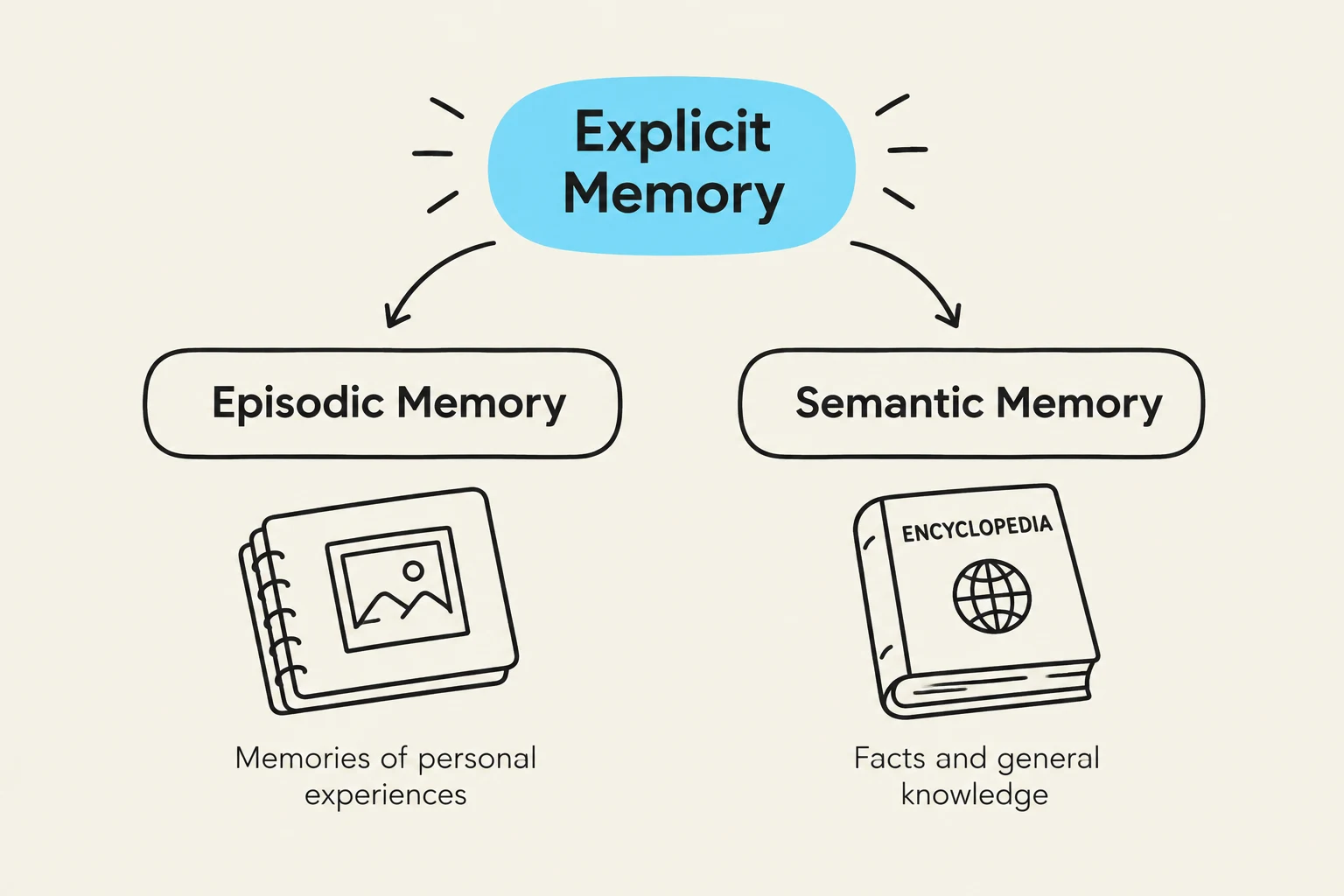
This diagram illustrates the two main types of explicit memory: episodic memory, which relates to personal experiences, and semantic memory, which pertains to facts and general knowledge.
Explicit memory, also referred to as declarative memory, is the system responsible for the conscious, intentional recollection of factual information, previous experiences, and concepts. Unlike implicit memory, which operates "under the hood" to influence our behavior without us realizing it, explicit memory requires active mental effort to retrieve.
Defining Explicit Memory
At its core, explicit memory is defined by its accessibility to our conscious awareness. When you are asked a question and you "search" your mind for the answer, you are engaging your explicit memory systems.
Psychologists generally divide explicit memory into two distinct categories: episodic memory and semantic memory. While they work together to build our understanding of the world, they serve very different purposes.
Exam Tip: If a question asks about "declarative memory," it is synonymous with "explicit memory." If it asks about "non-declarative memory," it is referring to implicit memory.
Episodic Memory: The Mental Time Machine
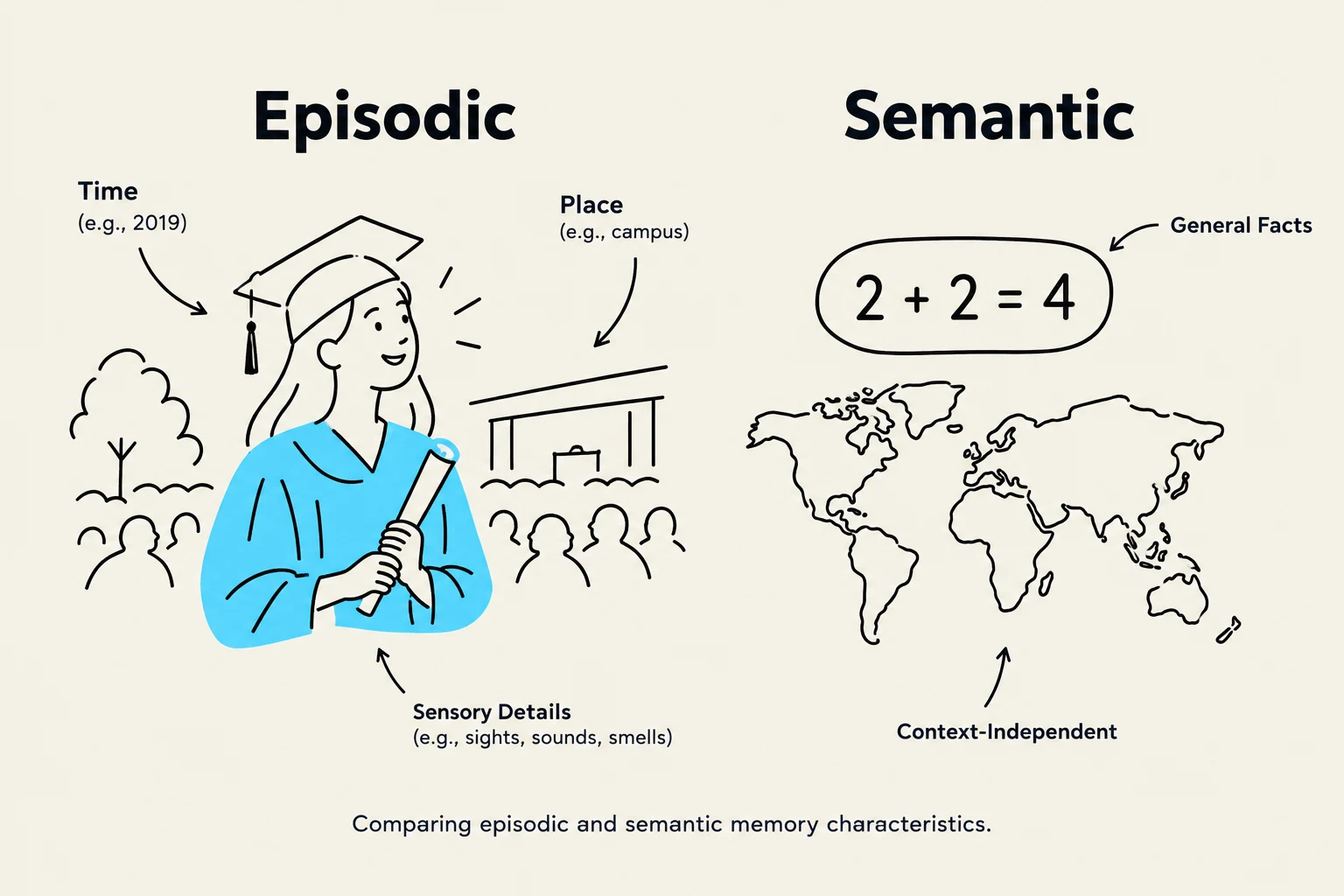
Episodic memory is your personal history. It is the ability to recall specific events or "episodes" that occurred at a particular time and place. These memories are often rich in sensory detail and are tied to a sense of "self."
Characteristics of Episodic Memory:
Contextual: It includes the where and when of an event.
Autobiographical: It forms the narrative of your life.
Sensory-rich: You might remember the specific song playing in the background or the temperature of the room during a significant moment.
Worked Example:
Imagine you are thinking about your high school graduation. You don't just remember that you graduated; you remember the feeling of the heavy gown, the sound of the principal's voice, and the specific person you sat next to in the front row. This reconstruction of a specific moment in time is a classic use of episodic memory.
Semantic Memory: The Library of Facts
While episodic memory is about experiences, semantic memory is about knowledge. Semantic memory is your internal encyclopedia—it contains the facts, concepts, meanings, and language rules that you have acquired throughout your life.
Characteristics of Semantic Memory:
Context-independent: You know that 2+2=4 regardless of whether you are sitting in a classroom or lying in bed; the fact exists independently of the moment you learned it.
General Knowledge: It includes vocabulary, mathematical rules, and social norms.
Less Personal: It focuses on the "what" rather than the "when" or "how it felt."
Worked Example:
If someone asks you, "What is the capital of Japan?", you will likely answer "Tokyo" almost instantly. You do not need to remember the specific moment in a geography class when you learned this fact; you simply possess the knowledge. This is semantic memory in action.
Comparing Episodic and Semantic Memory
This illustration compares episodic memory, which is context-dependent and includes personal experiences with time, place, and sensory details, to semantic memory, which consists of general facts and is context-independent.
To master this topic, it is helpful to see how these two systems interact and where they diverge.
Feature
Episodic Memory
Semantic Memory
Primary Focus
Personal experiences/events
General facts and knowledge
Awareness of Context
High (Time and Place)
Low (Context-free)
Subjectivity
Highly subjective/personal
Objective/factual
Example
Remembering your first day of college
Knowing that college is a level of education
Key Distinction: A common way to distinguish them is to ask: "Do you remember when you learned this?" If the answer is central to the memory, it is likely episodic. If the memory is just the fact itself, it is semantic.
The Role of the Brain
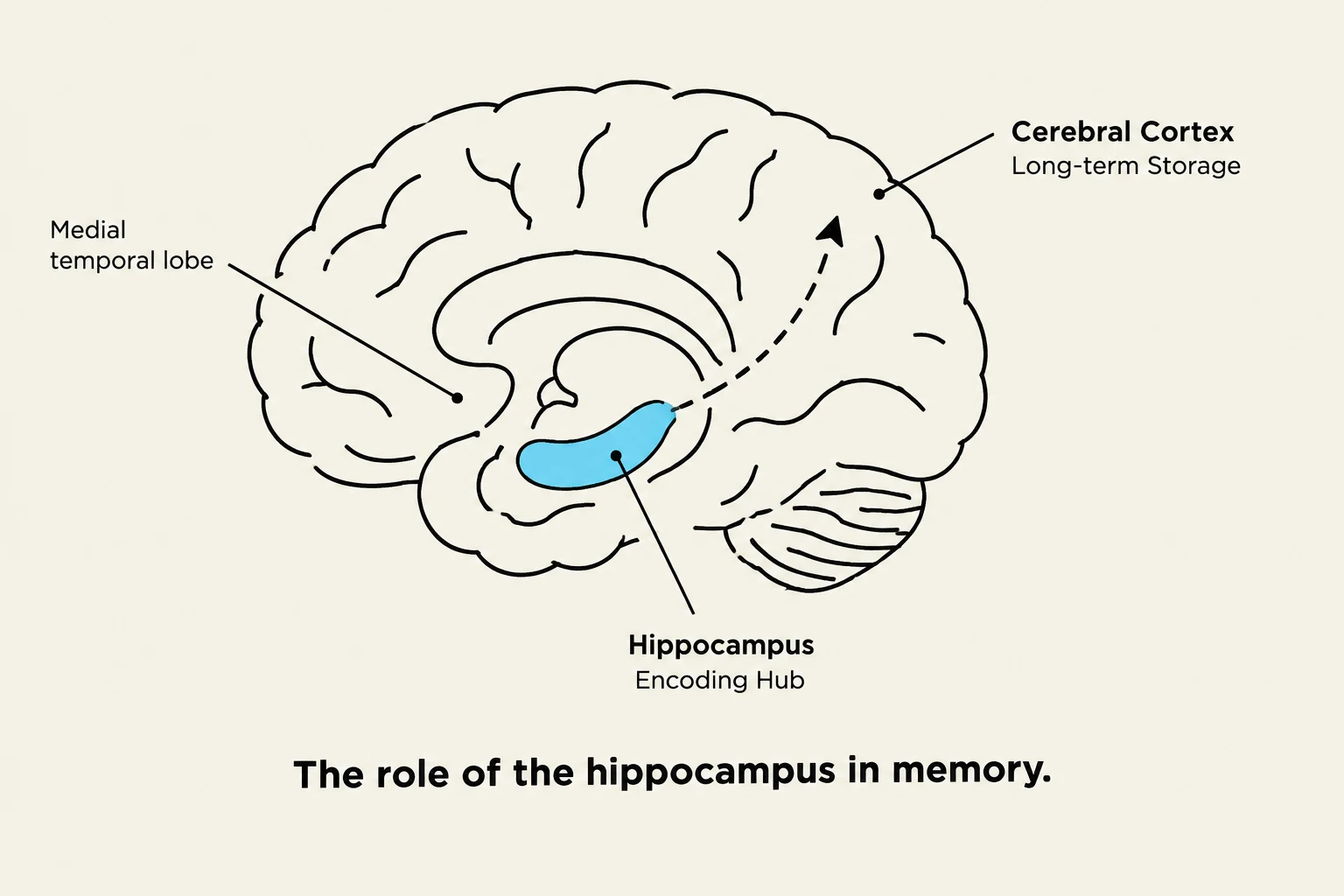
Diagram illustrating the role of the hippocampus in memory, highlighting its connection to the medial temporal lobe and cerebral cortex.
While the specific neural pathways are complex, explicit memory relies heavily on structures within the medial temporal lobe, most notably the hippocampus. The hippocampus acts as a critical hub for encoding new explicit memories and helping to organize them before they are eventually stored in various parts of the cerebral cortex for long-term retention.
Damage to these areas can lead to profound deficits. For instance, an individual might lose the ability to form new episodic memories (the ability to remember what they ate for breakfast) while still retaining their semantic knowledge (knowing that breakfast is a morning meal).
Summary
Explicit memory is our gateway to conscious thought and identity. Through episodic memory, we maintain a sense of our personal journey through time, and through semantic memory, we build a foundation of knowledge that allows us to navigate the world. Understanding the distinction between these two is fundamental to grasping how the human mind processes and stores the vast amount of information we encounter every day.
Keep reading for free.
Create an account to finish this reading and make it part of your study routine.