Understanding Executive Authority and Constitutional Conventions in Canada
An explanation of the Canadian executive branch, focusing on responsible government, constitutional conventions, sources of power, and limits on executive influence. It details the interplay between formal law, customary practice, and the royal prerogative.
In the Canadian legal system, the "Executive" is often referred to as "the government." While we frequently think of the Prime Minister or the Premier as the holders of power, the legal reality is more complex, involving a delicate balance between formal constitutional law, ancient royal traditions, and unwritten rules of practice. Understanding how the government exercises its authority requires looking beyond the written text of the Constitution Act, 1867 to the underlying principles of responsible government and the evolving nature of royal prerogative.
The Foundation: Responsible Government
The cornerstone of the Anglo-Canadian system is the principle of responsible government. This system ensures that the executive branch—the group of people who administer and implement the law—is not an independent entity acting with absolute whim, but is instead accountable to the elected representatives in the legislature.
Historically, this model emerged from Great Britain and was first adopted in the colony of Nova Scotia in 1848 before becoming the standard for Canada in 1867. Responsible government is characterized by three main features: a dual executive (the formal Crown and the political Cabinet), an elected office, and the application of constitutional conventions.
Exam Tip: Remember that "Responsible Government" does not mean the government is "responsible" in a moral sense, but rather that it is accountable to the legislature. If the executive loses the support of the legislature, it must resign.
This diagram illustrates the relationship between the Crown, the Executive (Cabinet), and the Legislature (Parliament) in a governmental system, outlining their respective roles and interactions.
Constitutional Conventions and Customary Practice
While the Constitution Act, 1867 provides the legal skeleton for the executive, the "flesh" of the system is provided by constitutional customary practice, also known as conventions. Conventions are unwritten rules that are not legally enforceable by courts but are considered binding by political actors.
These conventions modify how the written rules are applied in practice. For example, while the Constitution may grant certain powers to the Governor General, convention dictates that these powers are actually exercised by the Prime Minister and the Cabinet.
Key Conventions in Action
Several critical conventions maintain the stability of the Canadian state:
The Prime Minister and Cabinet: Conventions dictate how these leaders are chosen and how they manage the political and legislative agenda.
Ministerial Responsibility: This convention ensures that ministers are held accountable to Parliament for the actions of their departments.
The Confidence Convention: This is perhaps the most vital rule. It dictates that the government must maintain the "confidence" (the support) of the elected house. If a government loses a major vote (such as a budget), it is conventionally required to resign or call an election.
Sources of Executive Power
The executive does not draw its power from a single well; rather, it utilizes three distinct sources:
Constitutional Legislation: Primarily the Constitution Act, 1867, which outlines federal powers (ss. 9–16) and provincial powers (ss. 58–68).
Convention: The agreed-upon customary practices mentioned above.
Statutory and Common Law: Laws passed by Parliament (statutes) and rules developed by judges (common law).
Royal Prerogative vs. Statutory Authority
One of the most significant sources of executive power is the royal prerogative. This refers to the residual powers that belong to the Crown. Historically, the Crown held vast powers over legislation and adjudication, but much of this has transitioned into the hands of the federal and provincial Cabinets (acting as the "Governor in Council" or "Lieutenant Governors in Council").
However, there is a modern trend toward statutory authority. As society becomes more complex, Parliament passes specific laws (statutes) to authorize government actions that were once handled by prerogative power. For example, a Minister's specific duties are now often defined by a statute, such as the Department of Health Act, rather than by ancient royal decree.
This diagram illustrates the historical shift in power from Royal Prerogative, based on tradition and common law, to Statutory Authority, established by legislation and subject to parliamentary control. It shows the evolution from monarchical personal authority to a modern executive bound by law, with the growing role of Parliament and the enactment of statutes as key milestones.
Limits on Executive Influence
The executive branch is powerful, but it is not absolute. In the Anglo-Canadian system, the relationship between the executive and the legislature is a two-way street: if the executive holds a majority, it controls the legislature; however, if the executive loses that majority, the legislature gains control over the executive.
Beyond this political tug-of-war, there are two primary legal and structural limits on executive influence:
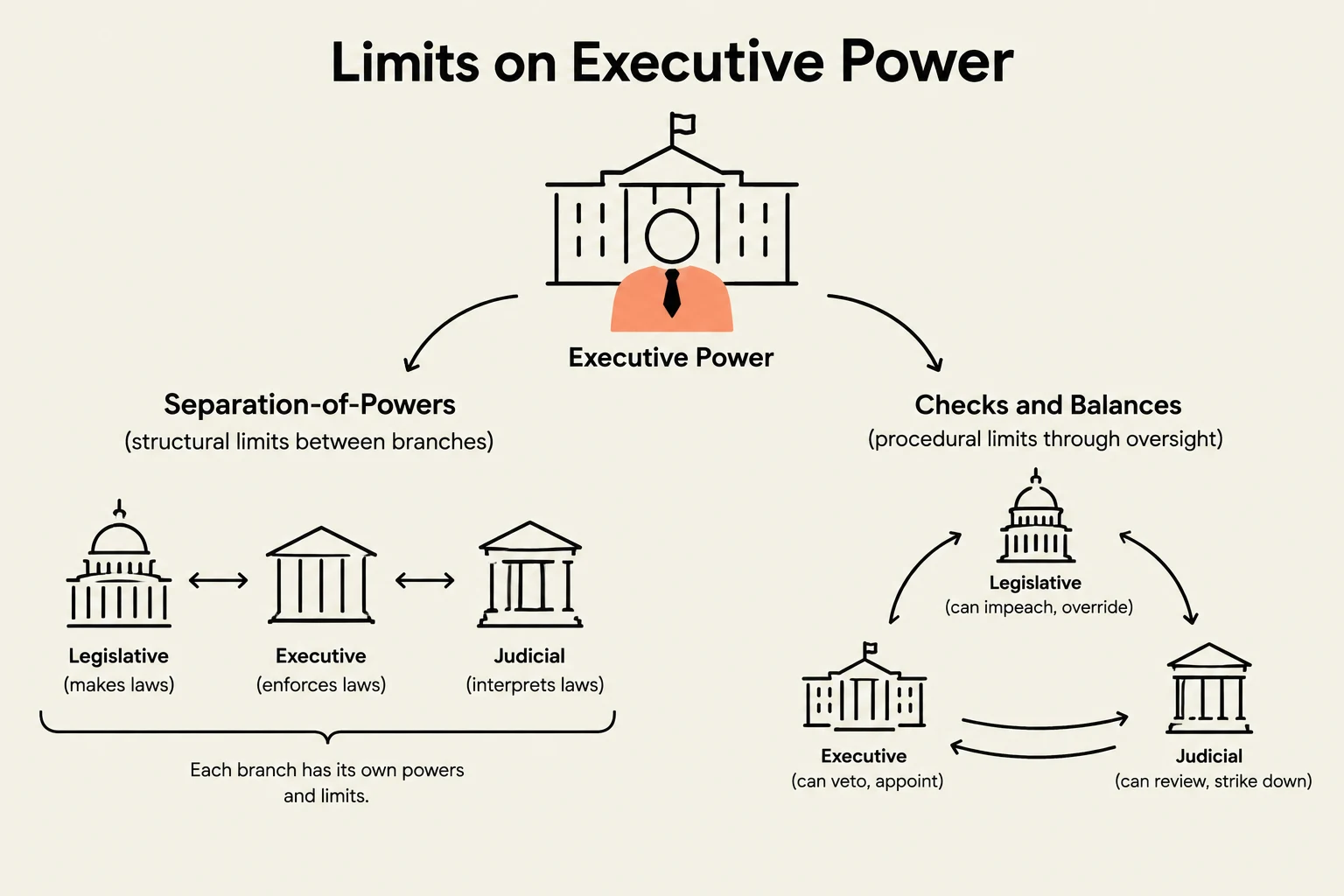
1. Separation-of-Powers Limits
The division of government into legislative, executive, and judicial branches prevents any single entity from exercising total control. This ensures that the people making the laws (Legislature), the people enforcing the laws (Executive), and the people interpreting the laws (Judiciary) remain distinct.
2. Civil Liberties Limits
The executive's power to implement policy is limited by the fundamental rights of citizens. The government cannot use its authority to infringe upon protected civil liberties.
Crown Immunity and Privilege
The Crown also enjoys certain unique legal protections that can act as limits on how individuals interact with the state:
Crown Privilege: This allows the government to withhold certain information from the courts to protect the public interest.
Presumption against legislation applying to the Crown: There is a legal assumption that a new law does not apply to the Crown unless the statute explicitly says so.
Crown Immunity: In certain civil cases, the Crown may be protected from being sued.
This diagram illustrates the concepts of Separation-of-Powers and Checks and Balances within a government, detailing the roles and limitations of the Legislative, Executive, and Judicial branches.
Summary Table: Sources of Power
Source
Description
Example
Constitution
Written legal framework
Constitution Act, 1867
Convention
Unwritten customary practice
Confidence Convention
Statute
Laws passed by Parliament
Department of Health Act
Prerogative
Residual Crown powers
Royal Proclamations
By balancing these sources of power against the limits of the law and the conventions of responsible government, the Canadian system attempts to ensure that while the government is strong enough to lead, it remains fundamentally accountable to the people and the law.
Keep reading for free.
Create an account to finish this reading and make it part of your study routine.