Evidence, Uncertainty, and Research Paradigms in Public Health
This content explores the fundamental concepts of evidence, uncertainty, and research paradigms within public health. It covers health indicators, the distinction between incidence and prevalence, social determinants of health, and the differences between equality and equity. The material also delves into various resea
In the field of public health, we are rarely presented with simple, black-and-white answers. Instead, we are tasked with interpreting complex patterns of disease, exposure, and social conditions to make decisions that protect entire populations. To do this effectively, practitioners must navigate the tension between what we know (evidence), what we don't know (uncertainty), and the theoretical lenses (paradigms) we use to view the world.
Measuring Health: Indicators and Status
To understand the health of a population, we cannot simply look at individual clinical diagnoses. We must use health indicators—measures that provide information about the health of a population or the factors that influence it. These indicators allow us to describe health status, monitor changes over time, and evaluate the effectiveness of public health interventions.
Indicators can be categorized by what they measure:
Health Status: The actual state of health (e.g., mortality rates, disease prevalence, or disability levels).
Determinants of Health: The factors that influence health, such as income, housing, or air quality.
Health System Performance: How well services are working (e.g., the percentage of scheduled inspections completed).
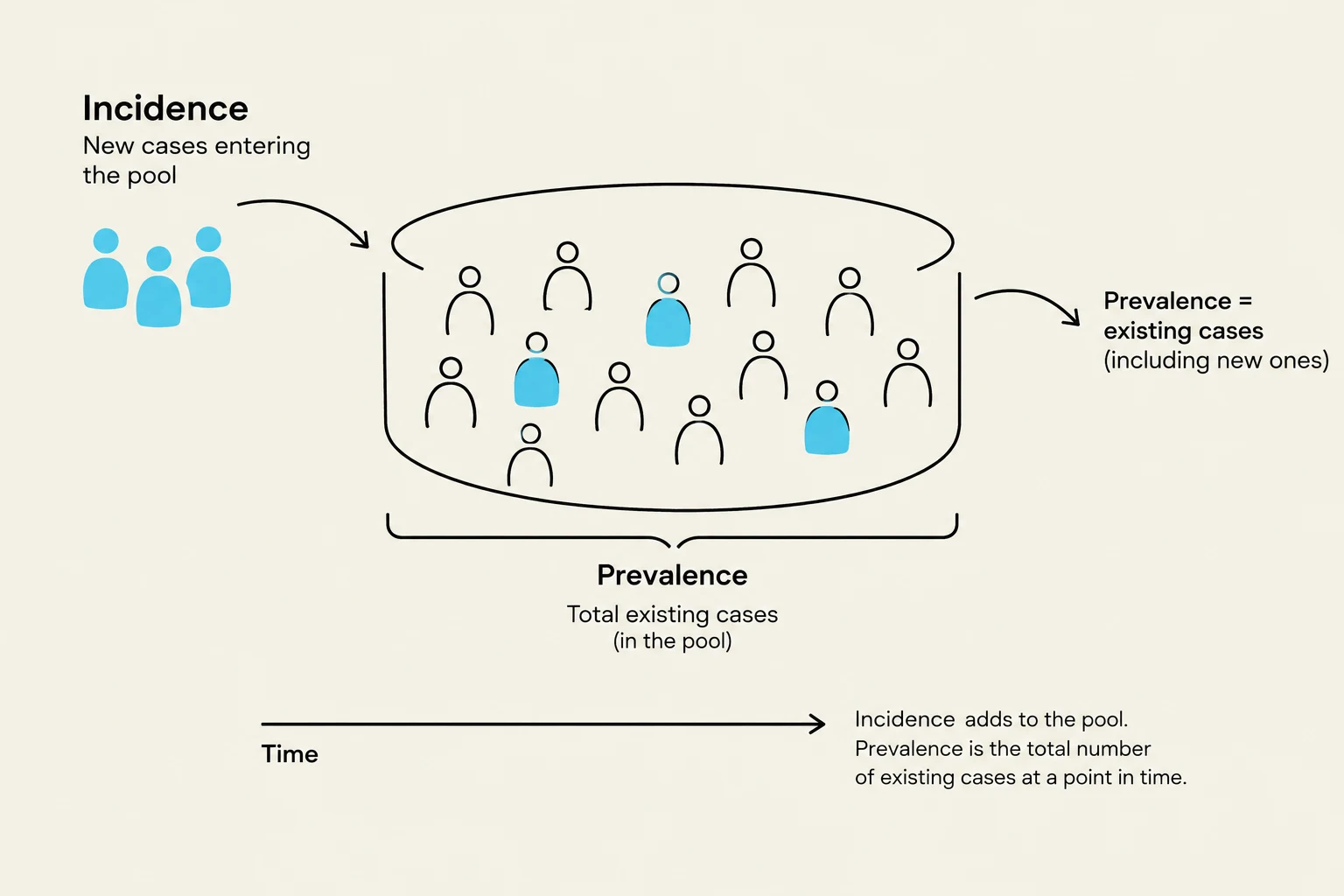
When interpreting these measures, it is crucial to distinguish between incidence and prevalence. Incidence refers to the number of new events occurring in a population over a specific period, whereas prevalence refers to the total proportion of a population living with a condition at a particular time (the "stock" of disease).
This diagram illustrates the concepts of incidence and prevalence in epidemiology. Incidence represents new cases entering a population pool, while prevalence denotes the total number of existing cases at a specific point in time. Incidence contributes to the overall prevalence.
Exam Tip: If a question asks about the "burden" of a disease or how much service capacity is needed for ongoing care, think prevalence. If it asks about the "risk" of contracting a new disease or the effectiveness of a prevention program, think incidence.
Navigating Evidence and Uncertainty
Public health data is rarely perfect. We often encounter conflicting evidence—for example, residents reporting respiratory symptoms near a factory while air monitors show pollutants are within legal limits. This does not mean the residents are wrong or that the data is useless; rather, it highlights the presence of uncertainty.
Uncertainty can arise from several sources:
Alternative Sources: Symptoms might be caused by something other than the suspected agent (e.g., drinking water or grocery store products).
Temporal Discrepancies: The timing of measurements might not align with when symptoms actually began.
Surveillance Bias: Changes in how we report or collect data can create the illusion of new trends where none exist.
Furthermore, we must be cautious not to confuse association with causation. Just because two things happen together (e.g., living near a highway and having asthma) does not mean one caused the other. To move toward a causal argument, we use frameworks like Hill’s Criteria, looking for a strong association, consistency across studies, a biological mechanism, and a clear temporal relationship (the exposure must happen before the outcome).
Equality, Equity, and the Social Determinants of Health
A central question in public health is: Why do some populations experience worse health than others? The answer often lies in the Social Determinants of Health (SDoH)—the non-medical factors, such as the conditions in which people are born, grow, live, work, and age.
Because these determinants are often distributed unevenly, we must distinguish between equality and equity:
Equality means providing everyone with the same resources or opportunities.
Equity means recognizing that people have different circumstances and providing the specific resources needed to achieve fair outcomes.
This illustration depicts the concept of equality, where everyone receives the same amount of support, contrasting it with equity, where support is adjusted based on individual needs.
Not every health difference is an inequity. A health inequity is a difference that is systematic, avoidable, and unfair. For example, while age-related health declines are biological, unequal access to clean water or hazardous working conditions are inequities. Environmental health practitioners apply an equity lens by asking who is disproportionately affected by a risk and who is least able to avoid it.
Research Paradigms: How We Create Knowledge
Our "worldview"—the lens through which we interpret the world—dictates what we consider to be "evidence" and what solutions we propose. In research, this is known as a paradigm. Consider how different researchers might approach the problem of low vaccination rates in a specific neighborhood:
Realism (Positivist): Assumes an objective reality exists. They would look for measurable, quantitative predictors of uptake, such as income levels or distance to clinics.
Interpretive/Relativism: Focuses on lived experience. They would ask how residents subjectively understand and feel about the vaccine.
Critical Research: Focuses on power and structure. They would examine how political decisions, systemic racism, or structural barriers prevent access.
Indigenous Research: Emphasizes Indigenous ways of knowing, focusing on community relationships, historical context, and knowledge shared across generations.
This diagram illustrates two approaches, Realist and Positivist, to understanding and addressing public health problems like homelessness, emphasizing data, context, mechanisms, and evidence-based solutions for better outcomes.
Summary Note: Understanding these paradigms is essential because the way we frame a problem determines the response. A biomedical lens might suggest a medical treatment, while a socioenvironmental lens might suggest a policy change to improve housing.
Keep reading for free.
Create an account to finish this reading and make it part of your study routine.