Understanding Equality and Discrimination in the U.S.
An overview of the historical and legal struggle for equality in the United States, exploring concepts of de jure and de facto discrimination, constitutional protections, legislative milestones, and persistent disparities.
The United States was founded on the profound proposition that "all men are created equal". However, the history of the nation is defined by a persistent tension between this high ideal and the reality of systemic inequality. The struggle for equality—defined as the right of every person to equal protection under the laws and equal access to society’s opportunities—is an ongoing process of navigating legal, social, and political barriers.
Understanding the Nature of Discrimination
To understand the fight for civil rights, one must distinguish between the different ways inequality manifests in society. Scholars and legal experts generally categorize discrimination into two distinct forms: de jure and de facto.
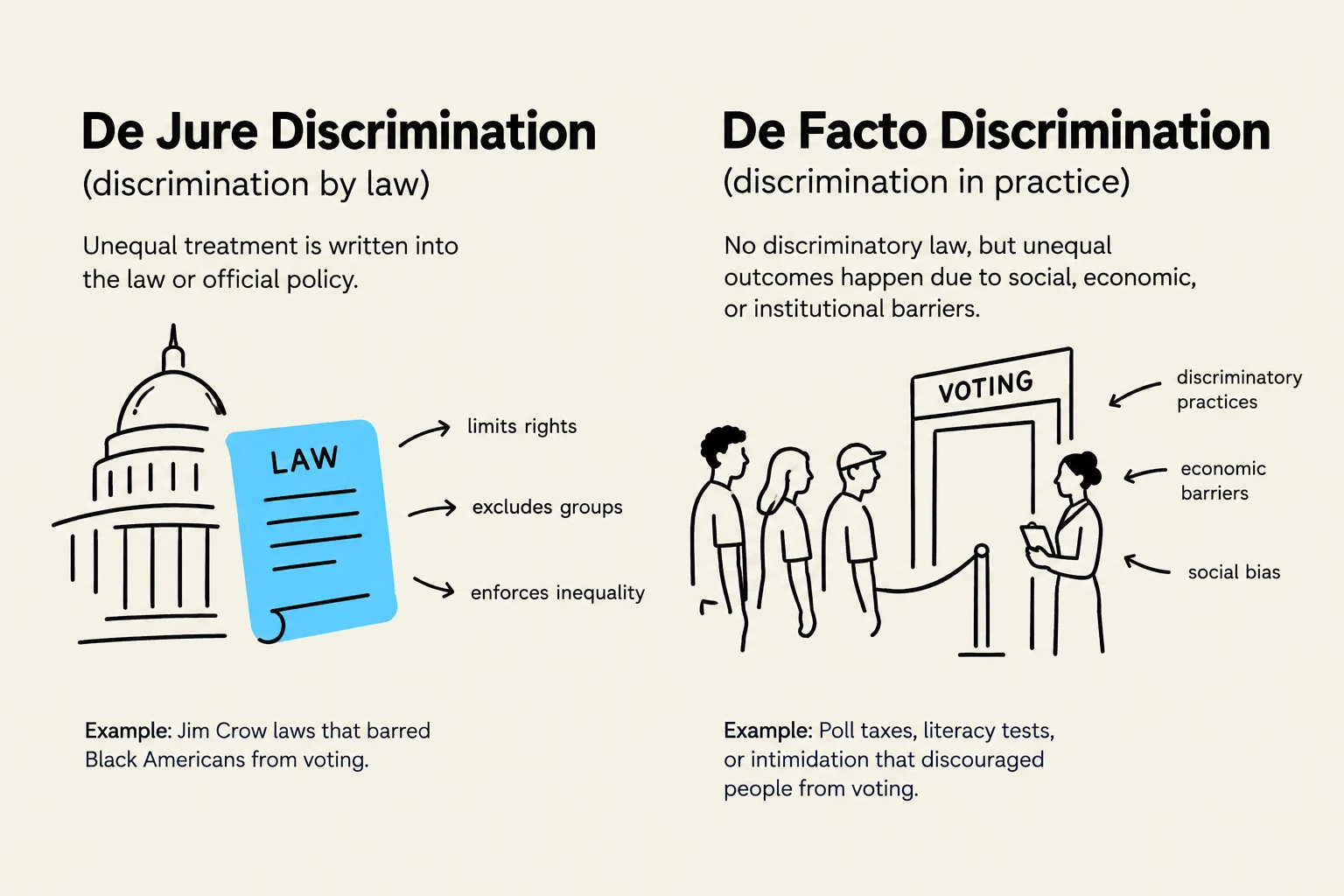
De jure discrimination refers to discrimination that is explicitly mandated or imposed by law. A historical example includes the era of Jim Crow laws or state-sanctioned segregation in schools.
De facto discrimination is more subtle; it describes a condition where historically disadvantaged groups have fewer opportunities and benefits due to social practices, prejudice, and financial constraints rather than direct legal mandates. Because de facto discrimination is embedded in social customs and economic structures, it is often much more difficult to eradicate than laws that can simply be repealed.
This illustration contrasts De Jure Discrimination (discrimination by law) with De Facto Discrimination (discrimination in practice), providing examples for each.
Study Tip: On exams, remember that de jure = "by law" and de facto = "in practice." Affirmative action policies were often designed to address de facto discrimination by aiming for "equality of result".
The Constitutional Framework for Equality
The primary legal engine for the pursuit of equality is the Fourteenth Amendment. This amendment provides two critical clauses that govern how the government treats its citizens:
The Equal-Protection Clause: This forbids states from denying any person "equal protection of the laws". It ensures that the government cannot treat similarly situated people differently without a valid reason.
The Due Process Clause: This ensures that the government must follow fair legal procedures before depriving an individual of life, liberty, or property.
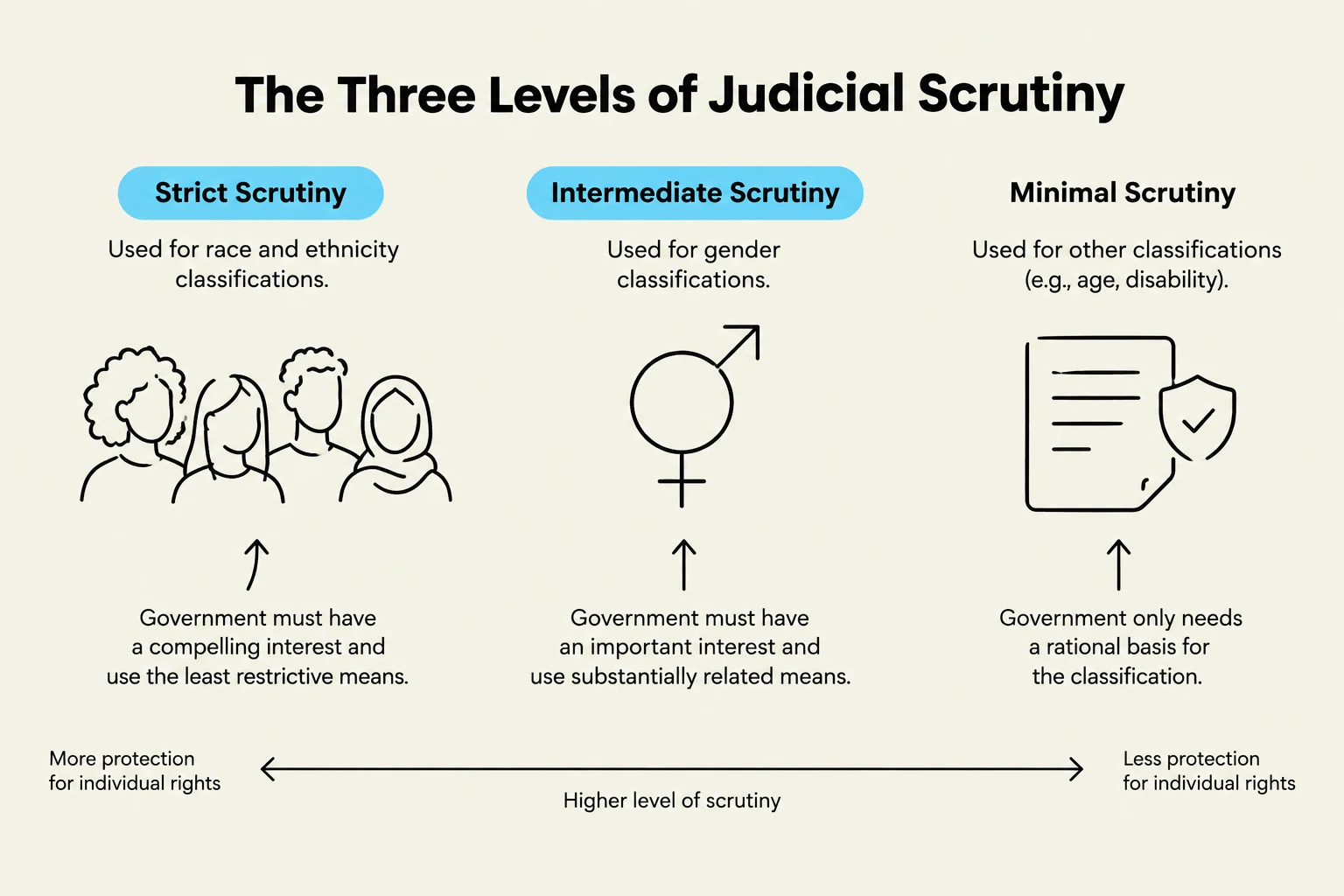
When courts evaluate whether a law violates the equal-protection clause, they apply different "levels of scrutiny" depending on the group being affected:
Strict Scrutiny: Applied to "suspect classifications" like race or national origin. The law is presumed unconstitutional unless the government can provide an overwhelming, compelling justification.
Intermediate Scrutiny: Applied to "almost suspect" categories like gender. The law must serve a clearly compelling and justified purpose.
Reasonable-Basis Test: Applied to other categories like age or income. The law is assumed constitutional unless no sound rationale can be provided.
This diagram illustrates the three levels of judicial scrutiny: strict scrutiny, intermediate scrutiny, and minimal scrutiny, along with their respective applications and requirements for government classifications.
Legislative Milestones and Voting Rights
Political movements have been essential in transforming constitutional ideals into enforceable rights. One of the most significant victories was the Voting Rights Act (VRA) of 1965.
Before the VRA, many Black Americans were effectively disenfranchised through rigged literacy tests, poll taxes, and whites-only primaries. The VRA prohibited such discrimination and empowered federal agents to oversee voter registration. The impact was immediate and dramatic. For instance, in Mississippi, Black voter registration rose from just 6% before the VRA in 1965 to 60% by 1967. However, the power of this act has faced challenges in recent years, including the 2013 Shelby County v. Holder decision which weakened certain provisions.
Expanding Rights: LGBTQ Community and Marriage Equality
The struggle for equality has also moved into the realm of social identity and personal liberty. The LGBTQ community has seen significant judicial progress in recent years. In 2020, the Supreme Court ruled that the protections against sex discrimination in the Civil Rights Act of 1964 also extend to sexual orientation, providing much-needed job protections.
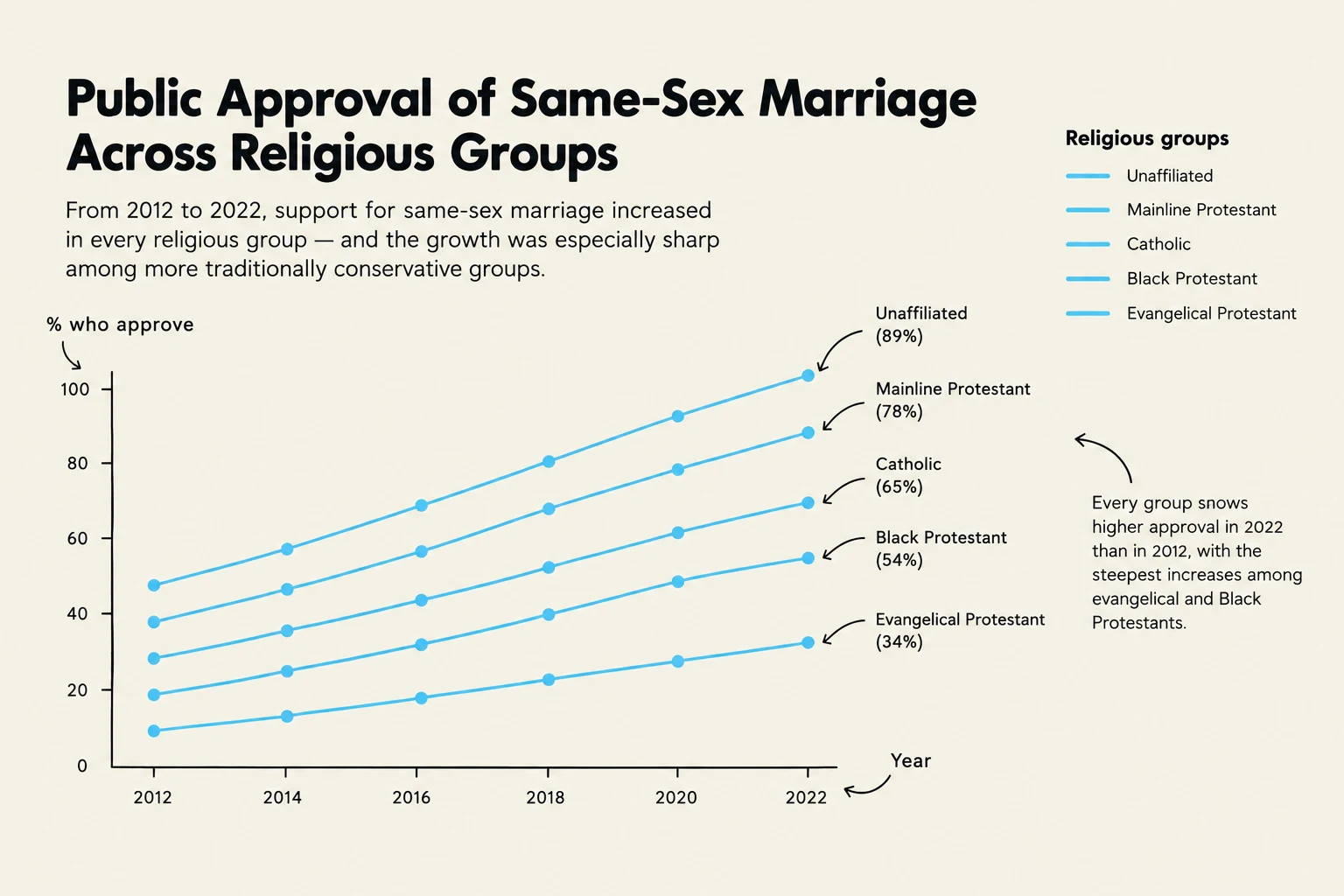
Furthermore, the nation has experienced a massive shift in public opinion regarding same-sex marriage. While Massachusetts became the first state to legalize same-sex marriage in 2004, the landmark Supreme Court case Obergefell v. Hodges (2015) eventually legalized marriage equality for all Americans.
This line graph illustrates the trend of public approval for same-sex marriage across various religious groups in the United States from 2012 to 2022. It shows an overall increase in approval for all groups, with the most significant growth observed among evangelical and Black Protestants.
Persistent Disparities: Poverty, Gender, and Demographics
Poverty rates in the United States are not distributed equally across racial or household lines. Data shows that Native Americans (23.1%) and Black Americans (19.5%) face significantly higher poverty levels than White Americans (8.2%). Additionally, "the feminization of poverty" describes the reality that female-headed households are disproportionately likely to live below the poverty line (23.4%) compared to two-parent households (4.7%).
Gender inequality also persists in political representation. While women have made strides—including the election of Kamala Harris as Vice President in 2020—they still hold less than one-third of congressional seats. In fact, the United States ranks below countries like Mexico, Canada, and several European democracies in terms of the percentage of women in national legislatures.
Changing Demographics
The demographic landscape of the U.S. is also shifting due to changing immigration patterns. In 1950, 78% of immigrants came from Europe and Canada. By 2020, that number plummeted to just 9%, as the majority of new arrivals originated from Latin America and Asia. This shift continues to reshape the cultural and political fabric of the nation.
Summary Table: Poverty by Group
Group
Poverty Rate (%)
Native American
23.1%
Black American
19.5%
Hispanic American
17.0%
White American
8.2%
Asian American
8.1%
(Source:)
Keep reading for free.
Create an account to finish this reading and make it part of your study routine.