Explore the fundamental concept of energy in chemistry, including its definition, types (potential and kinetic), units of measurement (calories and joules), and its role in chemical reactions.
In the study of chemistry, energy is a fundamental concept that governs how substances interact and transform. Whether we are looking at the combustion of fuel or the metabolic processes within our own cells, we are observing the movement and transformation of energy. This guide explores the nature of energy, how it is measured, and how it dictates the direction and speed of chemical reactions.
The Nature of Energy
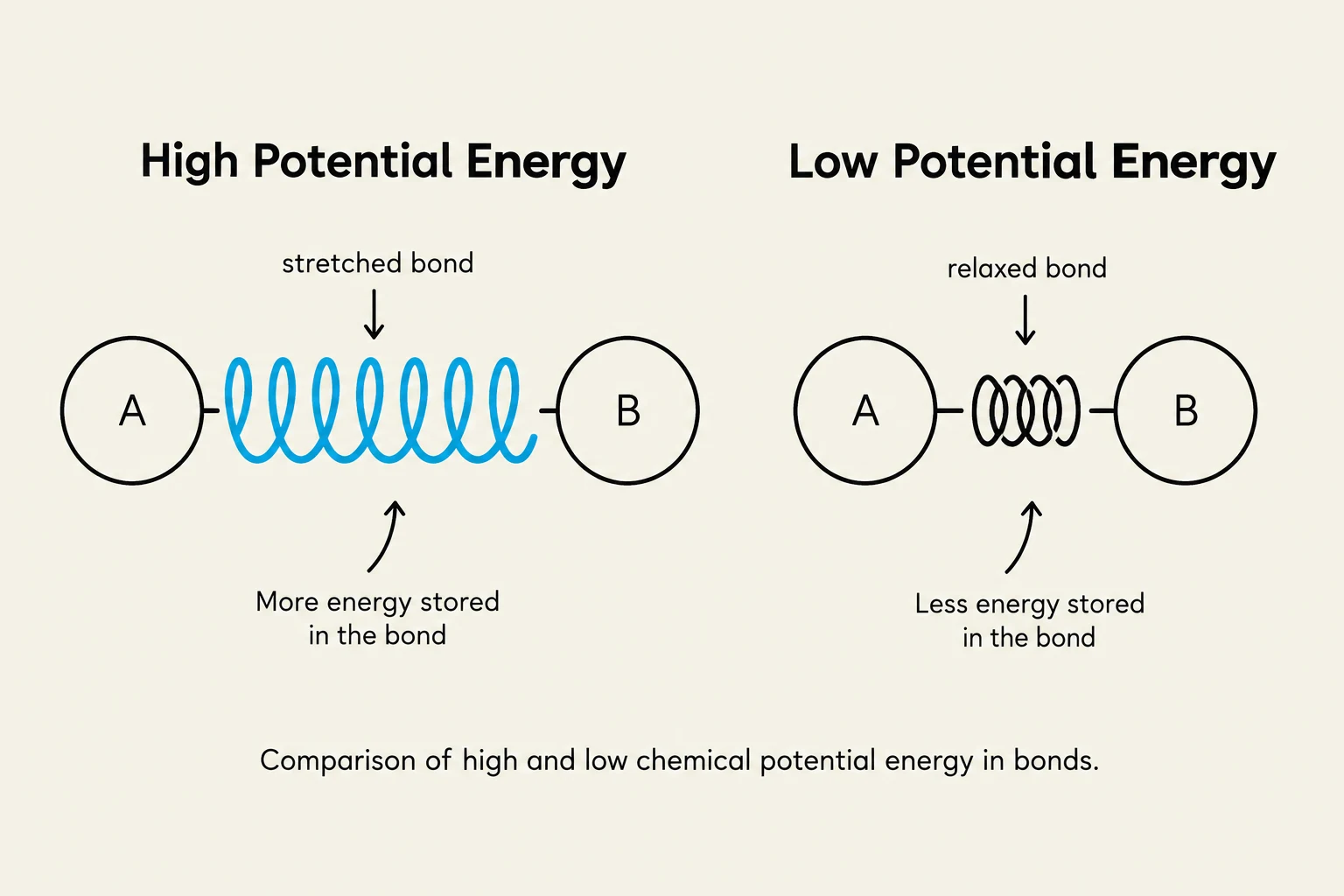
Comparison of high and low chemical potential energy in bonds, illustrating how a stretched bond stores more energy than a relaxed bond.
At its most basic level, energy is defined as the capacity to do work. In chemical systems, we primarily deal with two types of energy:
Potential Energy: This is stored energy. In chemistry, chemical potential energy is stored within the bonds of molecules. A compound with lower potential energy is considered more stable than a compound with higher potential energy.
Kinetic Energy: This is the energy of motion.
A critical principle in all scientific observations is the Law of Conservation of Energy, which states that the total energy in a system does not change; energy cannot be created or destroyed, only transformed from one form to another.
Units of Energy and Metabolism
To quantify energy, scientists use several different units depending on the context of the measurement.
Calories (cal): The amount of energy needed to raise the temperature of 1 g of water by 1∘C.
Joules (J): The standard SI unit for energy.
Conversions: It is essential to know the relationship between these units:
1 cal=4.184 J
1 kcal=1,000 cal
1 kcal=4.184 kJ
Note on Nutrition: In the context of human biology and food, a "Calorie" (with a capital C) is actually a kilocalorie (kcal). When you read a nutrition label, the energy provided by the metabolism of proteins, carbohydrates, and fats is measured in these larger Calories.
Energy Changes in Chemical Reactions
When a chemical reaction occurs, bonds are broken in the reactants and new bonds are formed in the products. This process involves a specific exchange of energy:
Bond Breaking: This process always requires an input of energy (it is endothermic).
Bond Formation: This process always releases energy (it is exothermic).
Enthalpy and the Heat of Reaction
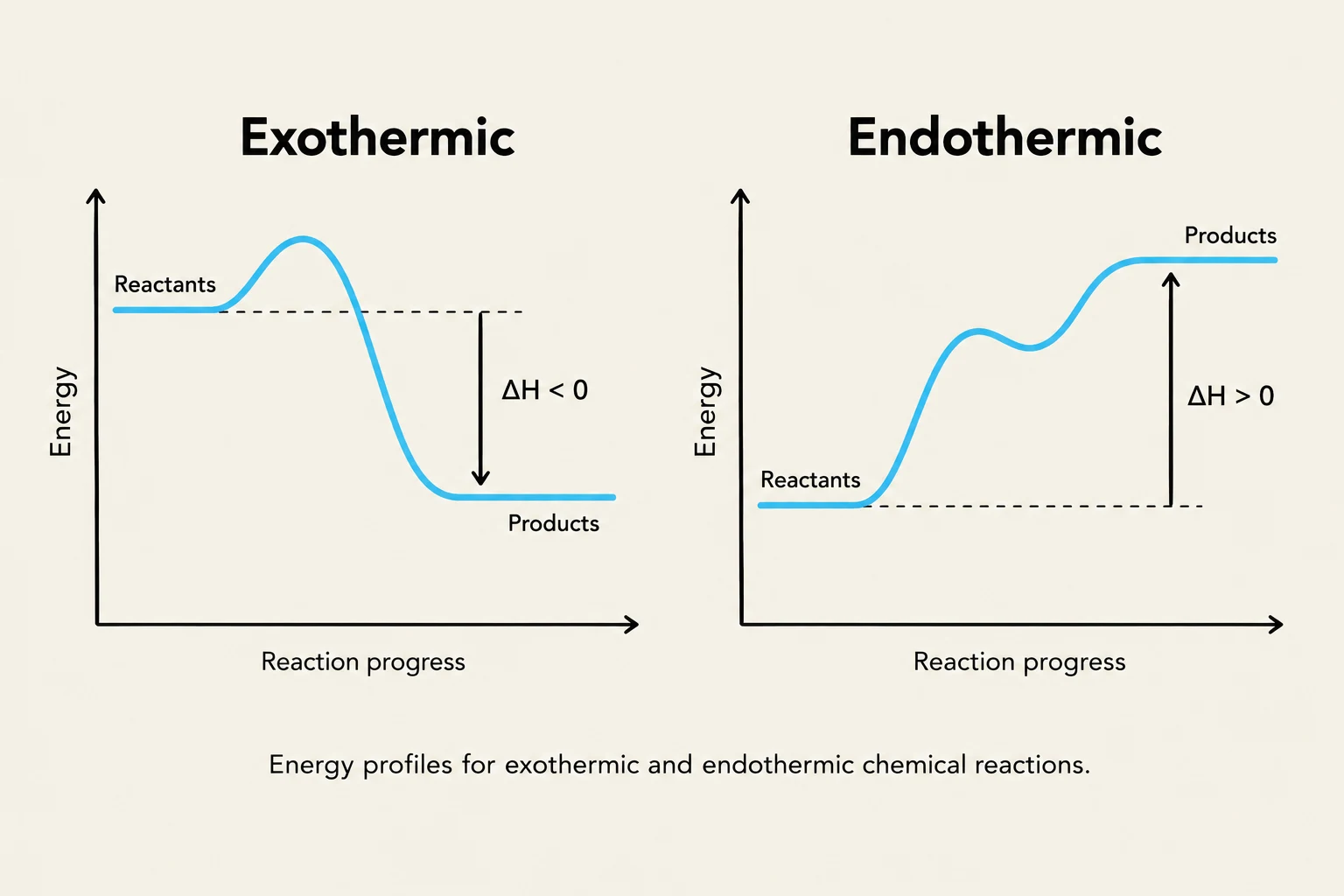
Energy profiles for exothermic and endothermic chemical reactions.
The change in heat absorbed or released during a reaction is known as enthalpy (ΔH), also called the heat of reaction.
Endothermic Reactions: If energy is absorbed, the reaction is endothermic, and ΔH is positive (ΔH>0).
Exothermic Reactions: If energy is released, the reaction is exothermic, and ΔH is negative (ΔH<0).
The value of ΔH tells us about the relative strength of the bonds. If ΔH is negative, the bonds formed in the products are stronger than the bonds broken in the reactants. If ΔH is positive, the bonds broken in the reactants are stronger than the bonds formed in the products.
Bond Dissociation Energy
The bond dissociation energy is the specific ΔH required to break a covalent bond by equally dividing the electrons between the two atoms. Because breaking a bond requires energy, bond dissociation energies are always positive values. Generally, the stronger the bond, the higher its bond dissociation energy.
Energy Diagrams and Reaction Rates
For a reaction to take place, molecules must collide with sufficient kinetic energy and the correct orientation.
The Energy Barrier
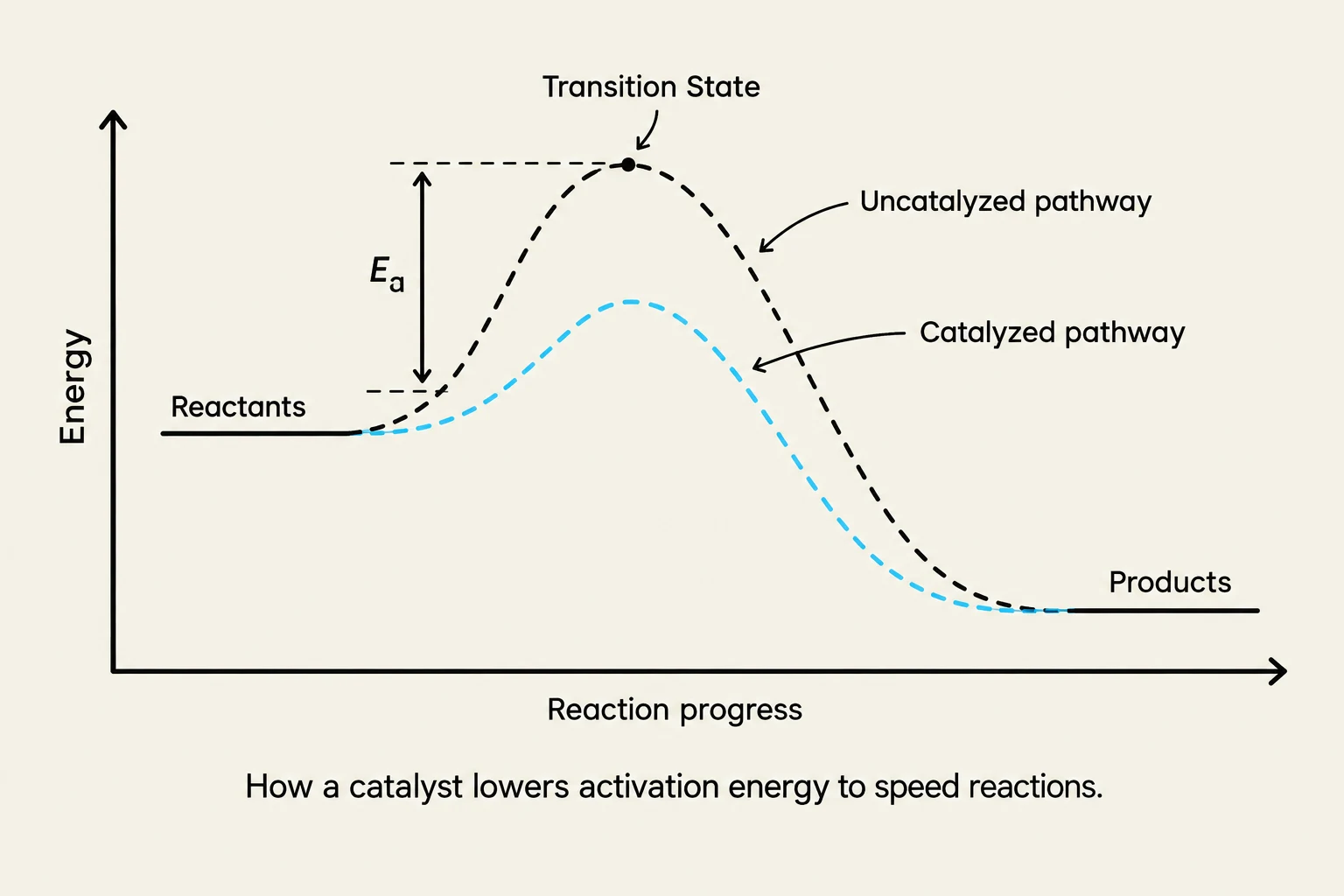
This graph illustrates how a catalyst lowers the activation energy required for a reaction to proceed, thereby increasing the reaction rate.
The minimum amount of energy that reactants must possess for a reaction to occur is called the activation energy (Ea). This is often referred to as the energy barrier. The highest point of energy reached during the collision is known as the transition state.
High Ea: If the energy barrier is high, few molecules have enough energy to cross it, resulting in a slow reaction.
Low Ea: If the barrier is low, many molecules can cross it, resulting in a fast reaction.
Catalysts
A catalyst is a substance that increases the rate of a reaction without being consumed in the process. It works by providing an alternative pathway with a lower activation energy (Ea), thereby speeding up the reaction without changing the overall ΔH. In biological systems, these catalysts are called enzymes.
Summary Table: Reaction Dynamics
Feature
Exothermic
Endothermic
Energy Change
Released to surroundings
Absorbed from surroundings
ΔH Sign
Negative ($-$)
Positive ($+$)
Bond Strength
Products have stronger bonds
Reactants have stronger bonds
Temperature
Often feels hot
Often feels cold
Exam Tip: When looking at a balanced equation, if "heat" is written on the product side, the reaction is exothermic. If "heat" is written on the reactant side, it is endothermic.
References
CHM104 CH6 Study Guide-1.docx
Keep reading for free.
Create an account to finish this reading and make it part of your study routine.