This content explains the fundamental roles of electrolytes and water in the body, detailing fluid compartments, movement mechanisms, and demographic variations. It covers the functions and imbalances of key electrolytes like sodium, chloride, potassium, calcium, phosphate, magnesium, and bicarbonate, including their c
Electrolytes are essential minerals that carry an electrical charge, categorized as cations (positively charged, such as Na+, K+, Ca2+, and Mg2+) or anions (negatively charged, such as Cl−, PO43−, and HCO3−). These substances are distributed between the intracellular fluid (ICF) and extracellular fluid (ECF). Their primary role is to maintain osmolality—the concentration of particles in a solution—and to facilitate the electrical impulses necessary for nerve conduction, muscle contraction, and cardiac rhythm.
Fluid Compartments and Movement
The body's water is divided into two main compartments: the intracellular fluid (ICF), located inside cells, and the extracellular fluid (ECF), located outside cells. The ECF is further subdivided into interstitial fluid, intravascular fluid, and transcellular fluids (such as cerebrospinal, synovial, and pleural fluids).
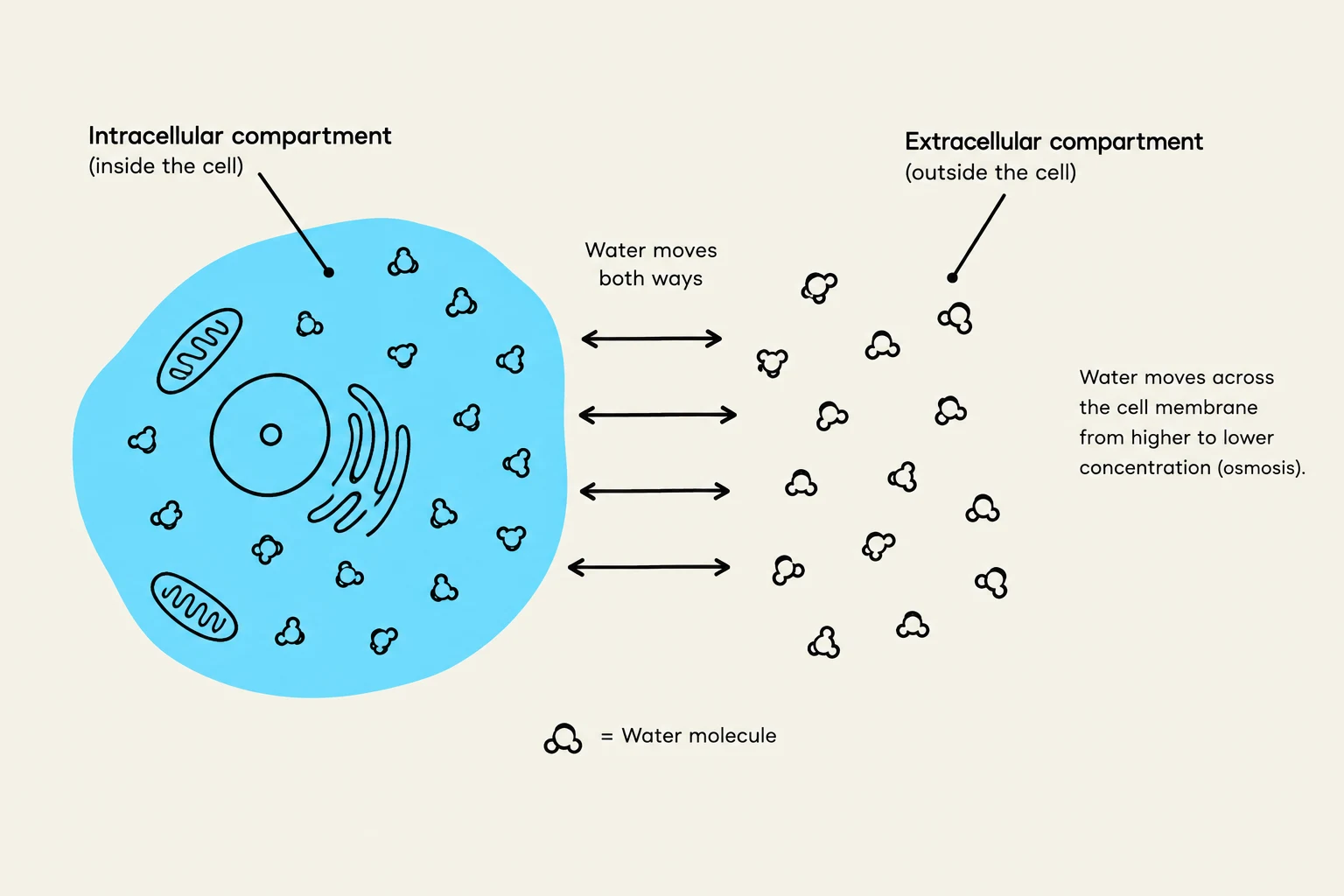
Movement between these compartments is driven by three primary mechanisms: filtration, diffusion, and osmosis. Water movement is specifically governed by osmotic and hydrostatic pressures. For instance, capillary hydrostatic pressure pushes water out of the vessels, while plasma oncotic pressure (driven largely by the protein albumin) pulls water back into the vessels.
Diagram illustrating osmosis, the movement of water across a cell membrane from an area of higher concentration to lower concentration.
Demographic Variations in Total Body Water (TBW)
Total Body Water is not a fixed percentage; it varies significantly across the lifespan:
Adults: Approximately $60%$ in males and $50%$ in females.
Pediatrics: 75–80% of body weight. Infants are at a much higher risk for dehydration because they have a higher metabolic rate and a greater body surface area relative to their mass, which increases insensible loss (unmeasurable loss through skin and lungs).
Aging: Older adults face an increased risk of dehydration due to a natural decline in TBW, decreased muscle mass, renal decline, and a diminished thirst perception.
Clinical Tip: A weight change of 1 kg is roughly equivalent to a 1 liter change in fluid volume.
Sodium (Na+) and Chloride (Cl−)
Sodium is the primary extracellular cation, with a normal serum level of 135–145 mEq/L. It is the chief regulator of fluid volume, blood pressure, and osmotic balance. Sodium and water move together; essentially, "water follows sodium".
Sodium Imbalances
Hyponatremia (<135 mEq/L): Often caused by sodium loss or excessive water gain (dilutional hyponatremia). This leads to cell swelling and can cause cerebral edema or increased intracranial pressure.
Hypernatremia (>145 mEq/L): Caused by sodium gain or water loss (dehydration). This leads to brain cell shrinkage.
Treatment for Hypernatremia: The initial treatment is to provide an isotonic salt-free fluid, such as $5%$ dextrose in water (D5W), to stabilize the sodium level.
Chloride (Cl−) is the primary extracellular anion and typically follows sodium to maintain electroneutrality and osmotic pressure. Consequently, chloride imbalances often mirror sodium imbalances: hypochloremia often accompanies hyponatremia, while hyperchloremia often accompanies hypernatremia.
Potassium (K+)
Potassium is the primary intracellular cation, with a normal serum range of 3.5–5.3 mEq/L. It is essential for nerve impulse conduction, protein synthesis, and, most critically, maintaining normal cardiac rhythms.
Potassium Imbalances
Potassium levels are tightly regulated by the kidneys and are highly sensitive to acid-base changes.
Hyperkalemia (>5.3 mEq/L): Can be caused by renal failure, cell trauma (like burns), or certain medications (e.g., ACE inhibitors). It can cause muscle twitches, weakness, and life-threatening cardiac arrhythmias, such as peaked T-waves or even cardiac arrest.
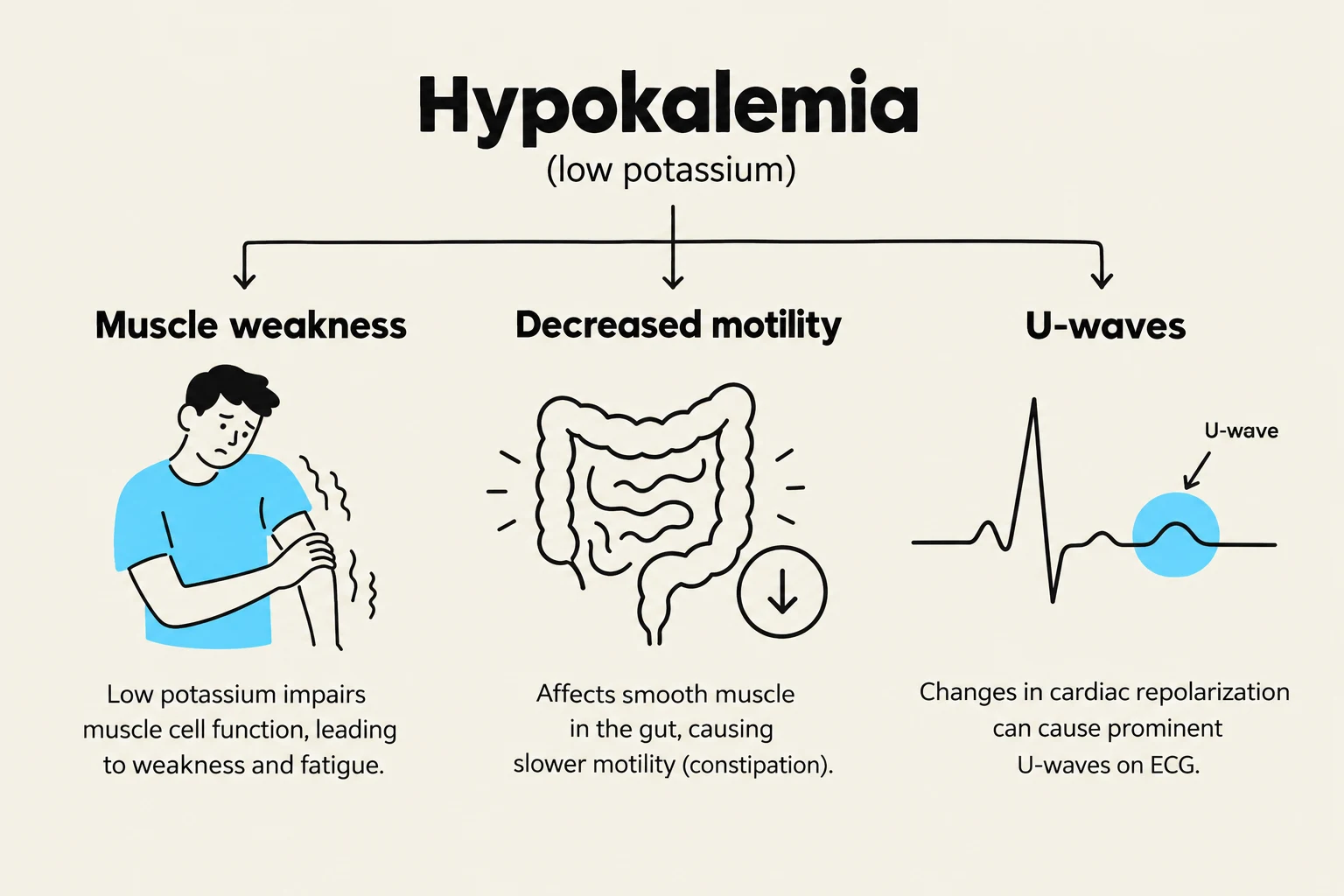
Hypokalemia (<3.5 mEq/L): Often caused by GI losses (vomiting, diarrhea) or diuretic use. It leads to "slow" physiological responses: decreased muscle tone, constipation, and lethal ventricular dysrhythmias.
Hypokalemia, or low potassium, can lead to muscle weakness, decreased gut motility (constipation), and prominent U-waves on an ECG due to changes in cardiac repolarization.
Calcium (Ca2+) and Phosphate (PO43−)
Calcium (8.6–10 mg/dL) is vital for bone health, blood clotting, and muscle contraction. It is regulated by parathyroid hormone (PTH), Vitamin D, and calcitonin.
Calcium Imbalances
Hypocalcemia: Characterized by increased neuromuscular excitability. Key clinical signs include Trousseau’s sign (carpal spasm with a BP cuff) and Chvostek’s sign (facial twitching).
Hypercalcemia: Often described by the mnemonic "bones, stones, abdominal groans, and psychic moans". This refers to brittle bones, kidney stones, constipation, and confusion/irritability.
Phosphate (2.5–4.5 mg/dL) is essential for ATP (energy) production and DNA formation. Importantly, calcium and phosphate have an inverse relationship; as one rises, the other typically falls.
Magnesium (Mg2+) and Bicarbonate (HCO3−)
Magnesium (1.7–2.3 mg/dL) acts as a cofactor for many enzymatic reactions and is crucial for muscle relaxation.
Hypomagnesemia: Leads to hyperactive deep tendon reflexes (DTRs) and neuromuscular excitability.
Hypermagnesemia: Leads to hyporeactive DTRs and neuromuscular relaxation.
Bicarbonate (22–26 mmol/L) acts as a base to maintain acid-base balance. It works alongside the respiratory and renal systems to buffer hydrogen ions (H+) and prevent significant fluctuations in blood pH.
Exam Tip: Remember the relationship between pH and Potassium. In acidosis, H+ enters the cells and K+ moves out into the ECF, causing hyperkalemia. In alkalosis, K+ moves into the cells, causing hypokalemia.
Keep reading for free.
Create an account to finish this reading and make it part of your study routine.