This article provides a comprehensive overview of depressive disorders, including DSM-5-TR criteria, clinical presentations, differential diagnoses, and multidimensional aspects. It covers Major Depressive Disorder, Disruptive Mood Dysregulation Disorder, Persistent Depressive Disorder, Premenstrual Dysphoric Disorder,
Depressive disorders represent a diverse spectrum of clinical presentations, ranging from chronic, low-grade mood disturbances to acute, debilitating episodes of profound sadness and physiological dysfunction. For the clinician, the challenge lies not only in identifying the presence of depressive symptoms but in distinguishing between various diagnostic categories that share overlapping features, such as grief, substance-induced states, and developmental mood disorders. This article provides a deep dive into the DSM-5-TR criteria, clinical presentation, differential diagnosis, and the multidimensional aspects of depression.
The DSM-5-TR Spectrum of Depressive Disorders
The DSM-5-TR categorizes several distinct disorders under the umbrella of depressive and related disorders. Understanding the nuances between these is critical for accurate diagnosis and treatment planning.
Major Depressive Disorder (MDD)
Major Depressive Disorder is characterized by discrete episodes of depressed mood or anhedonia (loss of interest or pleasure). These episodes represent a significant departure from the individual's baseline and must cause clinically significant distress or impairment.
Disruptive Mood Dysregulation Disorder (DMDD)
DMDD was specifically introduced in the DSM-5 to address a historical diagnostic crisis: a 40-fold increase in adolescent bipolar disorder diagnoses over the previous two decades. DMDD is characterized by:
Severe, recurrent temper outbursts that are inconsistent with the individual's developmental level.
Outbursts occurring ≥3 times per week.
A persistently irritable mood between outbursts.
Symptoms present for ≥12 months across at least 2–3 settings (e.g., home, school, peers).
Onset before age 10, with diagnosis typically occurring between ages 6 and 18.
Epidemiologically, DMDD affects 2%–5% of the population and is more common in males. Crucially, DMDD does not increase the risk of developing Bipolar Disorder, distinguishing it from the bipolar spectrum.
Persistent Depressive Disorder (PDD)
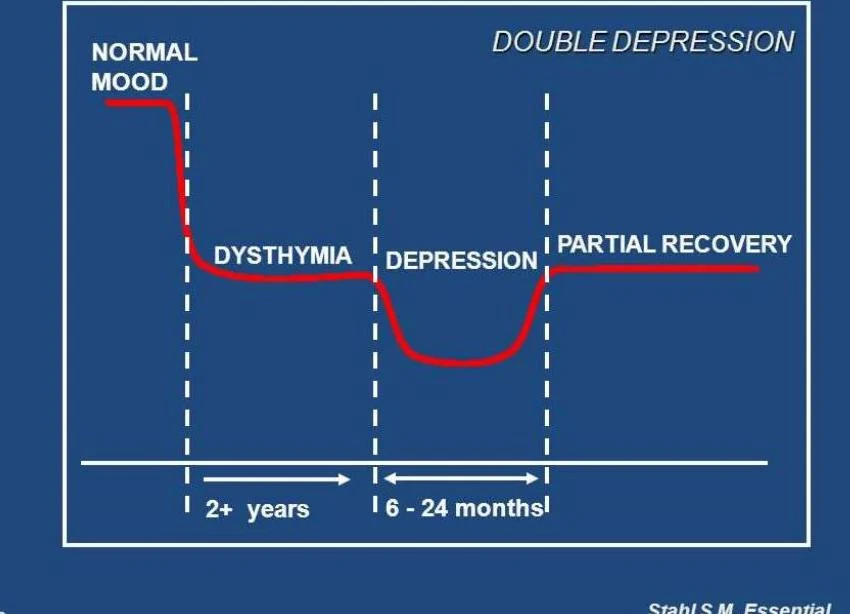
Formerly known as Dysthymia, PDD is defined by a chronic depressed mood lasting ≥2 years. In children and adolescents, the mood may be irritable, and the required duration is 1 year. To meet the criteria, the mood must be accompanied by at least two of the following: changes in appetite, sleep disturbances, fatigue, low self-esteem, poor concentration, or feelings of hopelessness.
A critical concept for students is "Double Depression." This occurs when an individual with underlying Persistent Depressive Disorder experiences a superimposed Major Depressive Episode.
This graph illustrates the concept of double depression, showing a progression from normal mood through dysthymia and major depression, with a period of partial recovery.
Premenstrual Dysphoric Disorder (PMDD)
PMDD is a cyclical disorder affecting 2–6% of menstruating women. It requires at least five cyclical symptoms occurring the week before the onset of menses, which then lessen or stop during the week post-menses. Symptoms include affective lability, anger, irritability, depressed mood, anxiety, anhedonia, fatigue, and physical symptoms like bloating or joint pain. Diagnosis is confirmed via two months of prospective symptom ratings.
Secondary Depressive Disorders
Clinicians must always rule out external causes before diagnosing a primary mood disorder.
Substance/Medication-Induced Depressive Disorder
This occurs when depressive symptoms (depressed mood or anhedonia) emerge in direct relation to intoxication, withdrawal, or exposure to a medication. Common substances involved include alcohol, opioids, amphetamines, cocaine, hallucinogens, and sedatives.
Depressive Disorder due to Another General Medical Condition (GMC)
If the depressive symptoms are a direct physiological consequence of another medical condition, the diagnosis must reflect this (e.g., "Depressive Disorder due to hypothyroidism"). Examples include stroke, Parkinson's disease, multiple sclerosis, and Cushing's disease.
Clinical Presentation and Differential Diagnosis
Subjective vs. Objective Findings
When conducting a clinical interview, it is vital to distinguish between what the patient reports (subjective) and what the clinician observes (objective).
Subjective Findings (History):
Mood: Sadness, hopelessness, or worthlessness.
Anhedonia: Decreased interest in pleasurable activities or libido.
Vegetative Symptoms: Appetite changes (often weight loss), sleep disturbances (insomnia or hypersomnia), and fatigue.
Suicidality: Ranging from passive thoughts to active plans with intent.
Masked Depression: A clinical "edge case" where patients present primarily with somatic complaints (e.g., fatigue, weight changes, pain) that may mask the underlying psychological distress.
Objective Findings (Mental Status Exam):
Psychomotor Retardation: Visible slowing of movement, speech (latency), and thought processes.
Psychomotor Agitation: Visible restlessness or severe nervousness.
Affect: The clinician's observation of the patient's emotional expression, which may be flat, blunted, tearful, or irritable.
The Differential Diagnosis Challenge
One of the most common areas for error is distinguishing between Grief (Bereavement) and Major Depressive Disorder (MDD).
Feature
Grief/Bereavement
Major Depressive Disorder
Core Feeling
Emptiness and loss
Depressed mood/Anhedonia
Mood Fluctuations
Positive emotions/humor are still possible
Pervasive unhappiness and misery
Self-Esteem
Generally stable
Low self-esteem/Worthlessness
Thoughts of Death
About "joining" the deceased
Focused on ending one's life due to pain/worthlessness
Exam Tip: If a patient presents with intense sadness following a loss but can still experience moments of humor or positive emotion, lean toward Grief. If the patient expresses pervasive worthlessness and a desire to die to escape pain, lean toward MDD.
Multidimensional Aspects and Assessment
Depression is not a monolithic entity; it is multidimensional, involving physical, emotional, and cognitive components.
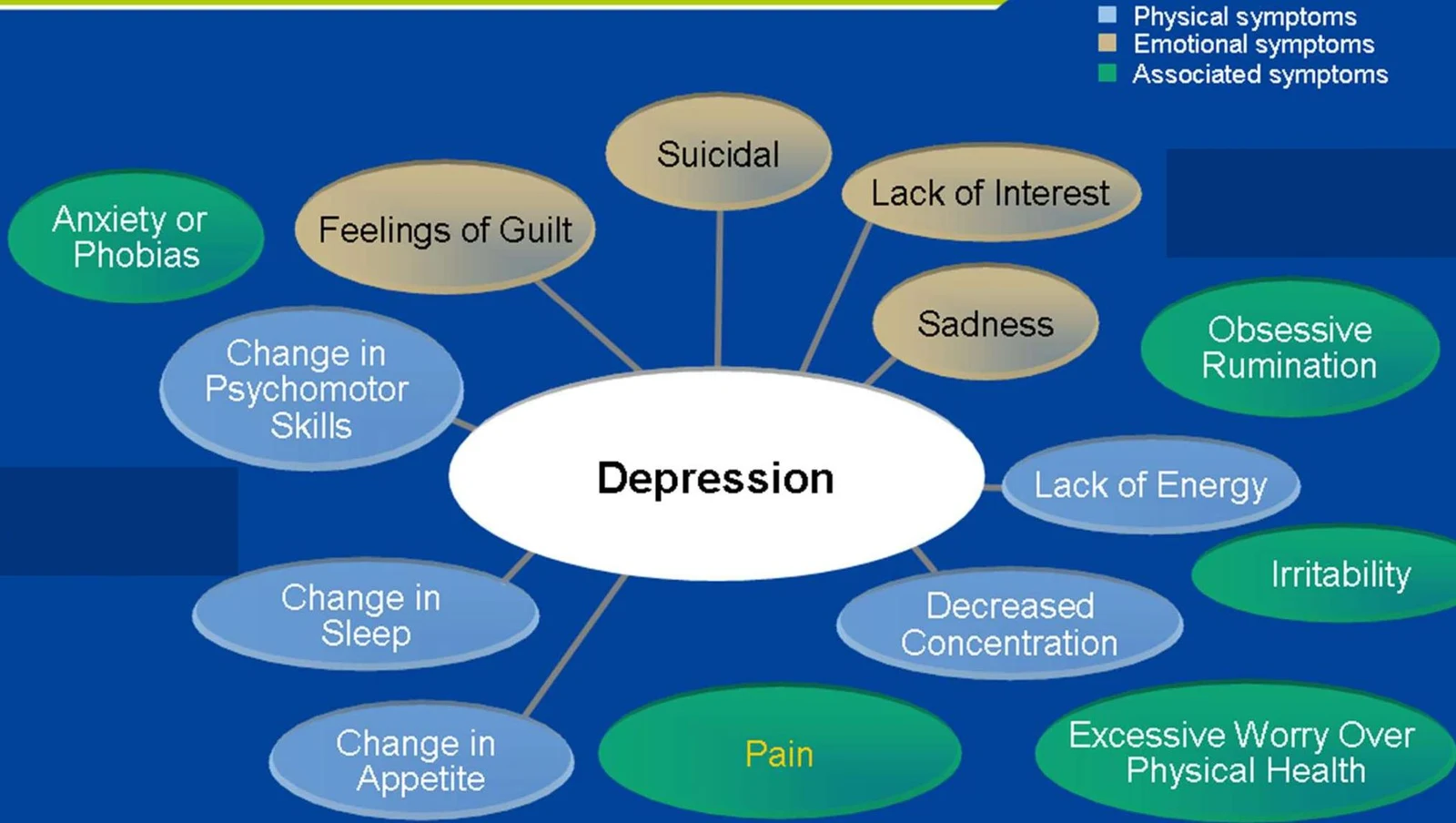
This diagram illustrates various symptoms associated with depression, categorized into physical, emotional, and associated symptoms.
As illustrated in the concept map, symptoms can be categorized into:
Physical: Changes in sleep, appetite, energy, and pain.
Emotional/Cognitive: Guilt, suicidal ideation, lack of interest, and excessive worry.
Psychomotor: Retardation or agitation.
The Mental Status Examination (MSE)
To synthesize these findings, clinicians use the Mental Status Examination. A complete MSE should assess:
General Appearance and Behavior
Speech: Rate, volume, and latency.
Motor Activity: Presence of agitation or retardation.
Mood and Affect: Subjective vs. objective emotional state.
Thought Process and Content: Assessing for rumination, delusions, or suicidal ideation.
Insight and Judgment: The patient's understanding of their condition.
Cognition: Attention, memory, and concentration.
Treatment Interventions
Treatment varies based on the specific diagnosis but often involves a combination of psychosocial and lifestyle interventions.
Psychosocial Interventions: Cognitive Behavioral Therapy (CBT), Interpersonal Therapy, and Psychodynamic/Insight-oriented therapies are standard for PDD and MDD. For DMDD, programs including a parental component have proven most effective.
Lifestyle and Education: For PMDD, patient education and routine exercise are recommended. For PDD, lifestyle changes and strengthening social supports are key components of management.
Keep reading for free.
Create an account to finish this reading and make it part of your study routine.