This content explores the complexities of deceptive communication, its prevalence, and the human difficulty in detecting lies. It details various cues such as microexpressions, interchannel discrepancies, and linguistic style that may indicate deception, and discusses the influence of mood on recognition accuracy.
In our daily social lives, we are constantly engaged in a complex dance of interpreting the intentions, feelings, and honesty of those around us. We rely on a vast array of nonverbal cues—from the way someone holds their gaze to the subtle pitch of their voice—to navigate these interactions. However, there is a significant gap between our desire to understand others and our actual ability to do so. While we use social perception to make sense of the world, we are surprisingly poor at detecting when someone is being dishonest.
The Reality of Deceptive Communication
Deception is far more common than most people realize. Research suggests that deceptive communication occurs in almost 20% of social interactions, and many individuals tell at least one lie every single day. In fact, during a brief first encounter, a majority of strangers will lie to one another at least once.
Despite how frequent lying is, humans are remarkably bad at spotting it. Most people perform no better than chance when trying to determine if someone is telling the truth. This failure to detect deception isn't necessarily due to a lack of observation, but rather due to psychological biases. For instance, we often have a natural tendency to perceive others as truthful, which means we don't even bother searching for clues of deception. Furthermore, our desire to be polite often makes us reluctant to call out or report when we suspect someone is lying.
Exam Tip: If asked why humans are poor at detecting deception, remember to mention both the cognitive aspect (we don't search for clues because we assume truthfulness) and the social aspect (the desire to maintain politeness).
Identifying the Cues of Deception
While we struggle to be accurate, researchers have identified several specific indicators that may signal a person is not being truthful. These cues often manifest across different "channels" of communication.
Microexpressions and Facial Cues
One of the most subtle indicators is the microexpression. These are fleeting facial expressions that last only a few tenths of a second and are extremely difficult for a person to suppress. Because they are so brief, they often reveal a person's true emotion before they have a chance to mask it with a "social" face.
Additionally, we may observe exaggerated facial expressions. When someone is attempting to deceive, they may overcompensate by making their facial expressions more intense than necessary to appear more convincing.
Interchannel Discrepancies
Another key indicator is the presence of interchannel discrepancies. Human communication involves multiple channels working in harmony: facial expressions, eye contact, body movements, posture, and even vocal tone (paralanguage). When a person is being honest, these channels usually align. However, a liar may find it difficult to control all these channels simultaneously. For example, someone might say something positive while their body language—such as fidgeting or avoiding eye contact—suggests nervousness or discomfort.
This diagram illustrates interchannel discrepancy, where a person's verbal message contradicts their nonverbal cues, indicating a mismatch between what they say and what they show.
Linguistic Style
Beyond the face and body, we can look at linguistic style. This refers to aspects of speech that are independent of the actual meaning of the words, such as the pitch, speed, or rhythm of the person's voice. Changes in these patterns can serve as indicators that a person may be deviating from the truth.
The Role of Mood in Deception Recognition
Interestingly, our own internal state can significantly impact our ability to perceive the honesty of others. Research has shown that mood and deception recognition are closely linked.
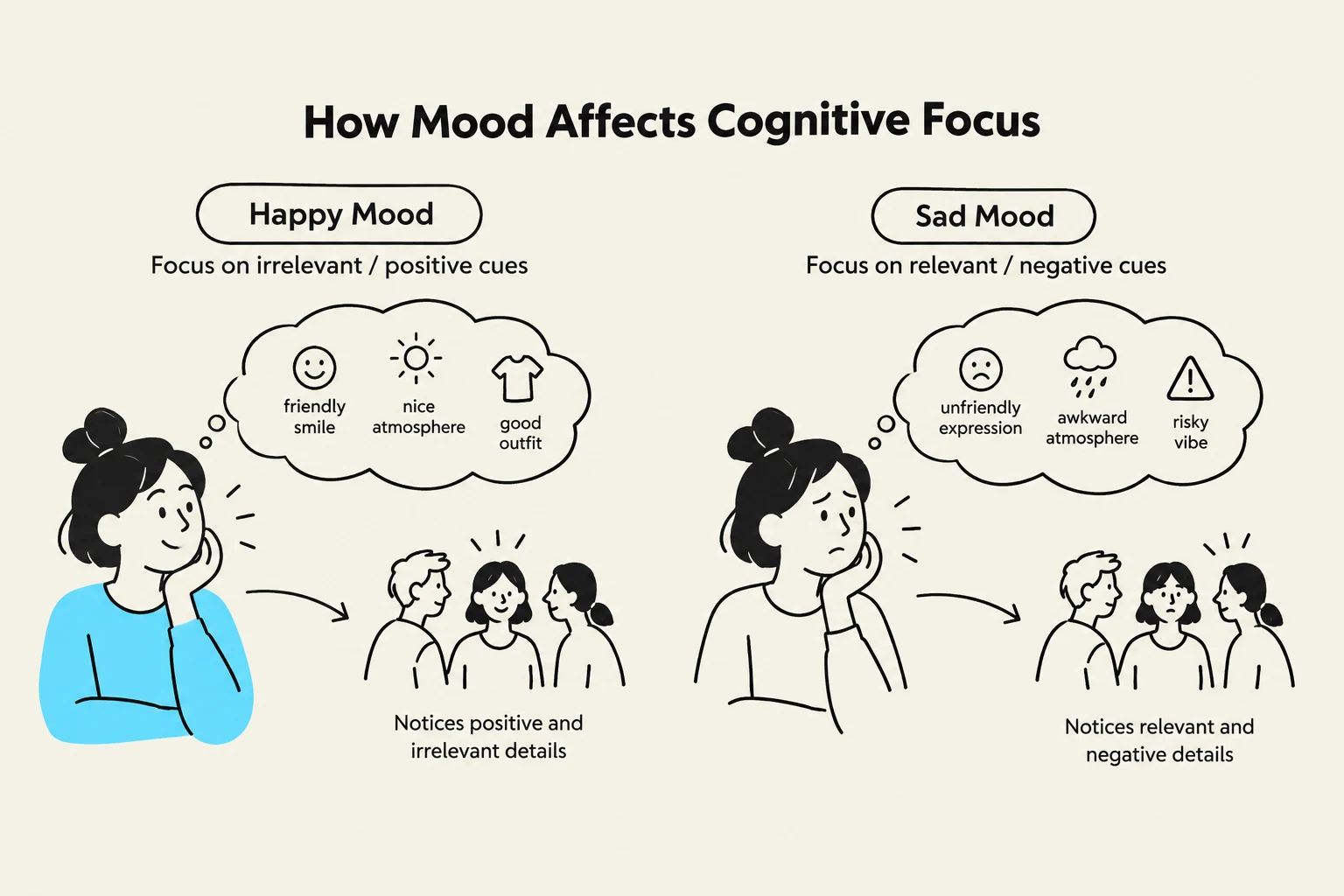
People in a sad mood tend to be better at recognizing deception than those in a happy mood. This is likely because negative emotions cause us to pay closer attention to the actual content, words, and meaning of a message. In contrast, people in a happy mood are often distracted by cues that are irrelevant to the message itself—such as how attractive or pleasant the speaker is. This distraction makes them less likely to notice the subtle discrepancies that signal a lie.
This illustration depicts how a happy mood leads to focusing on positive and irrelevant details, while a sad mood leads to focusing on relevant and negative details.
Summary of Deception Indicators
To help organize these concepts, the following table summarizes the primary nonverbal and linguistic indicators of potential deception:
Indicator Type
Specific Cue
Description
Facial
Microexpressions
Fleeting, involuntary expressions lasting fractions of a second.
Facial
Exaggerated Expressions
Overly intense expressions used to "prove" an emotion.
Body/Channel
Interchannel Discrepancies
Mismatches between words, face, and body language.
Body/Channel
Fidgeting
Movements like rubbing or scratching that suggest arousal or nervousness.
Vocal/Linguistic
Linguistic Style
Changes in pitch, speed, or rhythm of speech.
Conclusion
Recognizing deception is a high-stakes aspect of social perception. While we have developed various tools to interpret the world—from reading universal facial expressions of anger or joy to monitoring vocal pitch—our ability to catch a lie remains limited. By understanding the role of microexpressions, the importance of channel consistency, and the influence of our own moods, we can become more mindful observers of the complex social signals sent by those around us.
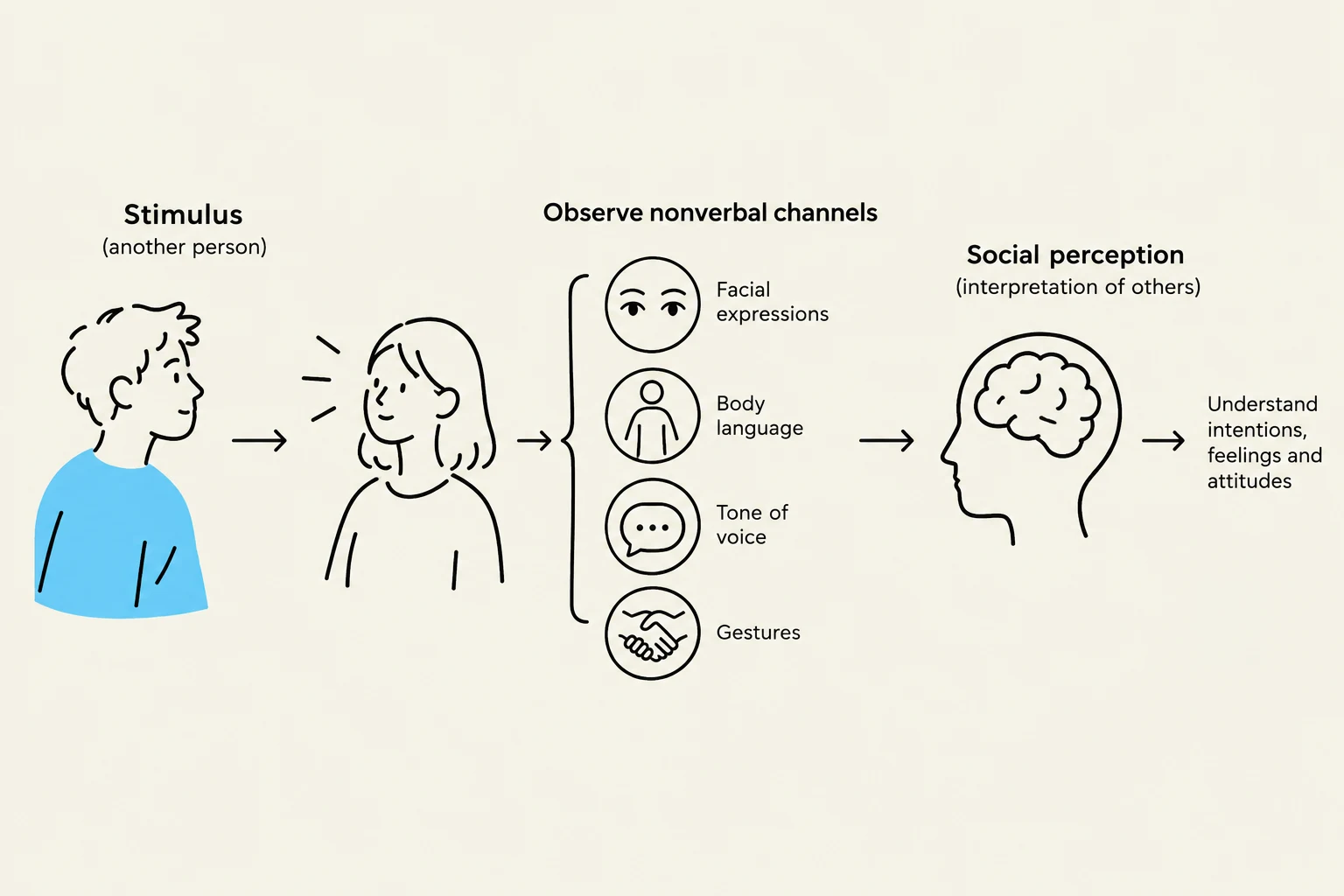
This diagram illustrates the process of social perception, where an individual observes nonverbal cues such as facial expressions, body language, tone of voice, and gestures from another person (stimulus) to interpret their intentions, feelings, and attitudes.
Keep reading for free.
Create an account to finish this reading and make it part of your study routine.