Understanding Cybersecurity Risk: Threats, Vulnerabilities, and Attacks
This content explains the distinct meanings of threat, vulnerability, and attack in cybersecurity and risk management. It details the risk formula (Risk = Threat x Vulnerability x Impact) with examples and provides a summary table for easy differentiation.
In the world of cybersecurity and risk management, terms like "threat," "vulnerability," and "risk" are often used interchangeably in casual conversation. However, for a security professional, these terms have distinct, precise meanings. Confusing them can lead to poor decision-making, such as spending a massive budget fixing a vulnerability that no one is actually exploiting, or worrying about a threat that has no way of reaching your systems.
To build a resilient security posture, you must first learn to distinguish between the weakness, the danger, and the event itself.
The Building Blocks: Vulnerabilities and Threats
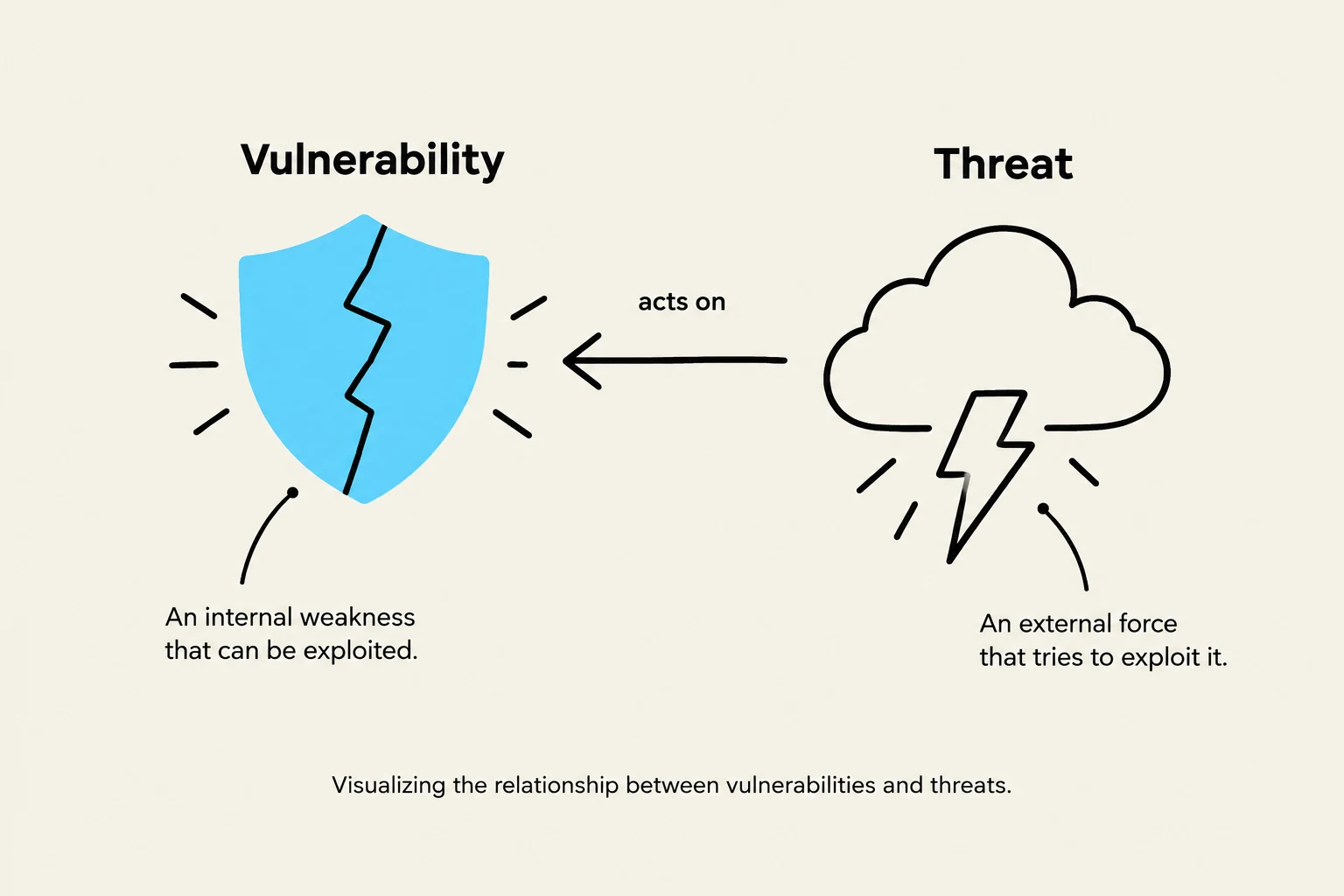
Visualizing the relationship between vulnerabilities and threats.
To understand risk, we must first break it down into its two primary components: the internal weakness and the external danger.
Vulnerabilities: The Weakness
A vulnerability is a weakness or flaw in a system, process, or design that could be exploited by a malicious actor. Think of a vulnerability as a "hole" in your defenses. It is an inherent characteristic of your environment.
Vulnerabilities can take many forms, including:
Technical flaws: A bug in a software program's code (e.g., a buffer overflow).
Configuration errors: Leaving a default password like "admin/admin" on a router.
Physical weaknesses: An unlocked server room door.
Human factors: An employee who is easily tricked into clicking a phishing link.
Threats: The Potential Danger
A threat is a potential danger that could exploit a vulnerability. A threat is an external or internal force that has the capability and intent to cause harm. While a vulnerability is a state of being (a weakness exists), a threat is an actor or an event (a person or a storm).
Threats are often categorized by their source:
Adversarial Threats: Hackers, nation-states, or disgruntled employees.
Accidental Threats: An employee accidentally deleting a critical database.
Environmental Threats: Floods, fires, or power outages that could damage hardware.
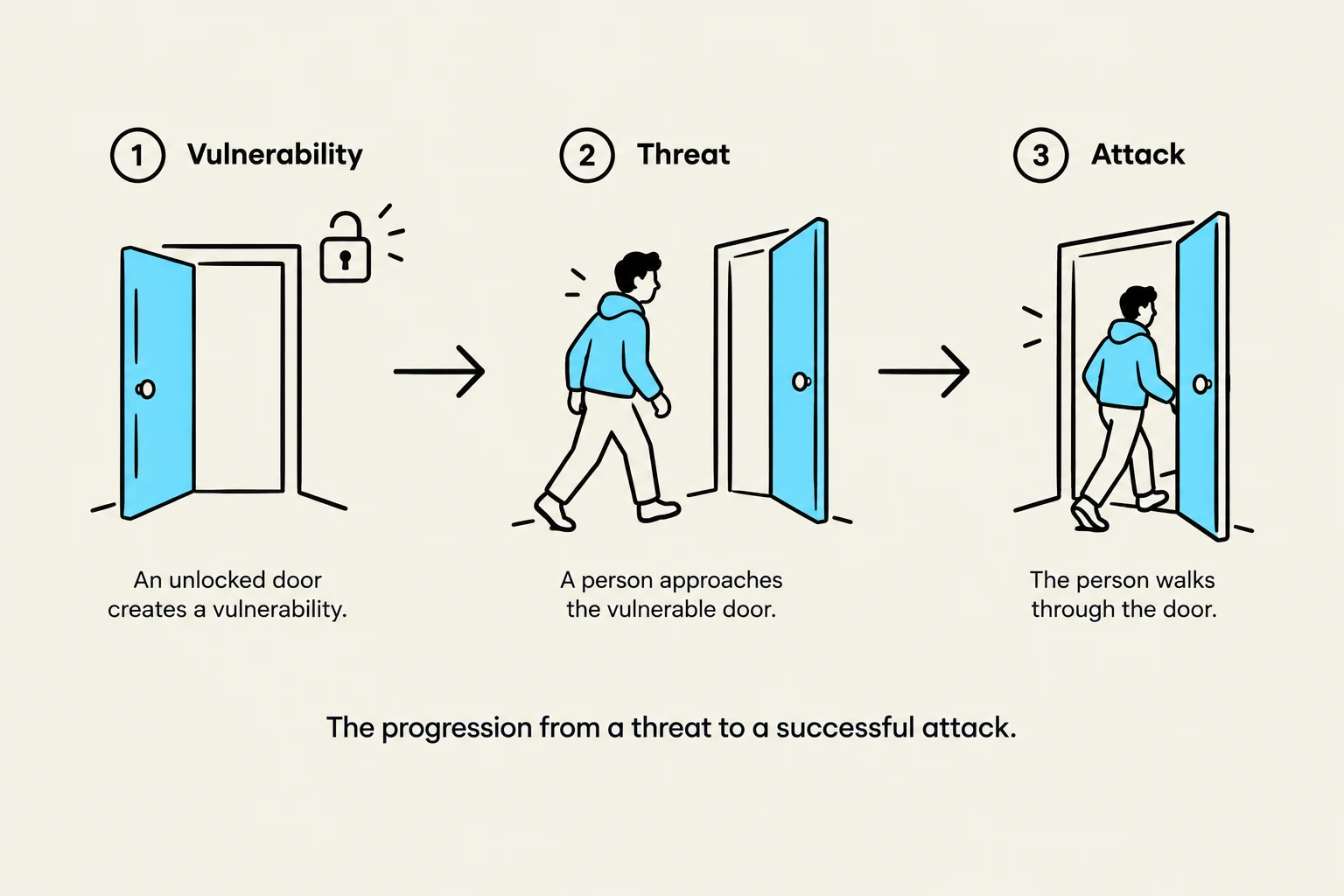
Exam Tip: Remember that a vulnerability cannot cause harm on its own. It is merely a door left unlocked. A threat is the person walking down the street who might see that unlocked door and decide to enter.
The Realization: Attacks
The progression from a threat to a successful attack, illustrating vulnerability, threat, and attack stages.
When a threat actor identifies a vulnerability and successfully uses it to compromise a system, we call this an attack. An attack is the actual realization of a threat exploiting a vulnerability.
If a vulnerability is the "unlocked door" and the threat is the "burglar," the attack is the "act of the burglar walking through that door and stealing the jewelry." Without the attack, the vulnerability remains a dormant risk, and the threat remains a theoretical danger.
The Risk Formula
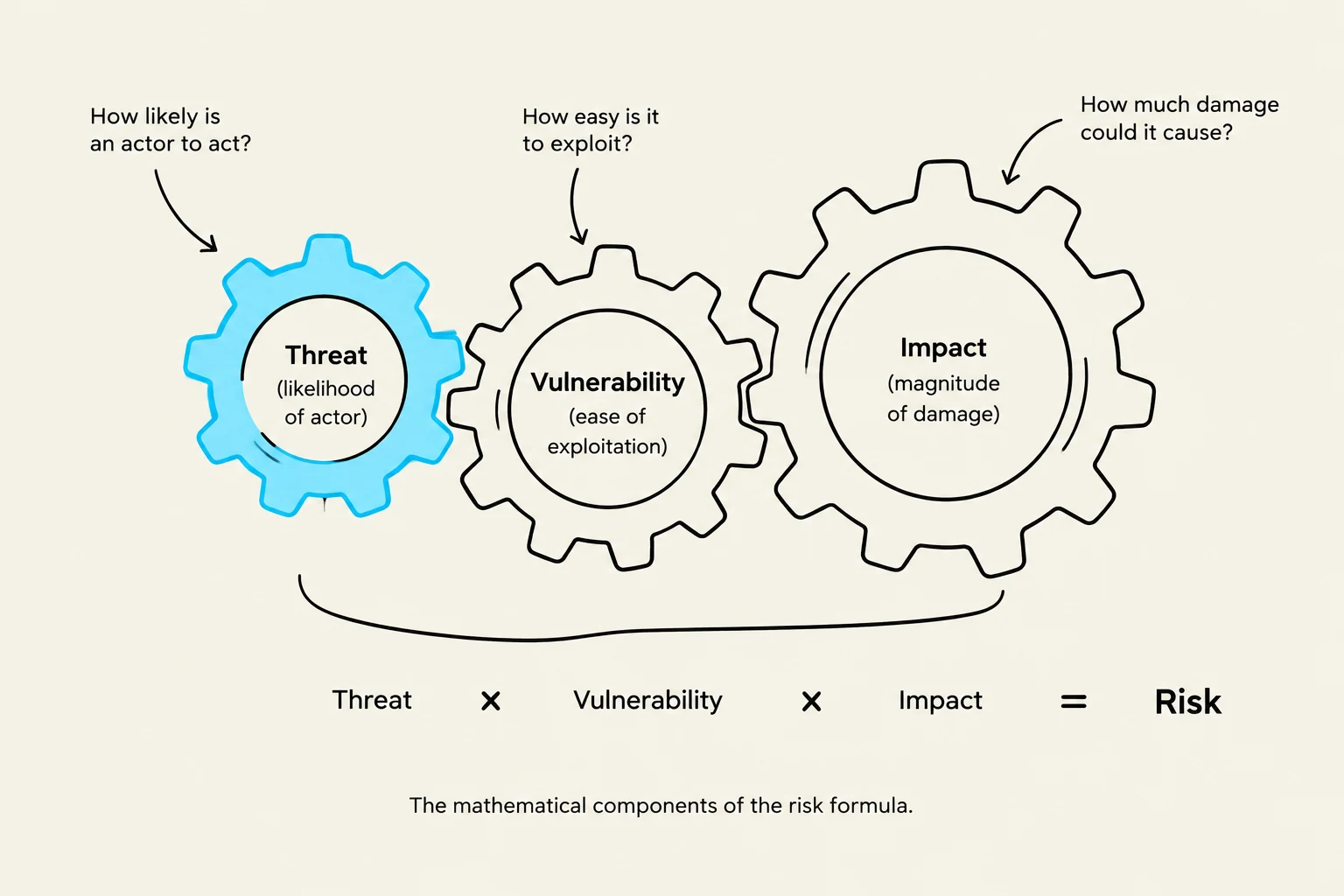
This diagram illustrates the components of a risk formula: Threat, Vulnerability, and Impact, which multiply together to determine Risk.
The relationship between these concepts is mathematically expressed through the concept of Risk. Risk is the probability that a specific threat will exploit a specific vulnerability, resulting in an impact to the organization.
In many professional frameworks, risk is simplified into a foundational formula:
Risk=Threat×Vulnerability×Impact
To understand how this works in practice, let's look at the variables:
Threat: How likely is it that a malicious actor will target us?
Vulnerability: How easy is it for them to succeed if they try?
Impact: If they succeed, how much damage (financial, reputational, or operational) will occur?
Worked Example: The Unpatched Web Server
Imagine a company running an old web server that has a known, unpatched security flaw (a vulnerability).
Scenario A (High Risk): The server is connected directly to the public internet (high exposure), and there are many automated bots scanning the web for this specific flaw (high threat). If the server is breached, the company loses all customer data (high impact).
Scenario B (Low Risk): The same server has the same flaw (the vulnerability is identical), but the server is located in a highly secure, isolated internal network with no internet access (low exposure). If it were breached, it would only affect a single test account (low impact).
By using this formula, security managers can prioritize their work. In Scenario A, the risk is unacceptable and requires immediate patching. In Scenario B, while the vulnerability exists, the overall risk is low enough that the company might choose to fix it during a scheduled maintenance window instead of an emergency.
Summary Table
To keep these concepts straight, use the following comparison:
Term
Definition
Analogy (The House)
Vulnerability
A weakness or flaw.
A broken window latch.
Threat
A potential danger/actor.
A thief looking for houses.
Attack
The exploitation of a weakness.
The thief climbing through the window.
Risk
The potential for loss.
The chance of your belongings being stolen.
By distinguishing between these three elements, organizations can move away from "reactive" security (fixing everything at once) and toward "risk-based" security (fixing the things that matter most).
Keep reading for free.
Create an account to finish this reading and make it part of your study routine.