Understanding Currency Risk in International Finance
This article explains currency risk (foreign exchange risk), its impact on multinational corporations, and the three main types: transaction, translation, and economic exposure. It details how exchange rate volatility affects profitability and asset value, providing a summary table for comparison.
In an increasingly globalized economy, businesses rarely operate within the confines of a single currency. When a company in the United States sells products to a client in Germany, or a Japanese manufacturer imports raw materials from Brazil, they are stepping into the realm of international finance. While these transactions offer growth opportunities, they introduce a significant variable: Currency Risk. This risk arises from the unpredictable fluctuations in exchange rates, which can turn a projected profit into a realized loss overnight.
Understanding currency risk is essential for managing both short-term profitability and long-term asset value. This article explores how exchange rate volatility impacts financial statements and the different ways these risks manifest in a corporate environment.
The Core of Currency Risk
At its simplest, currency risk (also known as foreign exchange risk or FX risk) is the potential for financial loss due to changes in the value of one currency relative to another. Because exchange rates are determined by a complex interplay of interest rates, inflation, geopolitical stability, and market sentiment, they are inherently volatile.
For a multinational corporation (MNC), this volatility impacts two primary areas:
Profitability: The immediate impact on cash flows, revenues, and expenses.
Asset Value: The long-term impact on the balance sheet and the valuation of foreign-held investments.
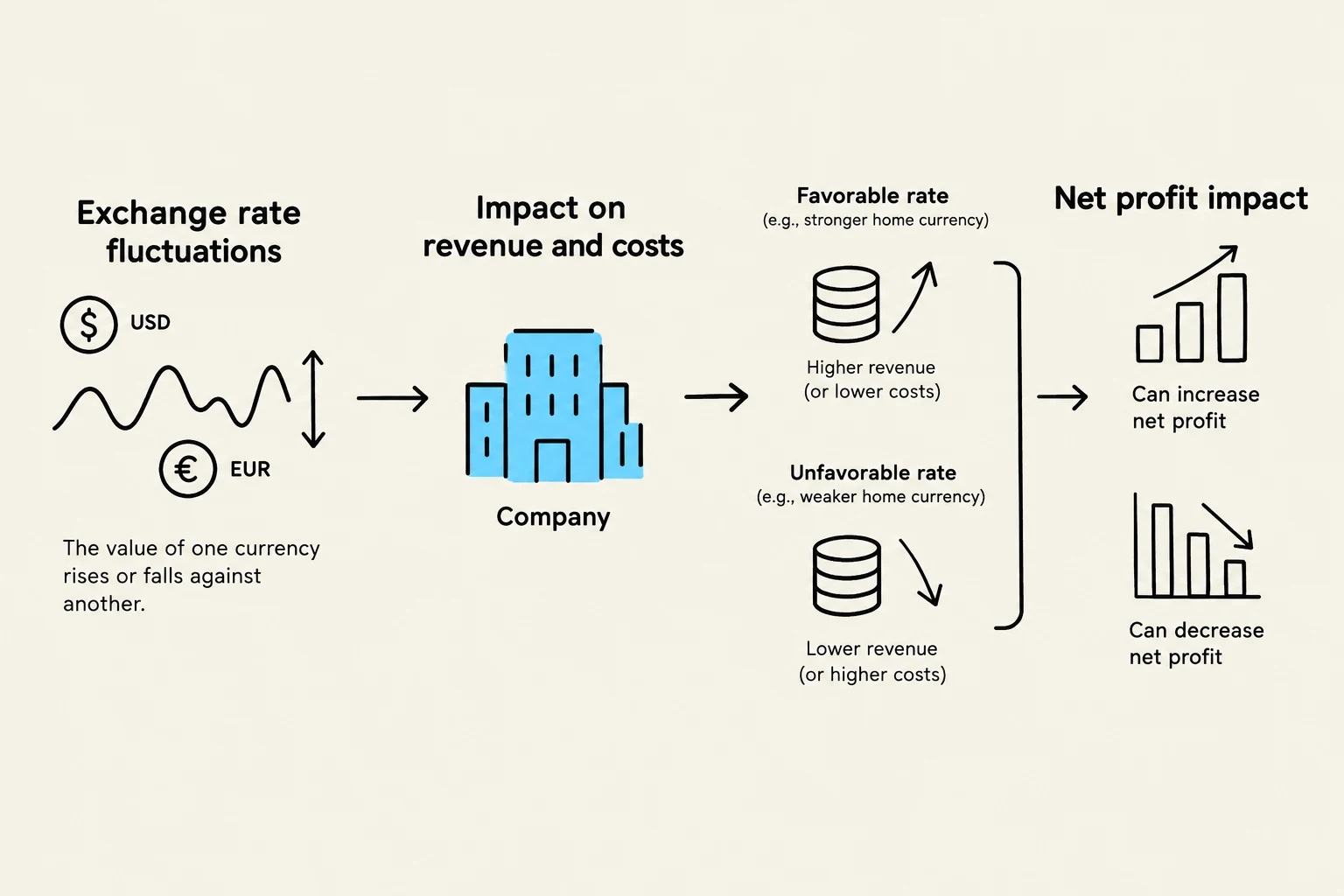
This diagram illustrates how exchange rate fluctuations impact a company's revenue, costs, and ultimately, its net profit.
Exam Tip: When analyzing currency risk, always distinguish between "Transaction Exposure" (the risk on specific contractual obligations) and "Translation Exposure" (the risk of revaluing foreign assets on a consolidated balance sheet).
Types of Currency Exposure
To manage risk effectively, one must first categorize it. Financial managers typically divide currency risk into three distinct types: Transaction, Translation, and Economic exposure.
1. Transaction Exposure
Transaction exposure is the most direct form of risk. It occurs when a company has a contractual obligation to pay or receive a specific amount of foreign currency at a future date.
For example, if a US-based firm agrees to buy machinery from a French supplier for €1,000,000, payable in 90 days, the firm is exposed to the risk that the Euro will strengthen against the US Dollar during those 90 days.
If the exchange rate changes from:
S0=1.10 USD/EUR
to:
S1=1.20 USD/EUR
The cost to the US firm increases:
Initial Cost=1,000,000×1.10=$1,100,000New Cost=1,000,000×1.20=$1,200,000
The firm has suffered a "transaction loss" of $$100,000$ simply due to the movement of the exchange rate.
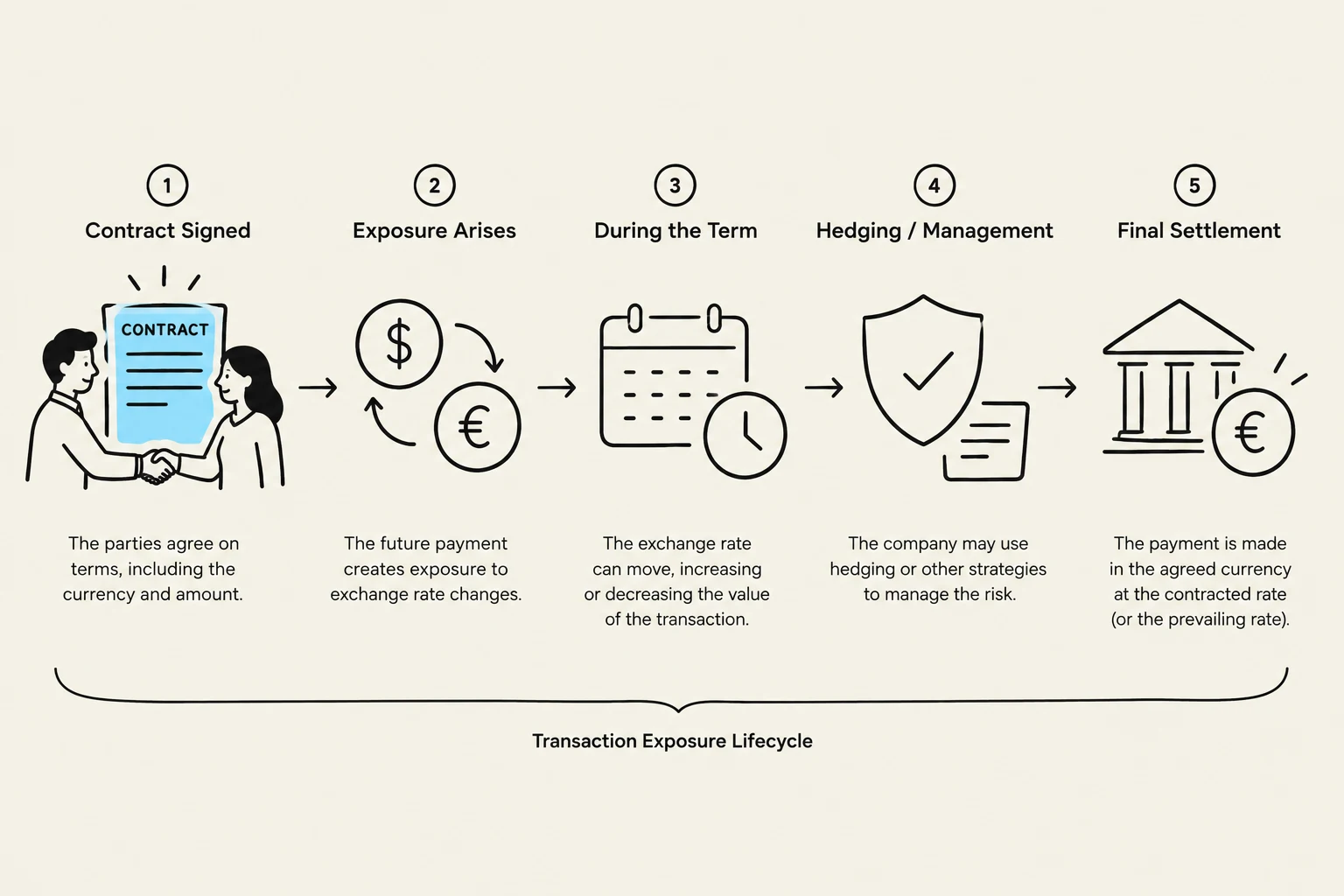
This diagram illustrates the five stages of the transaction exposure lifecycle: contract signing, exposure arising, during the term, hedging/management, and final settlement.
2. Translation Exposure (Accounting Exposure)
Unlike transaction exposure, which affects actual cash flows, translation exposure is an accounting phenomenon. It arises when a parent company must consolidate the financial statements of its foreign subsidiaries into its home currency for reporting purposes.
If a US company owns a subsidiary in the UK, the subsidiary's assets (buildings, inventory, cash) are recorded in British Pounds (GBP). When the US parent prepares its annual report, those GBP values must be converted into USD. If the Pound weakens against the Dollar, the value of the subsidiary's assets on the consolidated balance sheet will appear lower, even if the subsidiary's local performance was excellent.
3. Economic Exposure (Operating Exposure)
Economic exposure is the most complex and long-term form of risk. It refers to the extent to which a company's present value of future cash flows is affected by unexpected exchange rate changes. This affects a company's competitive position in the global market.
For instance, if the Japanese Yen weakens significantly against the US Dollar, Japanese exporters (like Toyota) become more price-competitive in the US market because their products become cheaper for American consumers. Conversely, a sudden strengthening of the Yen could make Japanese exports too expensive, hurting long-term market share.
This diagram illustrates the relationship between exchange rate volatility, economic exposure, and long-term competitive positioning. It shows how currency fluctuations impact a company's financial performance and strategic advantages over time.
Impact on Profitability and Asset Value
The cumulative effect of these exposures can be summarized by looking at the Income Statement and the Balance Sheet.
Impact on the Income Statement (Profitability)
Currency volatility affects the "top line" (revenue) and the "bottom line" (net income).
Revenue Impact: If a company earns revenue in a foreign currency that depreciates, the converted revenue in the home currency will decrease.
Expense Impact: If a company's costs (like raw materials) are denominated in a foreign currency that appreciates, the cost of goods sold (COGS) will rise, squeezing profit margins.
Impact on the Balance Sheet (Asset Value)
Translation exposure directly impacts the valuation of assets. A company may hold significant "Net Assets" in a foreign country. If the local currency devalues, the total equity of the firm—as reported in the home currency—will decrease. This can affect debt-to-equity ratios and other key financial covenants required by lenders.
Summary Table: Comparing Exposures
Feature
Transaction Exposure
Translation Exposure
Economic Exposure
Primary Impact
Cash Flow
Accounting/Reporting
Market Value & Strategy
Focus
Specific contracts/invoices
Financial statement consolidation
Long-term competitiveness
Nature
Realized (Actual money lost/gained)
Unrealized (Paper gains/losses)
Potential (Future cash flows)
By understanding these nuances, financial managers can implement hedging strategies—such as forward contracts, options, or diversifying production locations—to mitigate the impact of exchange rate volatility on their organization's financial health.
Keep reading for free.
Create an account to finish this reading and make it part of your study routine.