Understanding Crown Oil Royalty Reporting and Pipeline Splits
This article explains the complex process of reporting Crown oil royalties and managing pipeline splits in the Alberta oil and gas industry. It covers preparing royalty splits, the logistics of the pipeline split process, and the importance of accurate production forecasting, including calculations for penalties.
In the Alberta oil and gas industry, the movement of crude oil from a production site to a refinery involves a complex web of ownership transfers, regulatory reporting, and financial reconciliations. Central to this process is ensuring that the Alberta Crown receives its accurate share of mineral rights revenue through precise volume tracking and forecasting. This article explores the mechanics of preparing royalty splits, the logistics of the pipeline split process, and the critical importance of accurate production forecasting.
Preparing Crown Royalty Splits
Preparing a Crown royalty split requires meticulous documentation of how oil moves through the midstream system. A standard oil split letter or delivery statement must identify the specific Delivering Facility (such as a production battery), the Receiving Facility (such as a terminal or cleaning plant), and the exact Custody Transfer Point.
Key components of a reporting package include:
Crown Volume: The specific volume of oil allocated to the Alberta Petroleum Marketing Commission (APMC).
Shipper and Owner IDs: Unique identification codes for the entities handling and owning the oil.
Transportation Allowances: In certain scenarios, costs incurred when oil is moved via truck rather than pipeline may be claimed, provided specific regulatory conditions are met.
Exam Tip: When preparing a split letter, always ensure the Producer/Operator code, the facility code, and the specific owner/purchaser IDs are clearly mapped to their respective volumes to prevent reconciliation errors.
The Pipeline Split Process
The pipeline split process describes the transition of ownership as oil moves from the wellhead to the end user. This journey involves several distinct roles:
Battery Operators: They manage the initial production and provide volumes to parties taking oil "in kind," such as working interest owners (WIO) and the Crown.
LACT (Lease Automatic Custody Transfer) Units: These units are located at the battery and serve as the primary measurement point for custody transfer. They ensure the oil meets specific quality standards (such as sulfur content, density, and water/sediment levels) required by the pipeline company.
A diagram illustrating a typical liquid measurement system, detailing components such as strainers, air eliminators, meters, transmitters, analyzers, and control valves, along with explanatory notes on their application and placement.
Shippers: Once oil leaves the battery, it is owned by the shipper. Shippers purchase space on the pipeline and manage the sale of the oil to end users like refineries.
Pipeline/Railroad Companies: These entities provide the physical transportation service but do not own the commodity.
Major gathering hubs like Edmonton and Hardisty serve as the primary injection points where these volumes enter large-scale carrier systems, such as Enbridge.
Forecasting Crude Oil Production Volumes
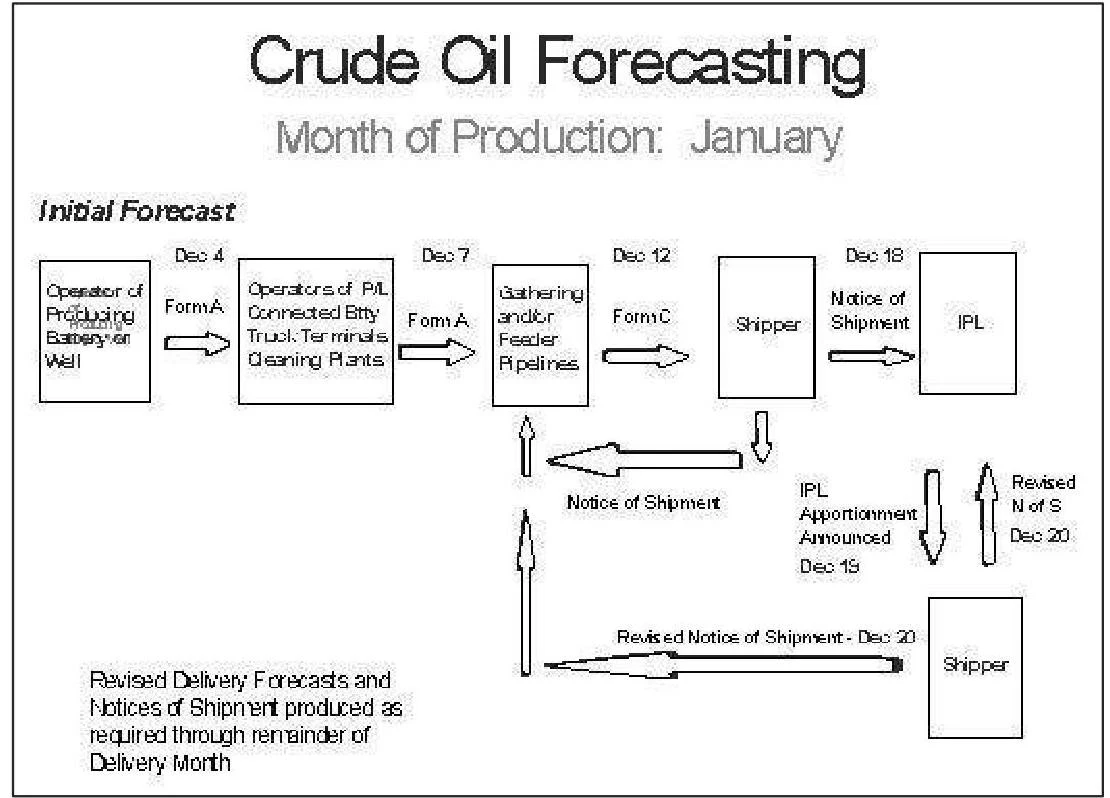
Because the Crown's revenue depends on accurate volume reporting, operators must engage in rigorous forecasting. This process involves predicting the Crown's royalty share using Royalty Calculation Data Tables and Par Prices provided by the Department of Energy (DOE).
This flowchart illustrates the process of crude oil forecasting for the month of January, detailing initial forecasts, gathering and feeder pipelines, shipper notifications, and revised delivery forecasts.
Operators manage this forecasting through two primary forms:
Form A: Used for the initial monthly forecast of volumes.
Form B: Used to submit revised volumes if the original Form A forecast changes.
Reporting via Petrinex and Managing Adjustments
Most pipeline and terminal operators require that splits be submitted via Petrinex. These can be generated from Production Accounting (PA) software or entered directly into the producer's Petrinex portal.
When discrepancies arise between the operator's reported volumes and the DOE's calculated royalties, the operator must reconcile them using the monthly APMC/Operator/DOE Reconciliation Report available in Petrinex.
Managing Errors and Penalties
Errors in oil splits can "snowball," affecting purchasers, shippers, and the Crown. Common causes for errors include incorrect well oil density settings, incorrect Crown royalty interest percentages, or failing to update monthly par prices.
Warning: Inaccurate forecasting can lead to incorrect Notices of Shipment and trunkline penalties. Operators may be charged back for any penalties incurred on the Crown's share.
The Alberta Petroleum Marketing Commission (APMC) imposes penalties for significant discrepancies (typically those greater than 1.0 m3):
Under-deliveries: The APMC will invoice the facility operator for the missing volumes.
Over-deliveries: Operators must use the "Edit Transportation Allowance and Over-delivery Claims" function in Petrinex to claim credit for over-delivered volumes.
The penalty rate is calculated as follows:
Penalty Rate=10%⋅APMC’s field price⋅discrepancy volumes
Worked Example: Over-delivery Penalty
If the Crown Royalty oil delivered is 12.0 m3 but the calculated amount should have been 10.0 m3, and the field price is $400/m3:
Discrepancy: $12.0 - 10.0 = 2.0\text{ m}^3$
Penalty Rate per unit: $0.10 \cdot $400 = $40/\text{m}^3$
Total Penalty: 2.0 m3⋅$40=$80.00.
Keep reading for free.
Create an account to finish this reading and make it part of your study routine.