This content explains the fundamental legal concepts of 'actus reus' (guilty act) and 'mens rea' (guilty mind) in criminal law. It distinguishes between criminal acts and omissions, detailing when a failure to act can lead to criminal responsibility due to a legal duty. The text also covers the burden of proof, defence
In criminal law, we often instinctively associate crime with a "bad act"—someone hitting, stealing, or burning something. However, the law also recognizes that sometimes, doing nothing can be just as criminal as doing something. This distinction between an act (a physical movement or deed) and an omission (a failure to act) is fundamental to determining criminal responsibility.
To understand how these concepts function, we must look at the "elements" of an offence. For a person to be convicted, the Crown must prove specific components beyond a reasonable doubt, primarily the actus reus (the guilty act or omission) and the mens rea (the guilty mind).
The Anatomy of an Offence: Actus Reus and Mens Rea
Every offence created by the Criminal Code is composed of specific elements that must be proven.
Actus Reus (The Physical Element): This is the "guilty act." Crucially, this element can be satisfied by either a positive physical action or a failure to act (an omission) when a legal duty exists.
Mens Rea (The Mental Element): This is the "guilty mind," representing the state of mind required for the offence.
Exam Tip: When "elementising" an offence in a problem question, always separate the physical requirements from the mental requirements. For example, in an arson charge, the actus reus is "setting fire to a building," while the mens rea is "wilfully".
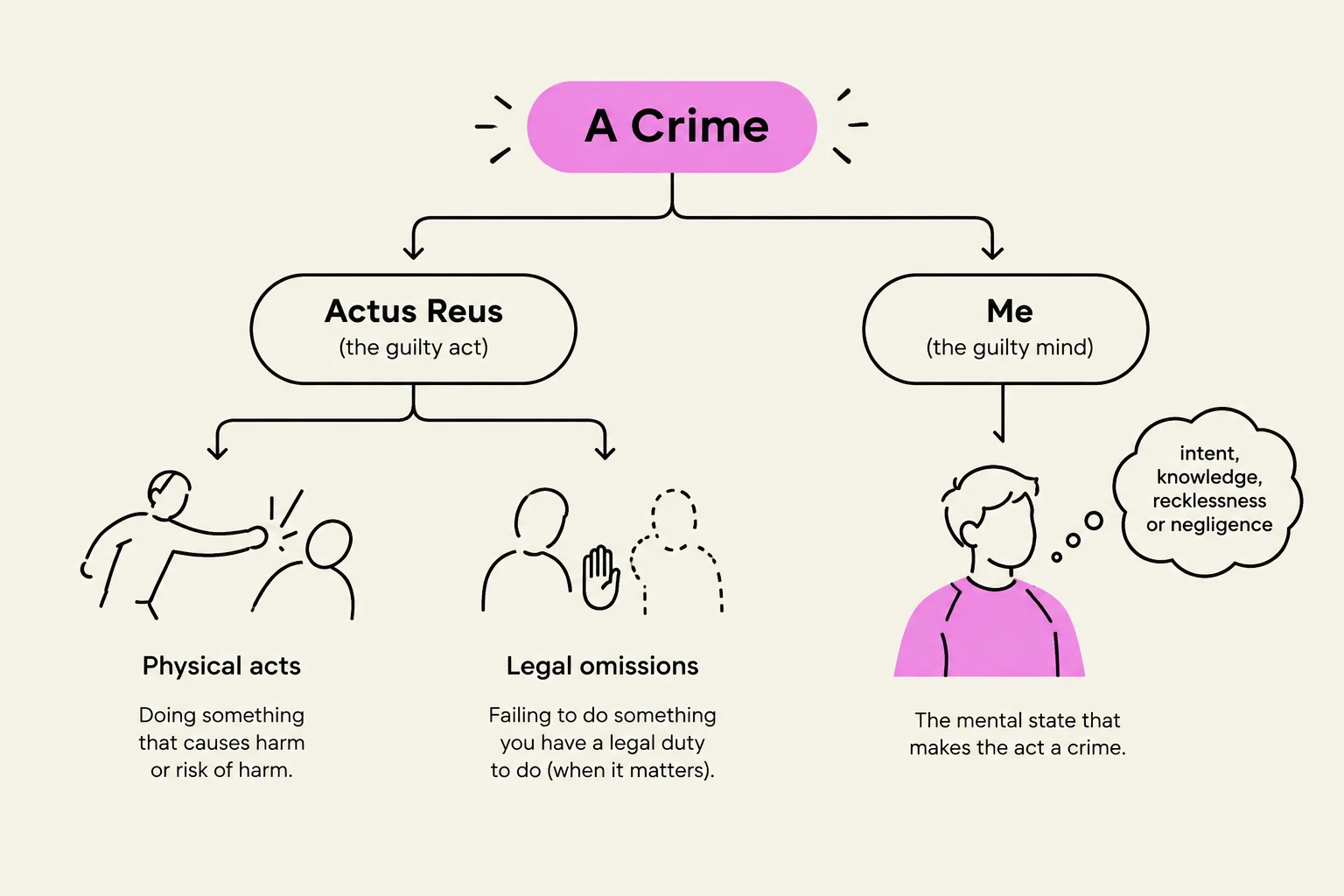
This diagram illustrates the two main components of a crime: the actus reus (guilty act) and the mens rea (guilty mind). The actus reus can be a physical act or a legal omission, while the mens rea refers to the mental state of the perpetrator, such as intent, knowledge, recklessness, or negligence.
It is important to note that in Queensland, the principle Actus non facit reum, non est mens rea (the act itself does not make a person guilty unless done with a guilty intent) is not an absolute rule. Under section 23(2) of the Code, unless an intention is expressly declared as an element of the offence, the intended result of an act or omission is immaterial. This leads to "strict liability" offences, such as speeding or selling unsafe food, where the prosecution does not need to prove a specific mental state.
When is an Omission Criminal?
You cannot be held criminally responsible for a mere failure to act unless you have a legal duty to act. If you see a stranger drowning and choose not to help, you generally have committed no crime. However, if you have a specific legal obligation to protect that person, your failure to act becomes an "unlawful omission".
The law identifies several specific categories where a duty to act exists, particularly regarding the preservation of human life.
1. Duty of Care for Children
Under section 286, anyone who has care of a child under 16 (including parents, foster parents, or guardians) has a legal duty to take reasonable precautions to avoid danger to the child's life, health, or safety. If a caregiver fails to act and the child suffers consequences, the law deems that the person "caused" those consequences through their omission.
2. Duties to Preserve Life
The Criminal Code imposes various duties to protect human life, such as:
The duty to provide necessaries (s 285).
The duty of persons doing dangerous acts (s 288).
The duty of persons in charge of dangerous things (s 289).
Note on Causation: These sections are often not "offence-creating" provisions themselves. Instead, they serve to establish that a person's failure to act satisfies the causation element of a more serious crime, such as manslaughter.
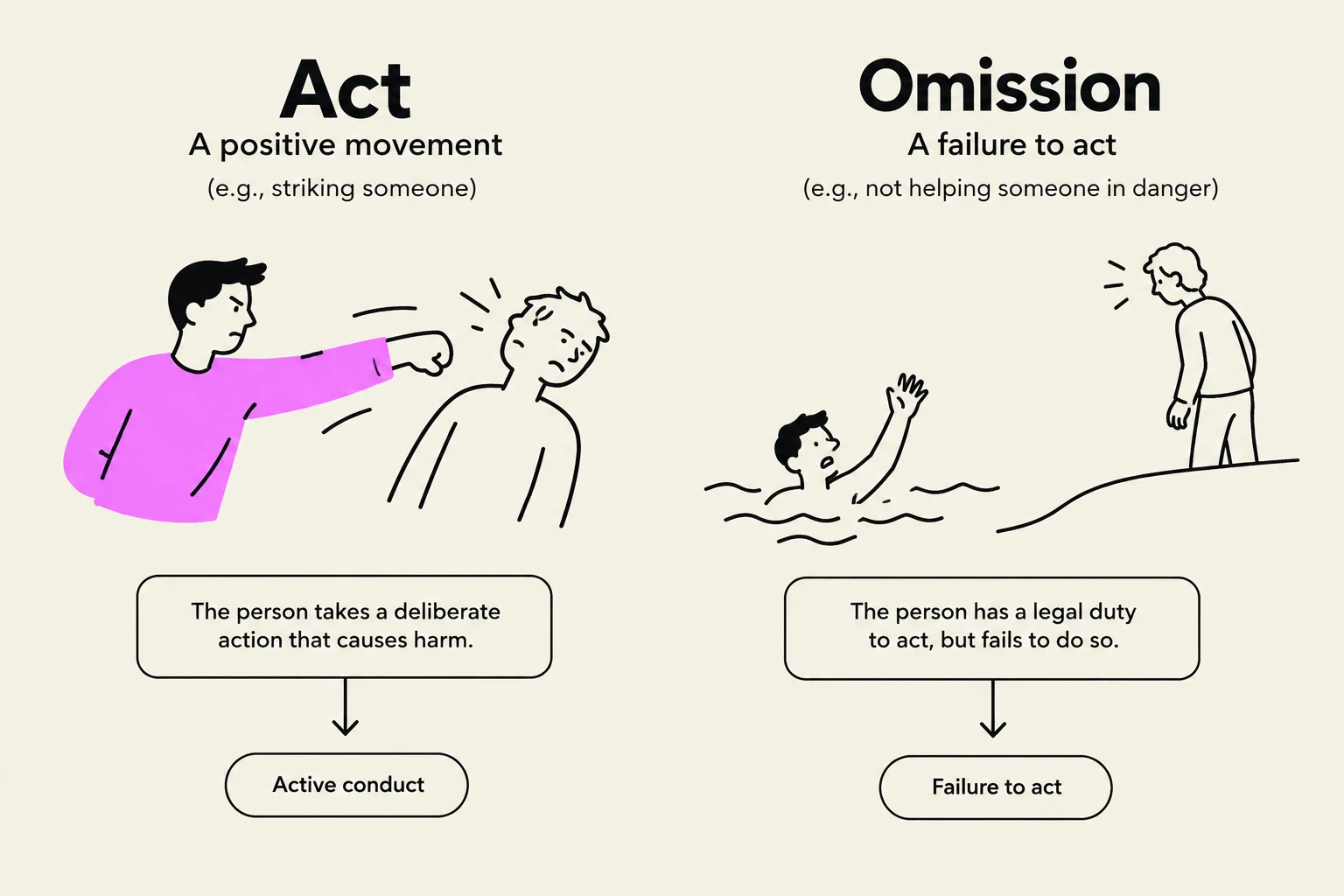
This illustration contrasts 'Act' (a positive movement causing harm, like striking someone) with 'Omission' (a failure to act when there is a legal duty to do so, like not helping someone in danger).
Principles of Responsibility and Defences
Even if an act or omission is proven, the law provides mechanisms to determine if the person is truly responsible.
The Burden and Standard of Proof
The Crown bears the burden of proof; they must prove every element of the offence. The standard of proof is "beyond a reasonable doubt". If any reasonable doubt remains, the accused must be given the benefit of that doubt.
Ignorance of the Law
A common misconception is that one can avoid liability by claiming they didn't know the law. Under section 22, ignorance of the law is no excuse. As established in Ostrowski v Palmer, it is irrelevant whether the accused knew their actions constituted an offence.
Defences and Mitigating Factors
If the elements of an act or omission are met, the accused may raise defences to negate or reduce responsibility:
Accident or Mistake of Fact: Acts done without intent or based on a wrong belief.
Self-Defence: Using force to protect oneself.
Immature Age: Children under 10 are not criminally responsible; children between 10 and 14 are only responsible if they had the capacity to know their actions were wrong.
Double Punishment vs. Double Jeopardy
Finally, the law protects individuals from being unfairly targeted by the state through two distinct principles:
Double Jeopardy: This asks whether the Crown can put a person on trial again for the same incident after they have already been acquitted or convicted.
Double Punishment: This prevents a person from being punished twice for the same act or omission. For example, if a person is fined for a public nuisance arising from an act, they cannot be punished again for a different offence arising from that exact same act.
Keep reading for free.
Create an account to finish this reading and make it part of your study routine.