Understanding Court Administration and Case Processing
This content explains the U.S. judicial system's administrative processes, courtroom actors, theories of case processing, legal reasoning methods like IRAC, and challenges like case delay and judicial accountability.
The United States judicial system is often perceived by the public as a purely adversarial battleground where truth is discovered through intense conflict. However, beneath the surface of high-profile trials lies a complex "paperwork bureaucracy" governed by systemic imperatives, social norms, and administrative pressures. Understanding how cases move from arrest to disposition requires looking beyond the legal "myth of reasoning" to examine the internal ecology of the courtroom, the actors involved, and the theories that explain why courts often prioritize efficiency and cooperation over constant litigation.
The Legal Framework: Principles and Constraints
The actions of courtroom actors are not random; they are constrained by legal imperatives (or legal norms). These are systemic requirements that dictate how actors must behave to function within the system, a concept known as systemic agency. Unlike a traditional workplace where a supervisor dictates behavior, in a court, the legal system itself imposes these duties.
The U.S. system operates within a delicate balance between two competing goals: crime control and due process. While crime control seeks to efficiently process offenders, due process protects individuals against arbitrary government power through fair, transparent proceedings. This balance is maintained through several key principles:
The Principle of Legality (Rule of Law): Mandates that courts enforce only positive laws that apply equally to all, preventing ex post facto or secret laws.
Justiciability: Ensures a case is appropriate for court by requiring standing (the right to bring the suit) and ripeness (the facts are ready for decision).
Jurisdiction and Venue: Jurisdiction is the court's legal authority to hear a case, while venue refers to the specific location assigned to that case.
Judicial Independence and Review: Independence protects judges from political influence to allow "free and fearless judging". Judicial review allows higher courts to examine the constitutionality of laws or lower court procedures.
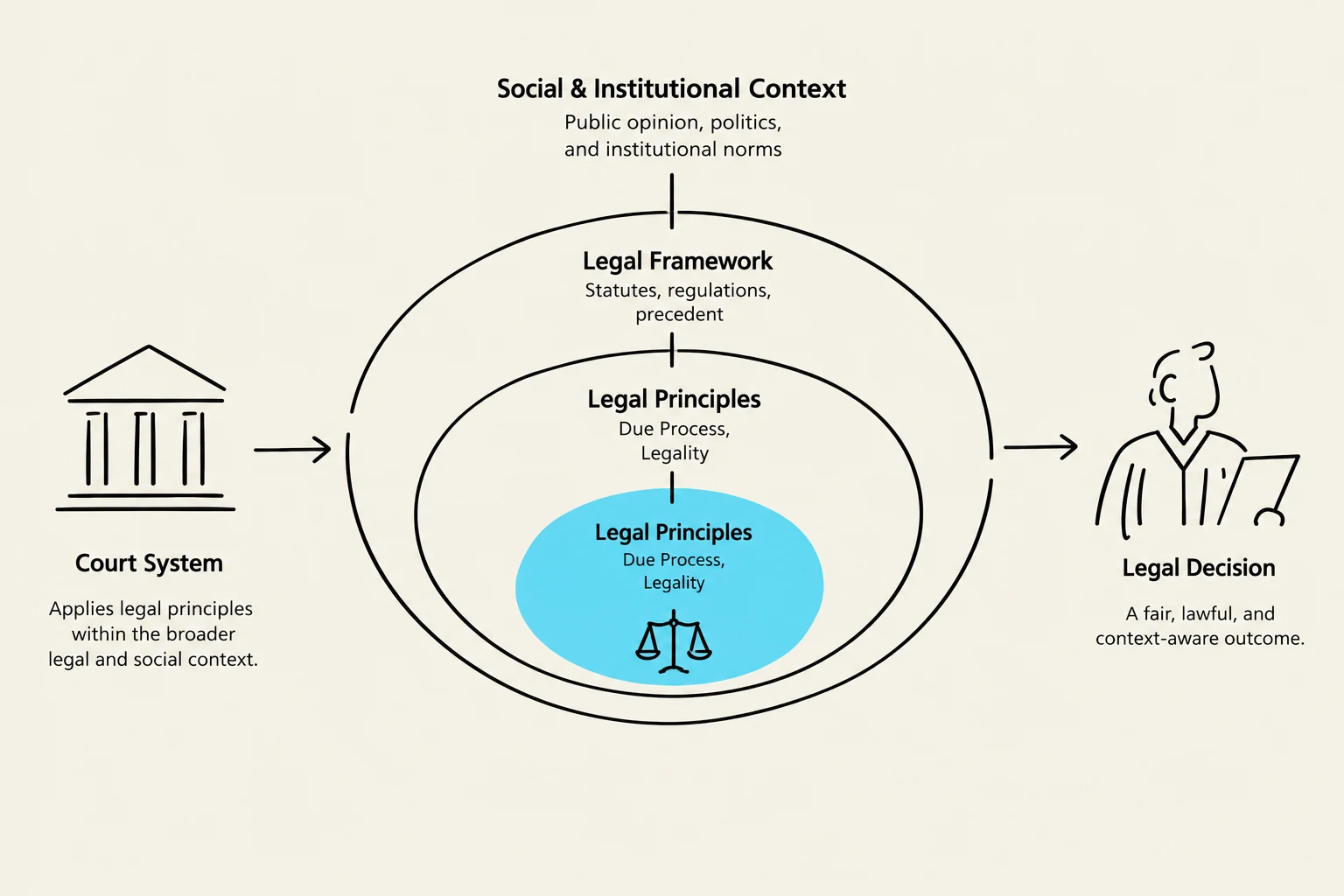
This diagram illustrates the components influencing a legal decision, starting from the court system and legal principles, within the social and institutional context, leading to a legal decision.
Courtroom Actors and the Work Group
The courtroom is populated by two distinct groups: Courtroom Regulars and Changing Participants.
Courtroom Regulars
These individuals experience the court as a routine part of their professional lives.
The Judge: Presides over the court, rules on motions, issues warrants, and instructs the jury.
Prosecutor: The government official conducting criminal proceedings.
Defense Attorneys: Can be Public Defenders (representing indigent defendants) or Private Attorneys (paid by the defendant).
Court Support Staff: Includes the Court Clerk (manages dockets and files), Court Reporter (takes verbatim transcripts), Bailiff (maintains order), and Court Administrator (manages budgets and personnel).
Changing Participants
These individuals are involved in specific cases but do not work in the court daily. This group includes Defendants, Witnesses, Jurors, and Spectators.
Exam Tip: Remember that the "Courtroom Work Group" specifically refers to the regular actors—the Judge, Prosecutor, and Defense Attorney—who interact daily and develop shared norms to process cases efficiently.
Theories of Case Processing
Why do many cases seem to move through the system with surprising speed and cooperation rather than intense conflict? Scholars use three primary theories to explain this:
Assembly-Line Justice: This theory suggests that due to massive caseloads and limited resources, courts use "mass production" techniques. Defendants are often treated as objects to be processed rather than individuals, leading to a heavy reliance on plea bargaining and group processing.
Discretion: Discretion is the authority to make decisions without reference to specific rules. It is exercised through legal judgments, policy priorities (selective enforcement), and personal philosophies.
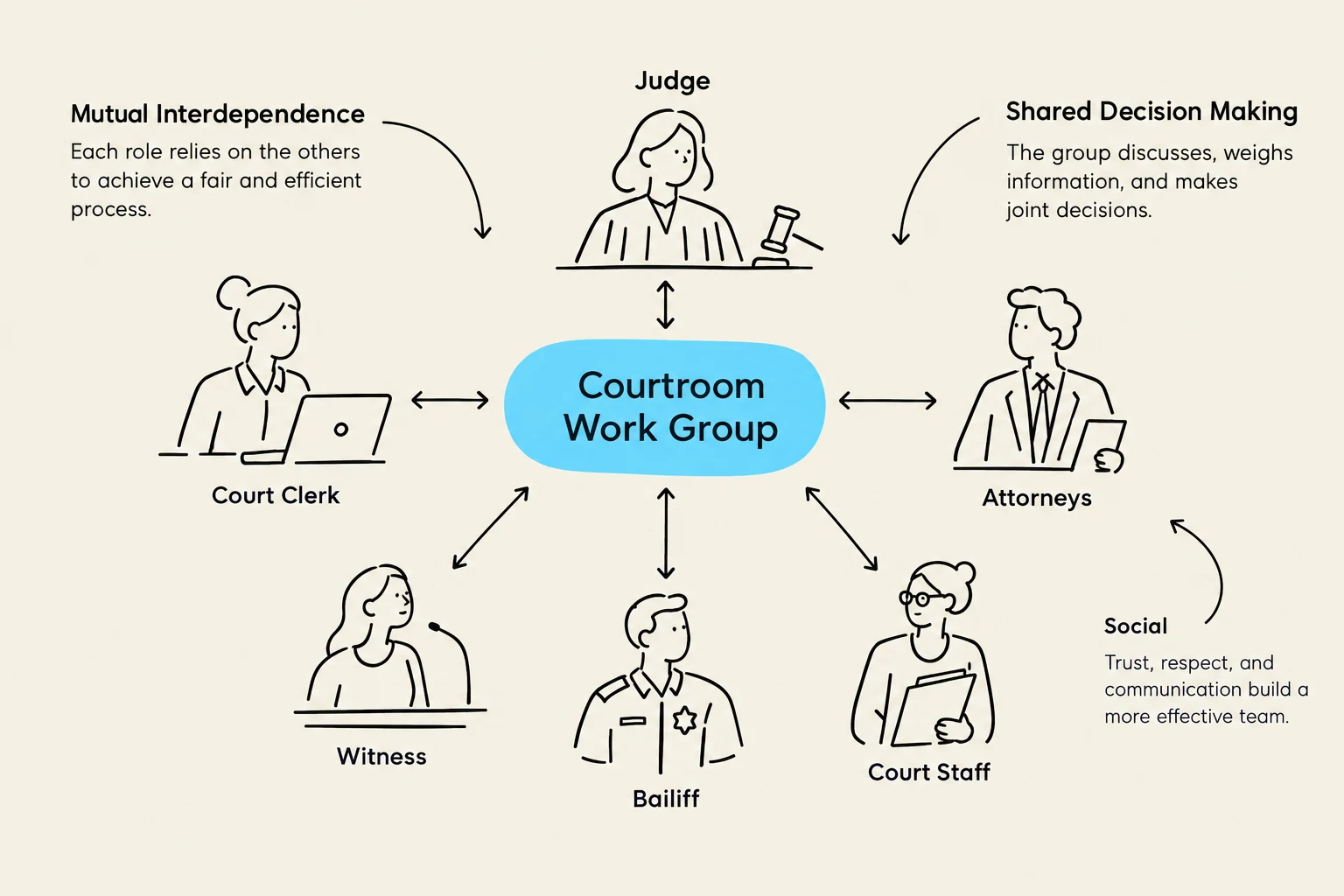
Courtroom Work Group: This theory posits that regular actors develop a "negotiated order". Because they are mutually interdependent—meaning they rely on each other to move cases through the system—they develop unwritten norms and shared goals, such as case disposition (closing cases).
This diagram illustrates the roles within a courtroom work group, emphasizing mutual interdependence and shared decision-making for an efficient legal process.
Legal Reasoning and the IRAC Method
To maintain coherence, legal professionals use legal reasoning to determine the relevance of facts. In trial courts, this often follows the IRAC method:
Issue: What is the legal question? (e.g., "Did the defendant commit burglary?")
Rule: What is the specific statute or law? (e.g., "Penal Code 459 defines burglary as...")
Analysis: How do the specific facts of this case apply to the rule? (e.g., "The defendant entered the building with intent to steal...")
Conclusion: Based on the analysis, what is the outcome? (e.g., "The defendant is guilty.")
In appellate courts, reasoning shifts toward precedent (the doctrine of stare decisis), analogy, and deduction.
The Challenge of Case Delay and the 6th Amendment
A central tension in court administration is the Right to a Speedy Trial guaranteed by the 6th Amendment. While the law seeks swift justice, "case delay" is a persistent problem caused by budget restrictions, court congestion, and continuances.
The landmark case Barker v. Wingo established that the right to a speedy trial is relative, not absolute. The court must use a balancing test to weigh the government's reasons for delay against the defendant's rights.
There are two main approaches to addressing delay:
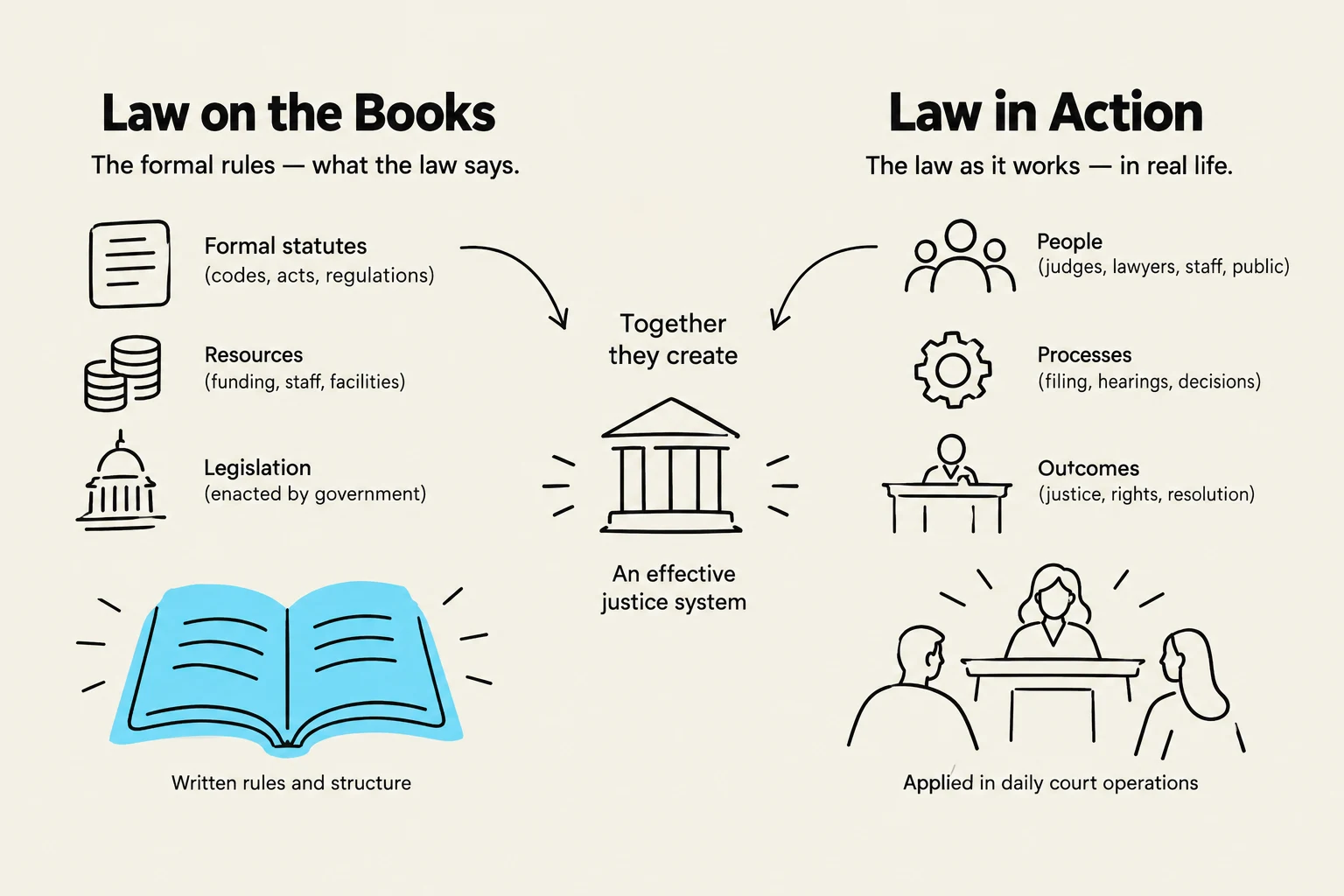
Law on the Books: Focuses on increasing resources (more judges/prosecutors) and implementing stricter speedy trial laws.
Law in Action: Focuses on the "internal ecology"—improving coordination, scheduling, and cooperation among the courtroom work group.
This diagram illustrates the distinction between 'Law on the Books' (formal rules) and 'Law in Action' (how the law functions in practice), showing how elements like statutes, resources, and legislation contribute to an effective justice system through people, processes, and outcomes.
Judicial Accountability and Ethics
Because judges hold immense power, the system must balance Judicial Independence with Judicial Accountability.
Formal Methods of Control: These include Impeachment (a legislative process for serious wrongdoing) and Recall Elections.
Informal Methods of Control: These include intervention by a Chief Judge (such as demotion or censure) or investigations by State Judicial Conduct Commissions.
All actors are also bound by Legal Ethics, such as the ABA's Model Rules of Professional Conduct, which prevent lawyers from misleading the court or allowing perjury.
Keep reading for free.
Create an account to finish this reading and make it part of your study routine.