


In the study of psychological science, researchers often seek to understand how different variables relate to one another in the real world. While experimental research allows us to determine cause and effect, correlational research is a vital tool used to identify patterns and associations between variables. By observing how changes in one factor correspond to changes in another, scientists can build a foundation for understanding complex human behaviors and phenomena.
What is Correlational Research?
Correlational research is a non-experimental method used to measure the statistical relationship between two or more variables. Unlike an experiment, where a researcher actively manipulates an independent variable to see its effect on a dependent variable, a correlational study observes variables as they naturally occur.
This method is particularly useful when it would be unethical or impossible to conduct a controlled experiment. For example, if a researcher wants to study the relationship between smoking and lung cancer, they cannot ethically force a group of people to smoke; instead, they must observe existing smokers and non-smokers to find a correlation.
Key Distinction: In an experiment, you manipulate variables to find causation. In a correlational study, you observe variables to find association.
The Correlation Coefficient ()
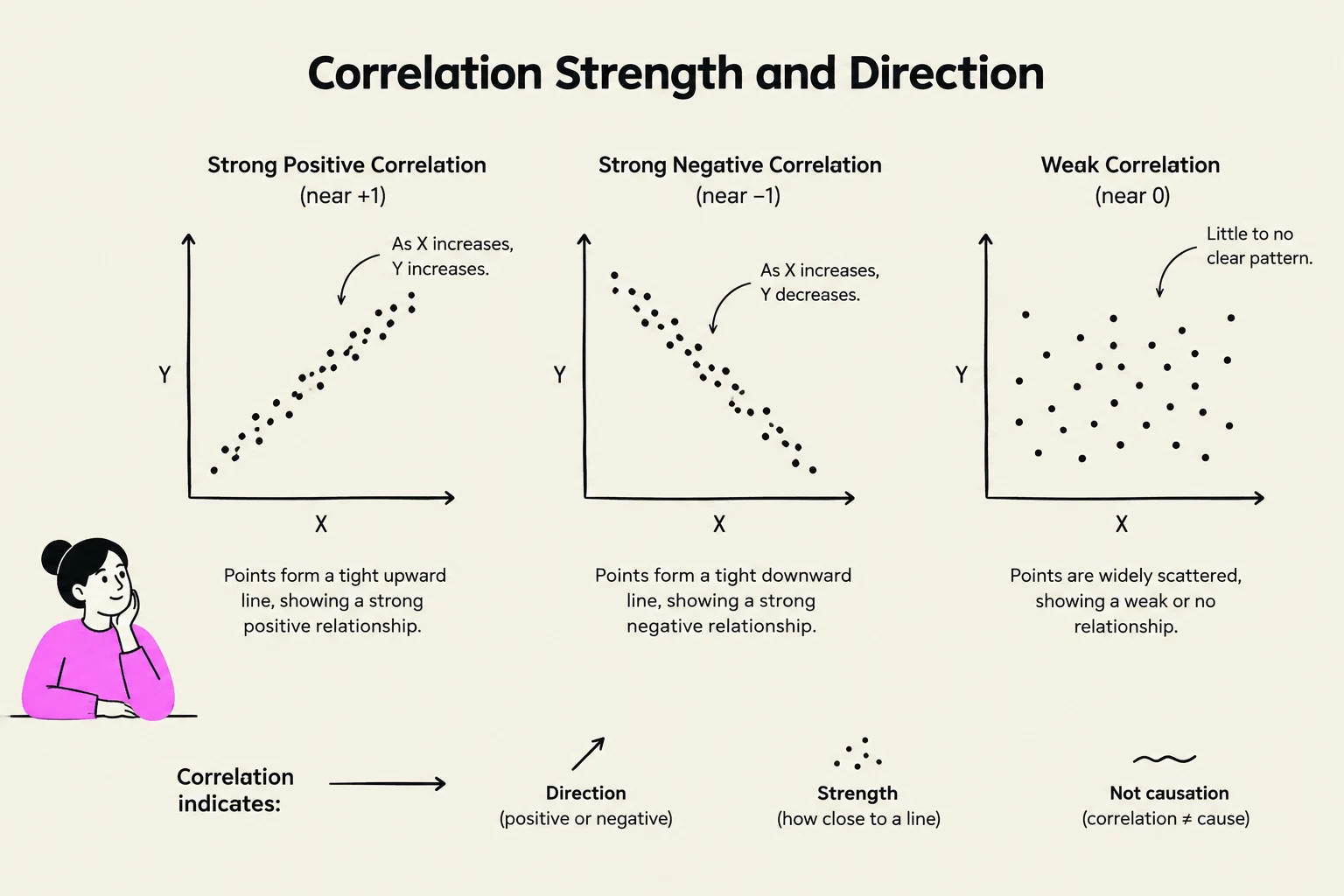
To quantify the strength and direction of a relationship, researchers use a statistical measure known as the correlation coefficient, typically denoted as . This value provides a standardized way to communicate how closely two variables move together.
The correlation coefficient always falls within a specific range:
- +1.00: A perfect positive correlation.
- 0.00: No relationship at all between the variables.
- -1.00: A perfect negative correlation.

Keep reading for free.
Create an account to finish this reading and make it part of your study routine.
Continue reading freeAlready have an account? Log in
Updated