Understanding Contract Formation: Offer and Acceptance
This guide explains the fundamental components of contract formation, including the elements of a valid offer, the process of acceptance, and various methods by which an offer can be terminated. It also touches upon the Statute of Frauds and the Parol Evidence Rule.
At its core, a contract is more than just a piece of paper; it is the objective manifestation of mutual assent between two or more parties. This "meeting of the minds" is legally recognized through two essential components: an offer and an acceptance. Understanding how these elements interact, how they are communicated, and how they can be terminated is fundamental to mastering contract law.
The Anatomy of an Offer
An offer is a proposal that creates the power of acceptance in the offeree. For a communication to qualify as a valid offer, it must satisfy three specific criteria: intent, certainty of terms, and communication.
1. Intent to Enter a Contract
The law does not look at what a person secretly intended in their mind, but rather at their outward manifestations. This is known as the objective standard: would a reasonable person in the offeree's position understand the offeror's words and conduct to mean they were making a binding proposal?.
Crucially, the offeror must propose a present bargain. For example, saying "I will make you an offer next week" is merely a promise to make an offer later, not an offer itself. However, saying "If you pay me $$10,000$ on November 1, I will let you use my cottage starting December 1" is a present bargain because the commitment is immediate, even if the performance happens in the future.
2. Reasonably Certain Terms
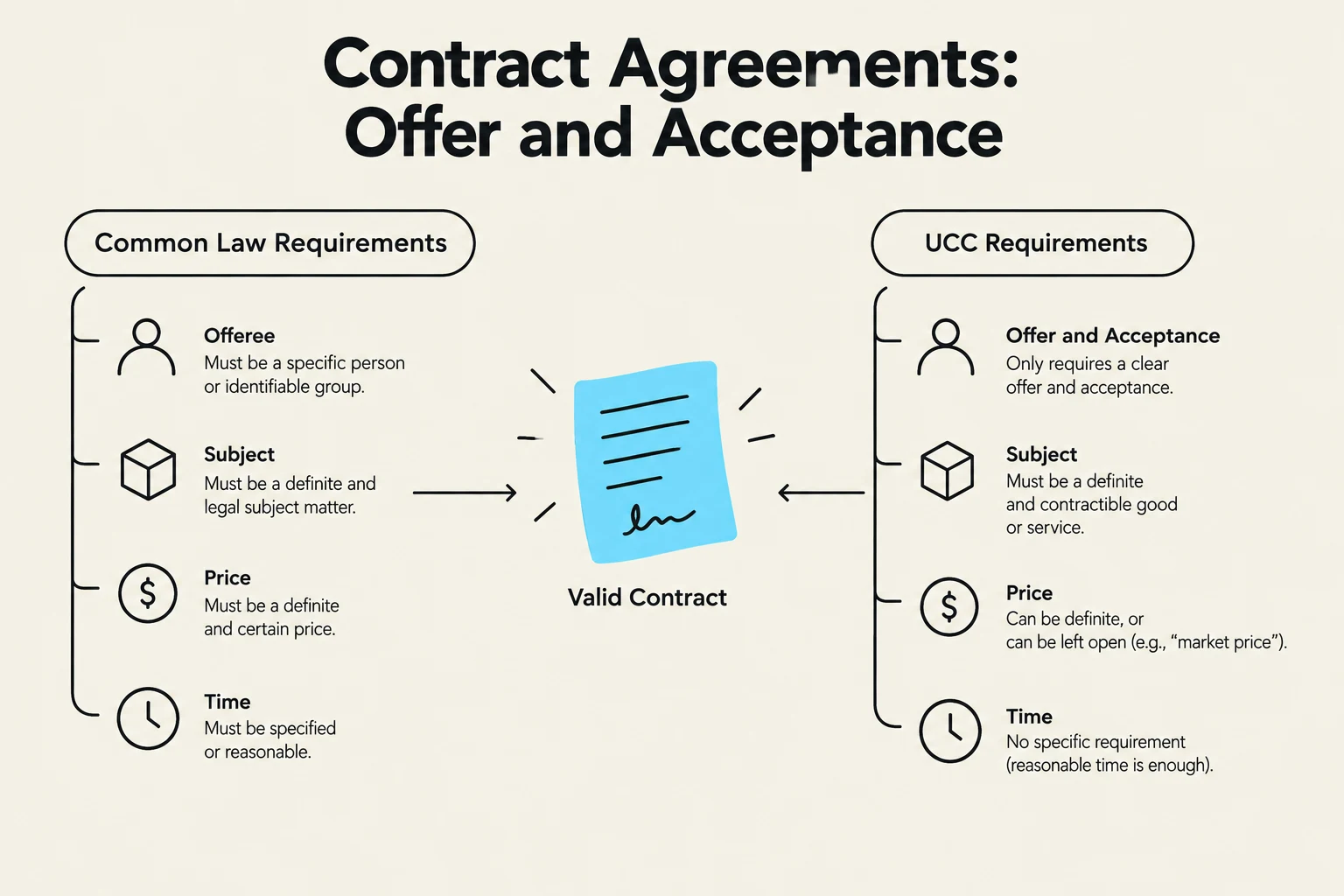
An offer must be clear enough that a court can determine what the parties agreed to. The requirements for "certainty" differ depending on whether the contract is governed by Common Law or the Uniform Commercial Code (UCC).
Common Law: Generally used for services or real estate, this requires the identification of the offeree, the subject matter, the price (consideration), and essential terms like the time for performance.
UCC: Used for the sale of goods, the UCC is more flexible. It only requires the type and quantity of goods to be identified. If other terms are missing, the UCC provides "gap fillers" to supply default terms for price, payment, and delivery.
This diagram illustrates the key requirements for contract agreements under Common Law and the Uniform Commercial Code (UCC), focusing on offer and acceptance, subject matter, price, and time.
3. Communication
An offer is only effective if it is communicated to the offeree. You cannot accept an offer you do not know exists; for instance, if you return a lost dog without ever seeing a reward flyer, you have not accepted the offer.
Exam Tip: Watch out for "Invitations to Bargain." Inquiries, expressions of opinion, price quotes, and preliminary negotiations (like Letters of Intent) are generally not offers. They are merely steps in a negotiation.
Distinguishing Offers from Negotiations
In many business scenarios, what looks like an offer is actually an invitation to negotiate.
Advertisements: Generally, ads are invitations for offers. However, if an ad is highly specific and promises a "limited acceptance" (e.g., "First person to show this ad gets a Rolex for $1"), it may constitute a valid offer.
Price Quotes: Sending a catalog or a price list is usually an invitation to bargain. The actual "offer" often occurs when the customer places an order based on that catalog.
Auctions: In an auction, the auctioneer is inviting offers. The bid made by the participant is the offer, and the fall of the gavel constitutes the acceptance.
Termination of an Offer
An offer does not stay open forever. It can be terminated through several methods, after which the offeree can no longer accept it:
Lapse of Time: If a deadline is stated, it is binding. If no time is stated, the offer ends after a "reasonable time".
Revocation: The offeror can withdraw the offer any time before acceptance. This is effective when the offeree receives notice.
Rejection: The offeree says "no".
Counteroffer: This is a critical concept. At common law, a counteroffer acts as both a rejection of the original offer and the creation of a new offer.
Other Factors: Death/incompetence of a party, destruction of the subject matter, or the subject matter becoming illegal.
Irrevocable Offers
While most offers can be revoked, two specific types are protected:
Feature
Option Contract
Firm Offer (UCC §2-205)
Applicability
Common Law & UCC (non-merchants)
UCC (Merchants only)
Consideration
Required (offeree pays to keep it open)
Not required
Writing Req.
Not strictly required by this rule
Must be a signed writing
Max Duration
As agreed / reasonable time
3 months
The Statute of Frauds: When a Writing is Required
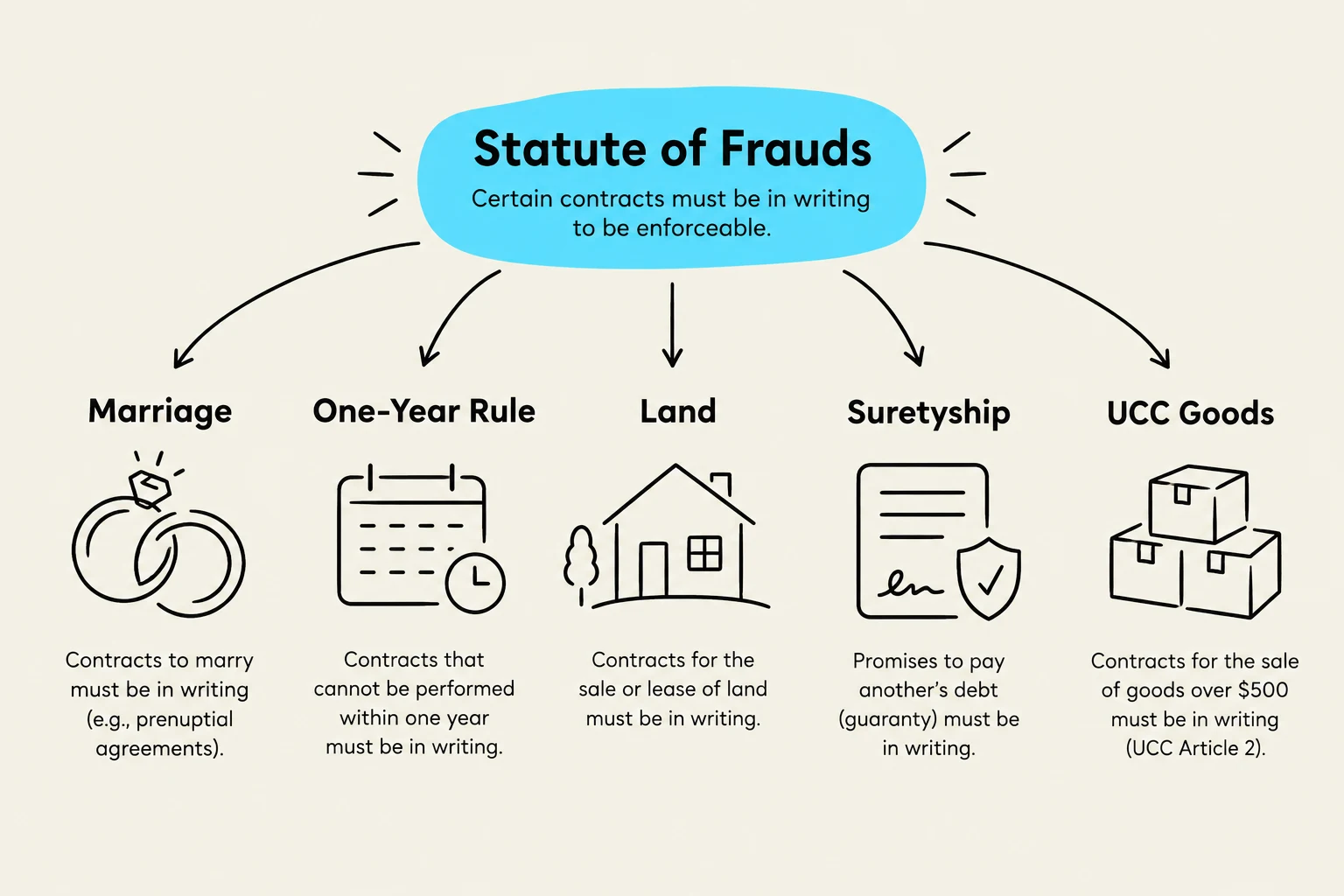
While oral contracts are often binding, the Statute of Frauds (SOF) requires certain contracts to be evidenced by a writing signed by the party to be charged (the person being sued) to be enforceable.
The Statute of Frauds requires certain types of contracts, including those related to marriage, land, and goods over $500, to be in writing to be legally enforceable.
Core SOF Categories and Exceptions
Marriage: Promises made in consideration of marriage (e.g., prenuptial agreements).
One-Year Rule: Contracts that cannot, by their own terms, be performed within one year. Exception: If one party fully performs, the SOF no longer applies.
Land Interests: Real estate transfers, mortgages, and leases. Exception: The "Part Performance" exception (e.g., paying part of the price or taking possession).
Suretyship: Guarantees to pay the debt of another. Exception: The "Main Purpose" exception, if the guarantor seeks a personal economic benefit.
UCC Goods: Sales of goods ≥$500 or leases ≥$1,000.
UCC Exceptions to the Writing Requirement
Even if a sale of goods exceeds $500, an oral contract may be enforceable if:
The goods are specifically manufactured for the buyer.
The party admits to the contract in legal proceedings.
There is partial performance (the buyer accepts the goods or the seller accepts payment).
Case Study: The Baseball Cap Problem
Wayne orally orders 500 caps at $8 each ($$4,000$ total). Pamela ships 120 caps, which Wayne accepts.
For the 120 caps delivered: The contract is enforceable due to the Acceptance Exception.
For the 380 caps undelivered: The oral contract is unenforceable under the SOF because it exceeds $500 and hasn't been performed.
Interpretation and the Parol Evidence Rule
Once a contract is formed, how do we interpret it? Courts focus on the intent of the parties at the time of formation.
The Parol Evidence Rule
This rule prevents parties from introducing evidence of prior or contemporaneous oral/written agreements that contradict or supplement a final, integrated contract. If a contract contains an integration clause (stating the document is the "complete and exclusive expression" of the agreement), courts follow the "Four Corners" Rule, looking only at the written document.
Exceptions (When extrinsic evidence IS allowed):
To prove defects in formation (fraud, duress, mistake).
To clarify ambiguities or correct clerical errors.
To show a condition precedent exists.
Contract Structure
A professionally drafted contract typically follows this anatomy:
Title: Identifies the nature of the deal.
Preamble: Identifies the parties and the date.
Recitals: The "Whereas" clauses providing context and intent.
Body: Contains the Deal-Specific Terms (price, quantity), General Terms (boilerplate, governing law), and Definitions.
Signature Block: Formal execution by authorized representatives.
Keep reading for free.
Create an account to finish this reading and make it part of your study routine.