Understanding Complementary and Alternative Therapies in Clinical Practice
This content explains Complementary and Alternative Medicine (CAM), including its regulation under DSHEA, common herbal preparations, critical drug-herb interactions, and nursing assessment and patient education strategies.
In the modern healthcare landscape, many patients seek health solutions outside the boundaries of conventional medicine. This approach, known as Complementary and Alternative Medicine (CAM), encompasses a wide range of practices, including botanicals, nutritional products, and herbal supplements used to either augment or replace traditional medical therapies. While the term "natural" often leads patients to believe these substances are inherently safe, healthcare providers must approach CAM with a high degree of clinical suspicion. Because many CAM products cannot be patented, they frequently lack the rigorous, large-scale safety and efficacy testing required for conventional pharmaceutical drugs.
Regulation and the DSHEA of 1994
One of the most critical concepts for nursing students to grasp is the regulatory framework governing these products. In the United States, the Dietary Supplement Health and Education Act (DSHEA) of 1994 dictates how supplements are managed.
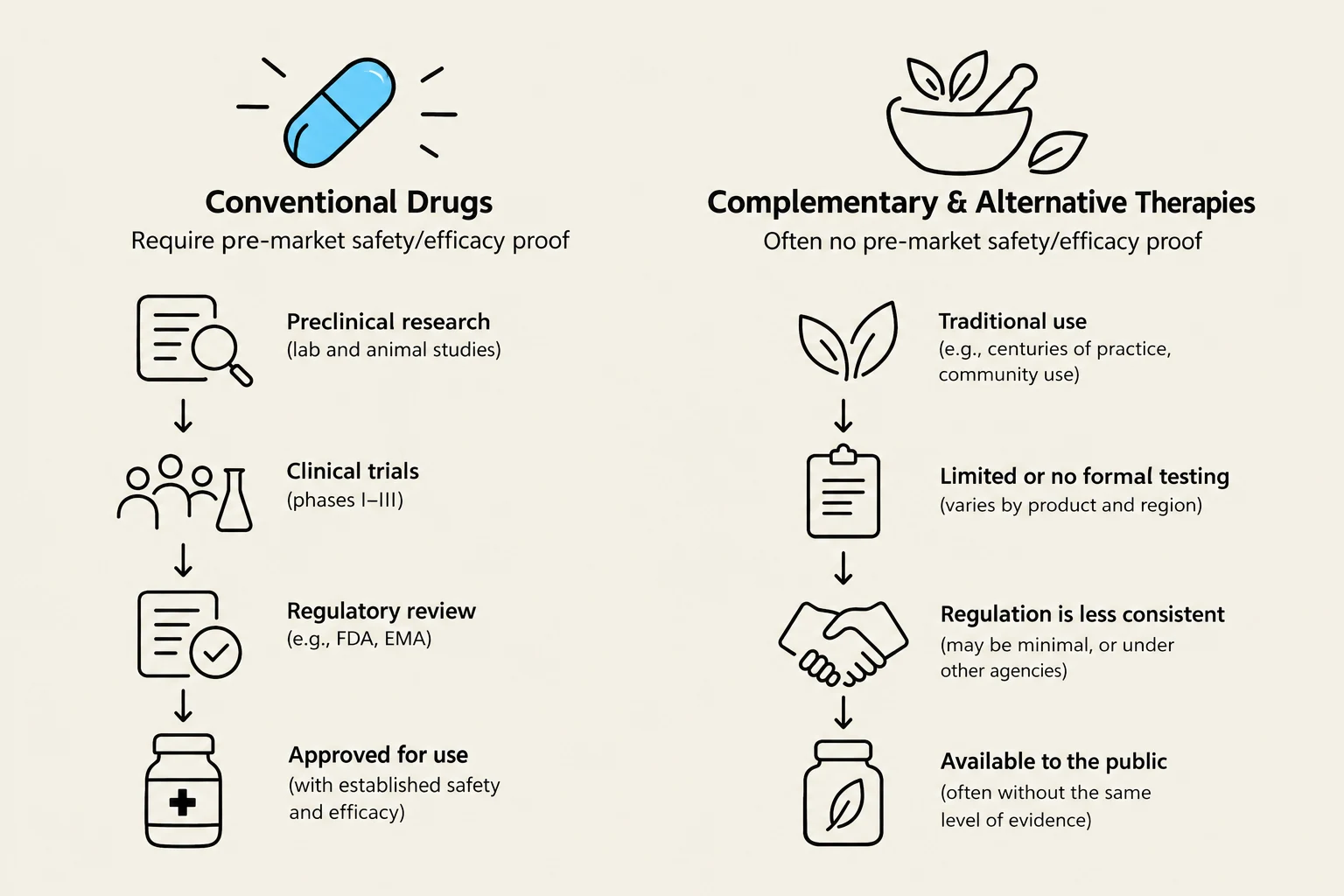
Under DSHEA, dietary supplements are defined as products intended to supplement the diet, taken orally, and labeled as such. A major distinction between supplements and prescription drugs lies in the burden of proof: while drug manufacturers must prove a product is safe and effective before it hits the market, supplement manufacturers are not required to demonstrate safety before marketing their products. Instead, the responsibility falls on the manufacturer to ensure truthful labeling and safety once the product is in circulation.
Claims and Manufacturing Standards
When reviewing supplement packaging, you will notice specific language regarding what the product "does." Manufacturers are permitted to make "structure and function" claims—for example, stating a product "helps increase blood flow" or "supports bone health". However, they are strictly prohibited from making "disease claims." They cannot state that a product can "diagnose, treat, cure, or prevent" a specific disease (such as claiming a supplement "cures cancer").
To ensure a baseline of quality, manufacturers must adhere to Current Good Manufacturing Practices (CGMPs). These standards require that labels accurately list the quality and strength of the contents and ensure that the products are free from contaminants.
This diagram compares the approval processes for conventional drugs and complementary/alternative therapies, highlighting differences in pre-market testing and regulation.
Common Herbal Preparations
Herbal medicine is often administered in various forms depending on the part of the plant being used and the desired speed of action. Understanding these preparations helps nurses provide better patient education regarding administration.
Decoction: This involves boiling tougher plant materials, such as bark or roots, in water to extract active compounds.
Infusion: A gentler method where plant materials like leaves or flowers are steeped in hot water.
Tincture: A concentrated extract made by soaking herbs in a solvent, typically alcohol, glycerin, or vinegar.
Topical Applications: These include liniments (liquid preparations for rubbing on the skin) or poultices (moist masses of plant material applied directly to the body).
Critical Drug-Herb Interactions
The most significant risk associated with CAM is the potential for drug-herb interactions. Many botanicals interact with the body's metabolic pathways, specifically by inducing or inhibiting the cytochrome P450 (CYP450) enzyme system in the liver.
When an herb induces an enzyme, it speeds up the metabolism of a co-administered drug, potentially making that drug less effective. Conversely, when an herb inhibits an enzyme, it slows down drug metabolism, which can lead to toxic levels of the medication in the bloodstream.
High-Risk Herbal Remedies
Herb
Common Use
Clinical Risk/Interaction
St. John’s Wort
Mild depression
Potent Inducer: Decreases effectiveness of antidepressants, birth control, and digoxin.
Goldenseal
Various
Potent Inhibitor: Can increase the levels of other drugs in the body.
Garlic
Cholesterol/BP
Anticoagulant Risk: Increases bleeding risk; reduces effectiveness of saquinavir.
Ginkgo biloba
Cognitive support
Anticoagulant Risk: Increases bleeding risk.
Ginger
Nausea
Anticoagulant Risk: Increases bleeding risk.
Ginseng
Energy/Vitality
Anticoagulant Risk: May interact with warfarin and calcium channel blockers.
Chamomile
Sleep/Anxiety
Anticoagulant Risk: Increases bleeding risk.
Exam Tip: If a question asks about the most common danger of combining herbs with medications, look for "increased bleeding risk" (especially with anticoagulants) or "altered drug metabolism via CYP450 enzymes."
Specific Botanical Profiles
To provide comprehensive care, nurses should be familiar with specific botanicals frequently used by patients:
St. John’s Wort: While used for mild depression, its role as a potent enzyme inducer makes it dangerous for patients on many maintenance medications, including oral contraceptives and digoxin.
Asian Ginseng: This is a notable example of a supplement that can interfere with both blood thinners (warfarin) and blood pressure medications (calcium channel blockers).
Turmeric: Often used for its anti-inflammatory properties, it should be monitored in patients with existing clotting concerns.
Lavender: Frequently used in aromatherapy for relaxation and anxiety reduction.
Saw Palmetto: Commonly used by men for prostate health, but its impact on hormone levels requires monitoring.
Echinacea: Often used to support the immune system during colds, though its efficacy is a subject of ongoing debate.
This diagram illustrates how a herb acting as an enzyme inducer can increase liver enzyme activity, leading to faster drug metabolism and a decreased drug concentration over time.
Clinical Implications and Nursing Assessment
The "natural" label is a common misconception among patients. As a nurse, your primary responsibility is to perform a thorough assessment that includes all herbal and over-the-counter (OTC) supplements.
The Nursing Process in CAM Assessment
When applying the Clinical Judgment Measurement Model, the nurse must Recognize Cues by asking open-ended questions such as, "Please tell me about any herbal remedies or nutritional supplements you take regularly". This is a vital part of medication reconciliation to avoid omissions, duplications, or dangerous interactions.
Patient Education and Safety
Nurses must provide clear, evidence-based guidance to ensure patient safety:
Surgical Preparation: Patients should be advised to discontinue all herbal therapies 2 to 3 weeks before surgery to minimize the risk of excessive bleeding or interference with anesthesia.
Pregnancy and Nursing: Patients must consult their healthcare provider before starting any herbal regimen, as many botanicals have not been tested for safety in pregnant or lactating women.
Medication Adherence: Patients should be taught that adding an OTC supplement or herbal remedy requires notification of their physician, as it may alter their prescribed treatment plan.
Clinical Pearl: Always document the specific herb, the dosage, and the frequency used by the patient. "Taking vitamins" is too vague; "Taking 500mg of Garlic extract twice daily" is actionable clinical data.
By integrating a thorough assessment of CAM into routine practice, nurses act as the first line of defense against potentially harmful drug-herb interactions, ensuring that the patient's pursuit of "natural" health does not compromise their clinical safety.
Keep reading for free.
Create an account to finish this reading and make it part of your study routine.