Understanding Combining Vowels in Medical Terminology
This guide explains the essential role of combining vowels in medical terminology, detailing the rules for their use when connecting word roots to suffixes or other word roots to ensure clear pronunciation and accurate meaning.
In the complex language of medicine, words are not just random strings of letters; they are precision-engineered tools built from specific components. To understand these terms, one must first understand the root. The root is considered the foundation of a word, providing the core meaning upon which all other elements are attached.
However, simply stacking roots and suffixes together often results in words that are difficult to pronounce. To solve this, medical terminology utilizes a combining vowel. Usually the letter o, the combining vowel acts as a linguistic bridge, facilitating smooth pronunciation and helping to define the relationship between different word parts.
The Mechanics of the Combining Vowel
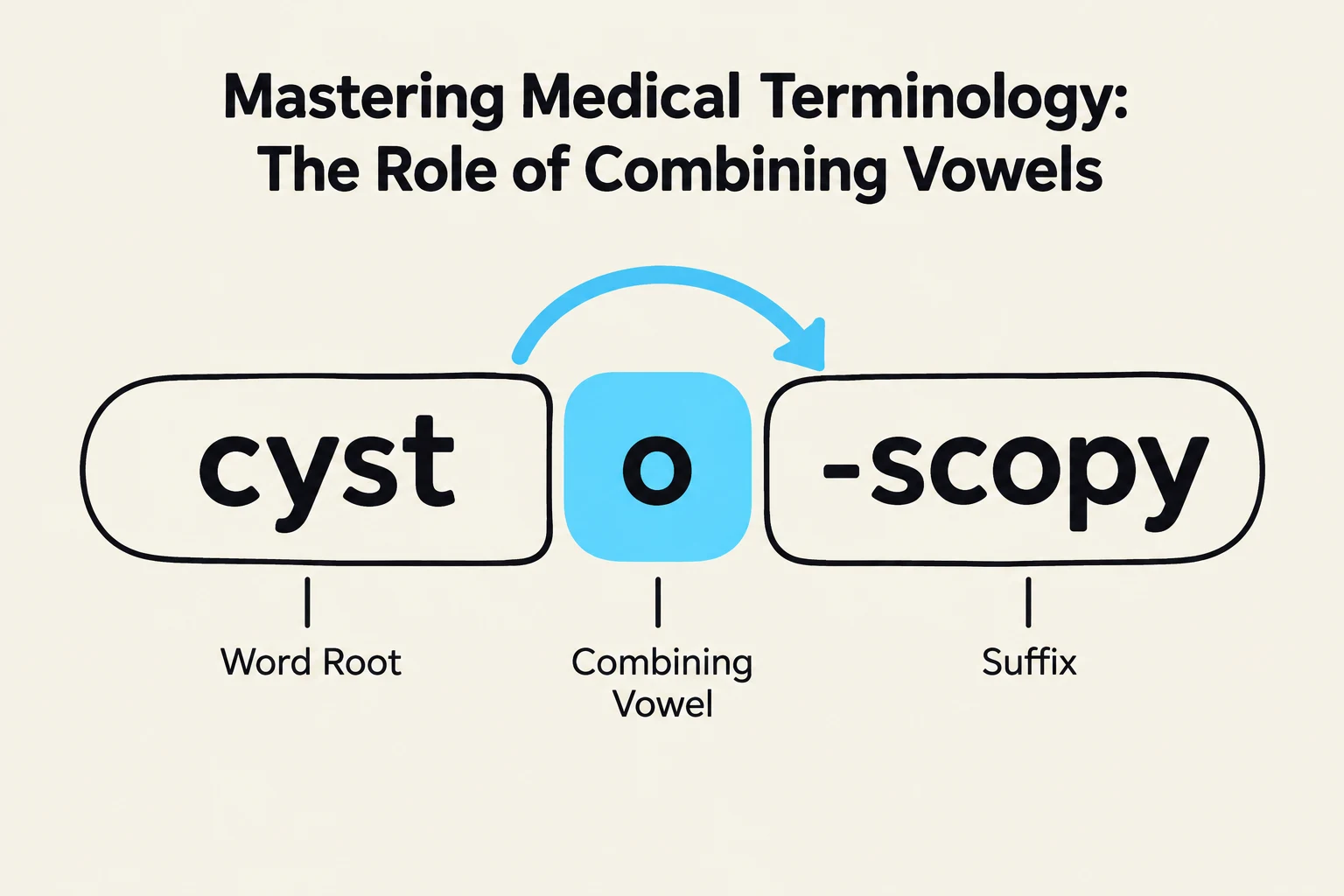
This diagram illustrates how a combining vowel, 'o', is used to connect a word root, 'cyst', with a suffix, '-scopy', to form a medical term.
A combining vowel is not just an arbitrary addition; it serves a functional role in informing the reader of a word element's relationship to a specific body part or system. For example, in the term cardiomyopathy, the combining vowel informs the reader that the term pertains to the heart. This flexibility allows a single root to be combined with various other elements to describe a vast array of illnesses, anatomical structures, and medical conditions.
There are two primary rules that dictate when a combining vowel should be used:
1. Connecting a Word Root to a Suffix
The most common use of a combining vowel is to join a word root to a suffix. The rule is straightforward: use a combining vowel when the suffix begins with a consonant. This maintains the phonetic flow and prevents awkward transitions between sounds.
Example: Consider the term cystoscopy. The root is cyst/o and the suffix is -scopy. Because the suffix begins with the consonant "s," the combining vowel o is used to join them.
Exam Tip: If the suffix begins with a vowel (such as -itis or -ectomy), you typically drop the combining vowel from the root. Always check the first letter of the suffix before deciding to include the "o".
2. Connecting Two Word Roots
Medical terms often describe complex conditions involving multiple anatomical structures. In these cases, two or more word roots are joined together. When joining two roots, a combining vowel is typically used to link them, regardless of whether the second root begins with a vowel or a consonant.
This rule ensures that the "combining form" (the root plus its vowel) remains intact, which is essential for the standard structure of medical language.
Advanced Applications and Complex Structures
This diagram illustrates how to combine word roots and suffixes, specifically showing that the combining vowel 'o' is retained when the second root begins with a vowel, as in the formation of the word 'gastroenterology'.
As medical terminology becomes more specific, the use of combining vowels follows predictable patterns even in highly complex terms.
Handling Vowel-Starting Roots
A common point of confusion for students is whether to use a combining vowel when the second root starts with a vowel. Even in these instances, the combining vowel is often retained to maintain the standard structure.
Example: Gastroenterology. In this term, the root gastr/o is linked to the root enter/o, which is then linked to the suffix -logy. Even though "enter" begins with a vowel, the "o" from the first root is maintained to bridge the two concepts.
Complex Multi-Root Terms
In advanced clinical settings, you may encounter "heavyweight" terms that utilize several roots in a row. These terms require multiple combining vowels to connect each anatomical structure before reaching the final suffix.
Example: Uvulopalatopharyngoplasty. This complex term uses multiple combining vowels to link the roots uvul/o, palat/o, and pharyng/o before applying the suffix -plasty.
Summary of Word Elements
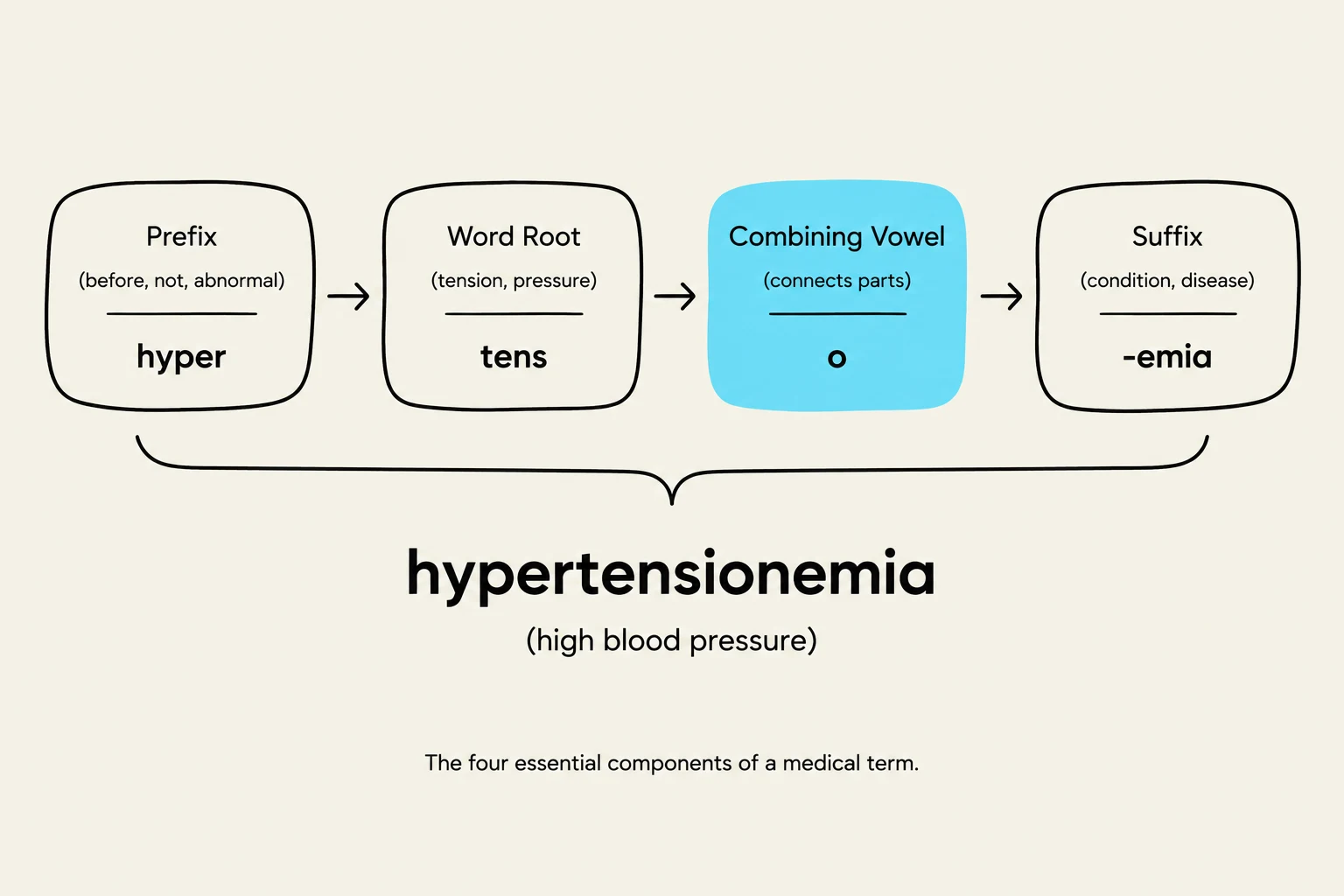
This diagram illustrates how the medical term "hypertensionemia" is formed by combining a prefix, word root, combining vowel, and suffix, with "hypertensionemia" meaning "high blood pressure."
To master the use of combining vowels, you must be able to deconstruct a word into its four constituent parts:
Prefix: Added to the beginning of a word to modify its meaning.
Word Root: The core foundation of the word.
Combining Vowel: The letter (usually "o") used for pronunciation.
Suffix: Added to the end of a word to indicate a condition, disease, or procedure.
Understanding these rules is the first step toward clinical literacy, allowing you to translate complex terms into understandable anatomical and pathological descriptions.
System
Root/Combining Form
Definition
Integumentary
Derm/o
Skin
Integumentary
Kerat/o
Keratin, horny layer of skin
Integumentary
Melan/o
Dark, black, melanin
Musculoskeletal
Arthr/o
Joint
Keep reading for free.
Create an account to finish this reading and make it part of your study routine.