


In linguistics, words are often categorized into two broad groups: open classes and closed classes. While open classes (like nouns and verbs) are constantly expanding as new technology and slang emerge, closed word classes are characterized by a relatively small, fixed membership that remains stable over long periods. These words act as the "glue" of a language, providing the structural framework necessary to connect ideas and specify relationships between entities.
The four primary closed word classes are pronouns, determiners, conjunctions, and prepositions.
Pronouns
Pronouns are words that stand in place of nouns or noun phrases. Their primary purpose is to prevent repetitive phrasing and to maintain cohesion within a text. For example, instead of saying "Janet likes music. Janet likes loud music," we use a pronoun: "Janet likes music. She likes it".
Properties of Pronouns: Gender and Number
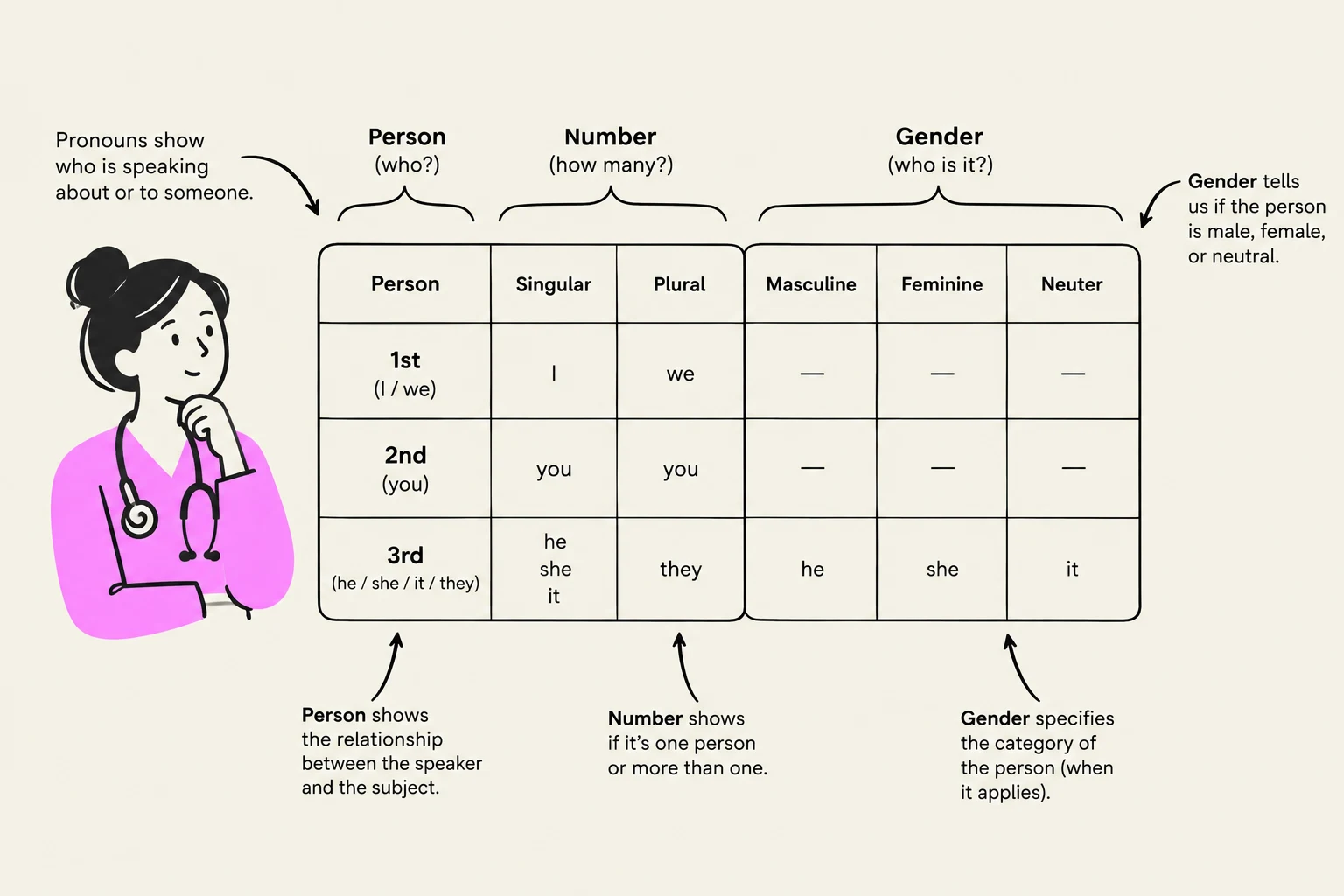
Pronouns are defined by several key linguistic properties, most notably person, number, and gender:
- Person: Refers to the speaker (first person, e.g., I), the listener (second person, e.g., you), or others (third person, e.g., he/she/it).
- Number: Distinguishes between singular forms (e.g., I, he, it) and plural forms (e.g., we, they).
- Gender: Traditionally links to masculine, feminine, or neuter categories.
Specific Types of Pronouns
Beyond general pronouns, there are specialized categories:
- Reflexive Pronouns: These are used when the subject and the object of a verb are the same entity (e.g., "I sent a photo of myself" or "They hurt themselves").
- Indefinite Pronouns: These refer to less specific or non-specific entities, such as some, any, or enough.
Keep reading for free.
Create an account to finish this reading and make it part of your study routine.
Continue reading freeAlready have an account? Log in
Updated