Understanding Civil Liberties and the Rights of the Accused in the U.S.
An overview of fundamental civil liberties in the U.S., including freedom of expression, religion, and the right to bear arms, as well as the rights of the accused under the Bill of Rights and due process.
In a democratic society, the relationship between the government and the people is defined by a delicate balance of power. While the government is tasked with maintaining order and safety, it is simultaneously restricted from infringing upon the fundamental freedoms of its citizens. These fundamental freedoms are known as civil liberties: specific individual rights, such as the right to a fair trial, that are constitutionally protected against government infringement. Understanding how these rights are defined, applied, and defended is essential to understanding the American legal system.
The Constitutional Framework: From Federal to State Protection
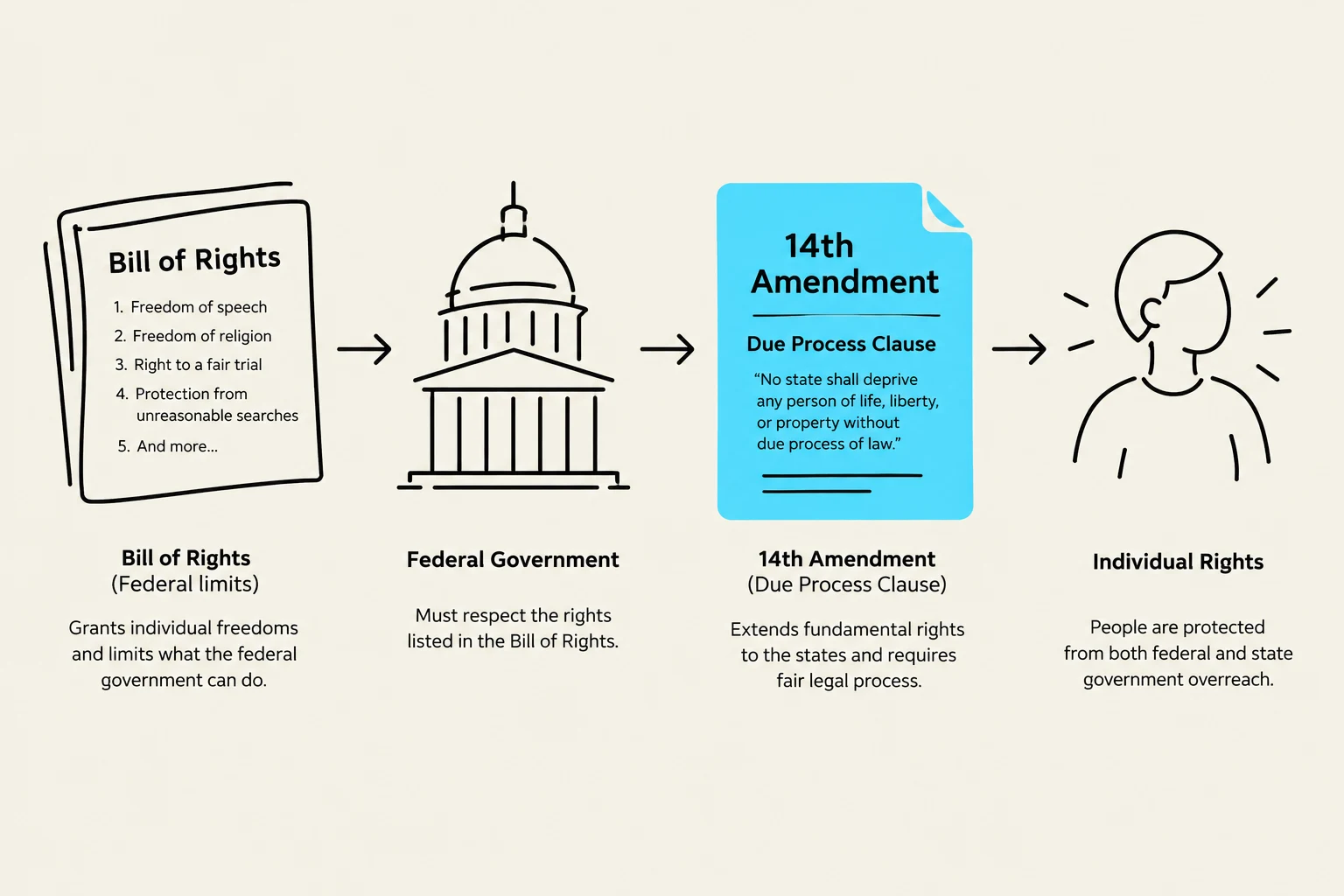
The foundation of American liberty lies in the Bill of Rights, the first ten amendments to the Constitution, which list the specific rights the federal government is obligated to protect. However, for much of early American history, these protections applied primarily to the federal government, leaving state governments with significant leeway in how they treated their citizens.
This changed through a legal evolution involving the Fourteenth Amendment. This amendment contains the due process clause, which stipulates that no person shall be deprived of life, liberty, or property without due process of law. Over time, the Supreme Court has used this clause to engage in selective incorporation—the process of invoking the Fourteenth Amendment to apply the protections of the Bill of Rights to the states one by one.
Exam Tip: If you are asked about the difference between the Bill of Rights and Selective Incorporation, remember that the Bill of Rights originally limited federal power, while selective incorporation (via the 14th Amendment) extends those limits to state governments.
This diagram illustrates the relationship between the Bill of Rights, the Federal Government, the 14th Amendment's Due Process Clause, and individual rights, explaining how fundamental rights are protected from government overreach.
Freedom of Expression
Freedom of expression is often considered the most basic of democratic rights, yet it is not absolute. The government may limit expression if it endangers national security, deprives others of their rights, or causes direct harm.
Speech and the Press
The First Amendment protects the right to speech and the press, but there are clear boundaries. You are generally free to say or write almost anything except for material that is obscene, constitutes slander (spoken false damage to reputation), or libel (written false damage to reputation).
When dealing with public figures, the legal standard for libel is much higher; a plaintiff must prove actual malice, meaning the statement was made with a knowing or reckless disregard for the truth. Additionally, the government is largely prohibited from prior restraint, which is the act of stopping speech or publication before it actually occurs.
Assembly and Religion
The right to assembly allows citizens to gather for various purposes. While the government cannot ban assembly based on its message, it can regulate the "time, place, and conditions" of a gathering to ensure public safety, provided these rules are applied evenly to all groups.
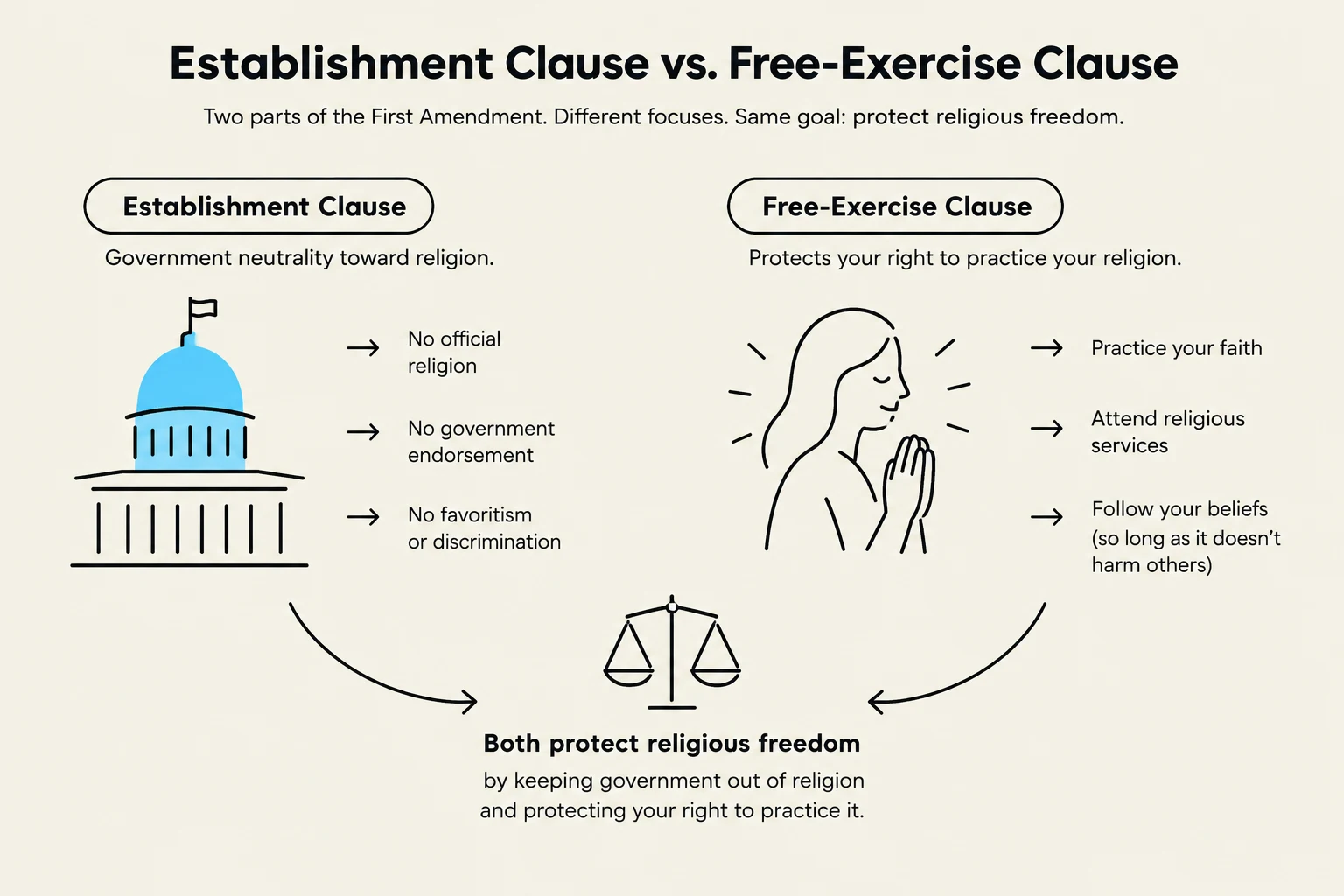
Religious freedom is protected through two distinct lenses:
The Establishment Clause: This prevents the government from favoring one religion over another or favoring religion over non-religion. Courts often use the Lemon test to evaluate this, checking if a policy has a nonreligious purpose, a neutral effect, and does not foster "excessive government entanglement" with religion.
The Free-Exercise Clause: This protects an individual's right to practice their religion as they see fit, though this right may be limited if religious practices conflict with valid, neutral laws.
This illustration explains the Establishment Clause and the Free-Exercise Clause of the First Amendment, both of which protect religious freedom.
The Right to Bear Arms
The Second Amendment has been a subject of significant judicial interpretation. Historically, it was viewed as a protection for state militias. However, in the landmark case District of Columbia v. Heller (2008), the Supreme Court ruled that the amendment protects an individual's right to bear arms for personal use. This individual right was later extended to apply to state and local governments in McDonald v. Chicago (2010).
Rights of the Accused and Due Process
The legal system includes "procedural due process"—the specific steps authorities must follow before a person can be lawfully punished. These safeguards are designed to prevent wrongful arrest, conviction, and punishment.
The Stages of Legal Protection
Search and Seizure (4th Amendment): Police generally need probable cause and a warrant to conduct a search. If evidence is obtained illegally, the exclusionary rule may prevent that evidence from being used in court.
Arrest and Interrogation (5th Amendment): Individuals have the right against self-incrimination (the right to remain silent). Following Miranda v. Arizona (1966), police must issue a "Miranda warning" to ensure suspects know their rights before interrogation.
Trial (6th Amendment): Defendants have the right to legal counsel, a speedy and public trial, and the right to confront witnesses.
Sentencing (8th Amendment): The Constitution prohibits cruel and unusual punishment and excessive bail.
Worked Example: The Exclusionary Rule
Imagine a police officer enters a home without a warrant or probable cause and finds illegal contraband. Under the exclusionary rule, even though the contraband is real evidence of a crime, the court may refuse to allow it to be used against the defendant because the constitutional protection against unreasonable search and seizure was violated.
While these protections are robust, the application of rights can be uneven. Issues such as racial profiling and varying incarceration rates across different states highlight the ongoing struggle to ensure that civil liberties are applied equally to all citizens.
Keep reading for free.
Create an account to finish this reading and make it part of your study routine.