Understanding Citizenship: Gender, State, and Social Membership
Explores the multifaceted nature of citizenship beyond legal status, examining feminist critiques of traditional theories, the roles of welfare states, and the concept of intersectionality in shaping power and belonging.
The concept of citizenship is often understood as a single status—a legal bond between an individual and a state. However, feminist scholars argue that we must speak of citizenships in the plural to capture the complex ways power is experienced in everyday life. This includes citizenship as legal status, as social membership, and as active political participation. By examining these different dimensions, we can see how gendered power dynamics shape who is included in society, how resources are distributed, and how individuals exercise their agency.
Social Membership and the Welfare State
Traditional theories of citizenship, most notably the framework developed by T.H. Marshall, viewed citizenship as a status that grants equal rights and duties to all members of a community. While Marshall’s approach was technically "gender-neutral," it was built upon an androcentric (male-centered) foundation. In the era when these theories were formulated, "full membership" in a community was implicitly tied to the male breadwinner—a worker who earned a wage and supported a family.
Feminist scholars have critiqued this by highlighting how gendered social rights were often excluded from the mainstream narrative. While Marshall focused on the rights of the male worker, women’s claims often centered on different areas, such as maternal health, widows' pensions, and protections for married women in the workforce.
From Decommodification to Defamilialization
In the study of welfare regimes, a central concept is decommodification: the degree to which a person can survive without relying entirely on the market for their livelihood. While this was a key metric for analyzing class-based welfare states, feminists argued it was insufficient for understanding gender.
For many women, being "decommodified" from the labor market was not enough if they remained heavily dependent on male relatives for economic survival. This led to the introduction of defamilialization—the ability of an individual to maintain a decent standard of living independently of family ties through paid work or social provisions.
Exam Tip: When comparing welfare state models, remember that "decommodification" focuses on the relationship between the individual and the market, whereas "defamilialization" focuses on the relationship between the individual and the family.
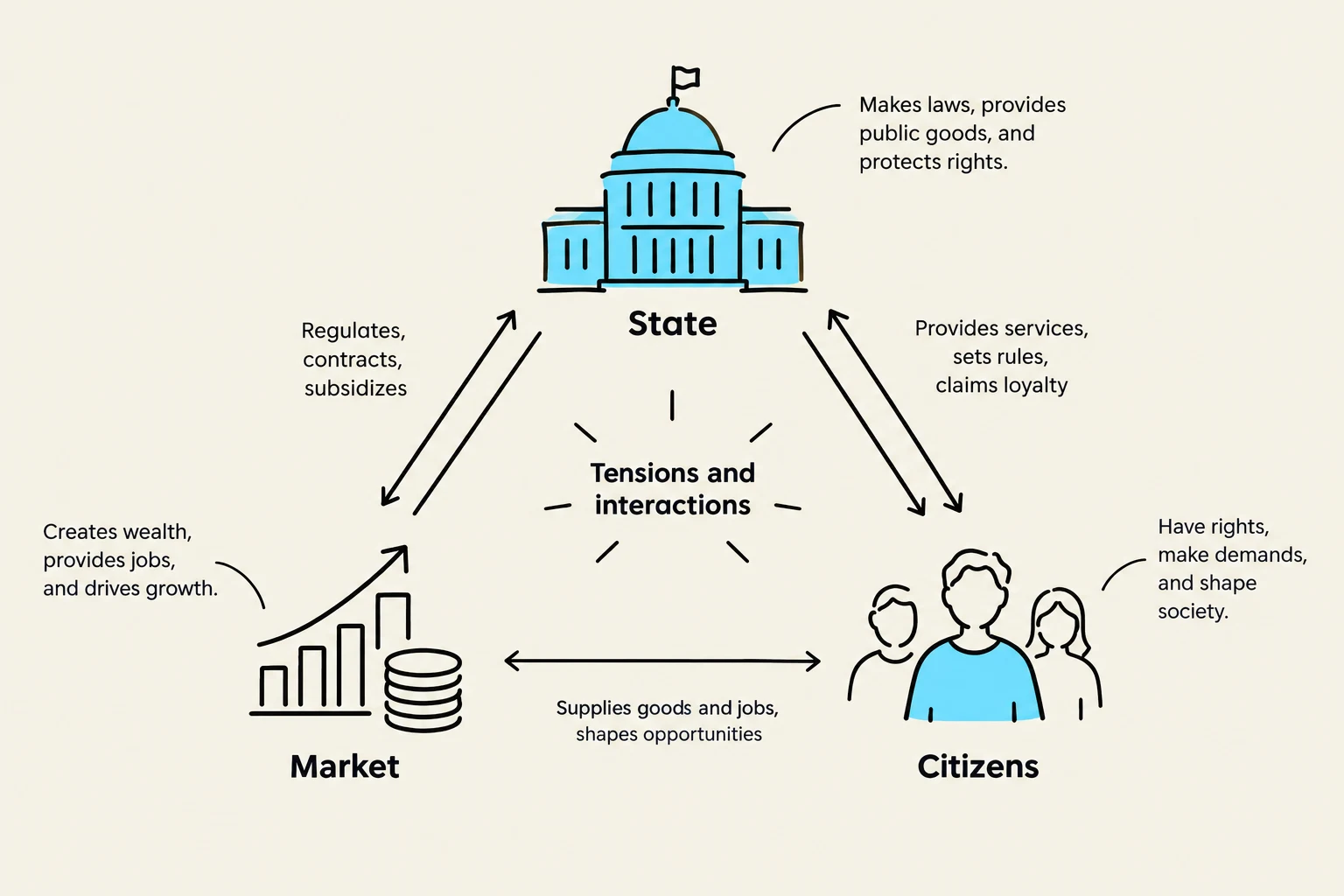
This diagram illustrates the interactions and tensions between the State, the Market, and Citizens, outlining their respective roles and influences on society.
The tension between these spheres can lead to different outcomes:
Refamilialization: A process where care obligations are shifted back onto family members (predominantly women), often due to the retrenchment of state services.
Gender Regimes: Typologies that categorize how different states manage the tension between paid work and unpaid care.
Participatory Citizenship and Agency
Beyond social rights, citizenship involves participatory citizenship—the active engagement of individuals in political life. This is often rooted in civic republicanism, which emphasizes the duty of the citizen to participate in the community.
However, feminist critiques point out that "civicness" is not a neutral concept. The ability to participate in deliberative democracy often requires time, money, and social networks—resources that are frequently unavailable to those burdened by unpaid care work.
Despite these structural barriers, women exercise agency through citizenship from below. This refers to political action that occurs outside formal institutions, such as social movements, grassroots organizing, and "acts of citizenship" that challenge existing power structures.
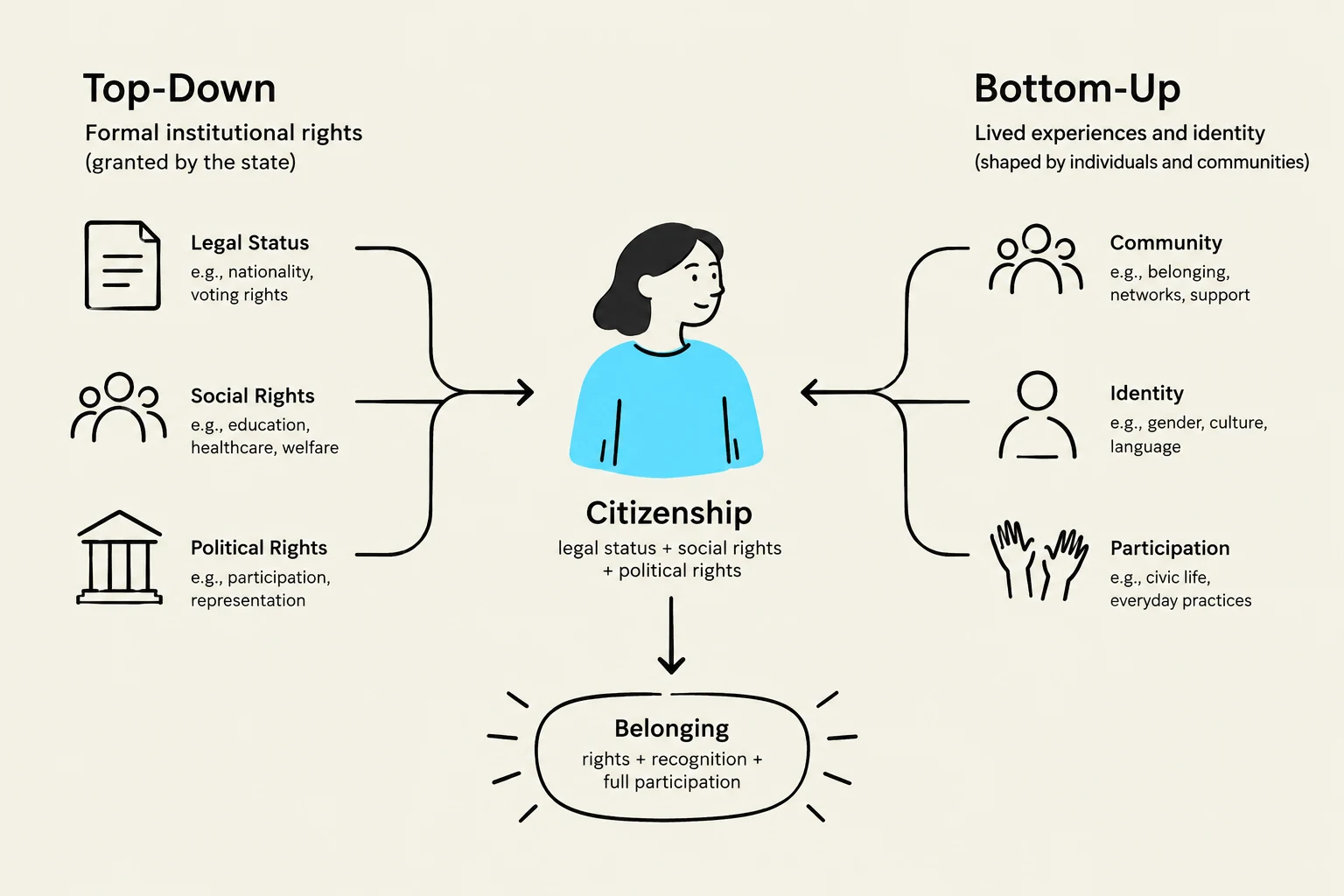
This diagram illustrates the concept of citizenship, differentiating between top-down formal institutional rights granted by the state (legal status, social rights, political rights) and bottom-up lived experiences and identity shaped by individuals and communities (community, identity, participation). Both contribute to a sense of belonging, defined as rights, recognition, and full participation.
The Dilemma of Difference
A fundamental challenge in feminist theorizing is the dilemma of difference (sometimes called Wollstonecraft’s dilemma). This dilemma describes the impossible choice women face when claiming rights:
Universalism (Gender-Neutral Citizenship): Advocating for equal rights based on a universal human rights framework. The risk here is "false universalism," where the "universal" standard is actually a male template that ignores the specific needs and biological realities of women.
Gender-Differentiated Citizenship: Validating women’s distinct roles as carers and protectors, often through an ethic of care. While this recognizes women's contributions, it risks "essentializing" gender roles—treating women as naturally being carers, which can be used to justify their exclusion from the public sphere.
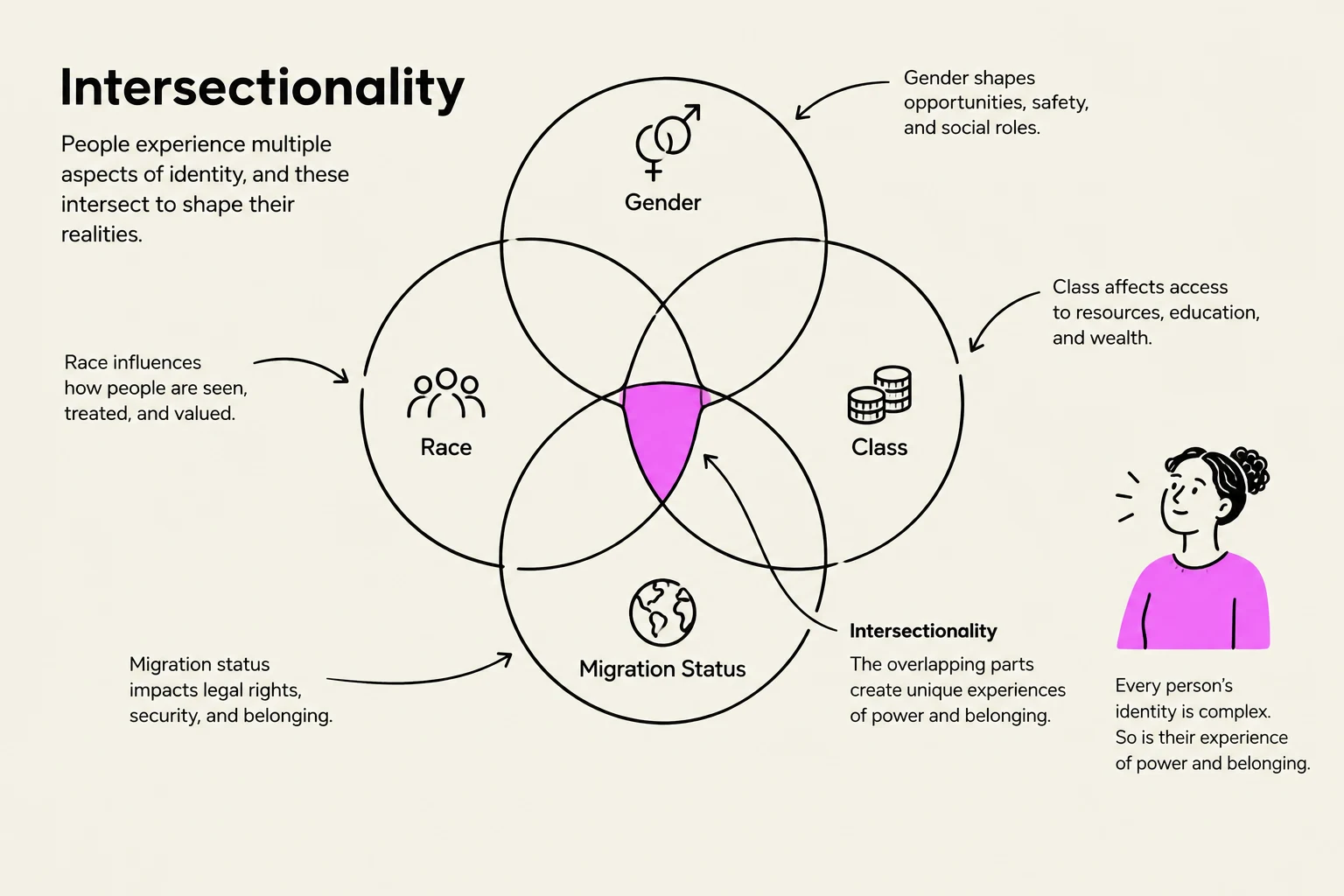
To navigate these tensions, many scholars propose gender-pluralist citizenship. This approach embraces intersectionality, recognizing that gender does not exist in a vacuum but intersects with race, class, age, and migration status. A pluralist framework seeks "solidarity in difference," attempting to build political movements that respect diverse identities without fragmenting the struggle for equality.
This diagram illustrates the concept of intersectionality, explaining how various aspects of identity such as gender, race, class, and migration status intersect to shape an individual's experiences of power and belonging.
Key Concept Summary:
Decommodification: Independence from the market.
Defamilialization: Independence from the family.
Refamilialization: Increased dependence on the family.
Intersectionality: The study of how multiple identities overlap to create unique forms of privilege or oppression.
In conclusion, the study of gender, state, and citizenships reveals that belonging is never a settled or neutral status. It is a continuous process of negotiation between the state, the market, and the family, shaped by the diverse identities and agency of individuals.
Keep reading for free.
Create an account to finish this reading and make it part of your study routine.