


Understanding how matter transforms is a cornerstone of chemistry. To describe these transformations, chemists use chemical equations to represent the starting materials (reactants) and the resulting substances (products). By mastering the different types of reactions and the rules for balancing them, you can predict the outcome of a chemical process and calculate exactly how much material is needed or produced.
Balancing Chemical Equations and Molecular Formulas
A chemical equation provides a shorthand for a reaction. When we write a "total" or "overall" reaction, we are showing the molecular formula for each of the starting chemicals and the products. The molecular formula represents the actual compound as a single unit, such as for water or for copper(II) nitrate.
However, simply writing the formulas is not enough; the equation must be balanced. According to the law of conservation of mass, atoms are neither created nor destroyed in a chemical reaction. Therefore, the number of atoms of each element must be the same on both the reactant and product sides. We achieve this by adding coefficients—the large numbers placed in front of chemical formulas—to ensure both sides are equal.
Exam Tip: When typing chemical equations into online homework systems, pay close attention to formatting. Subscripts (like the in ) and superscripts (like the $2+Cu^{2+}$) must be entered using specific buttons. Do not use "stacked" subscript/superscript buttons, as this is often marked incorrect.
Common Reaction Types
Chemical reactions are often categorized by how the atoms and charges are rearranged.
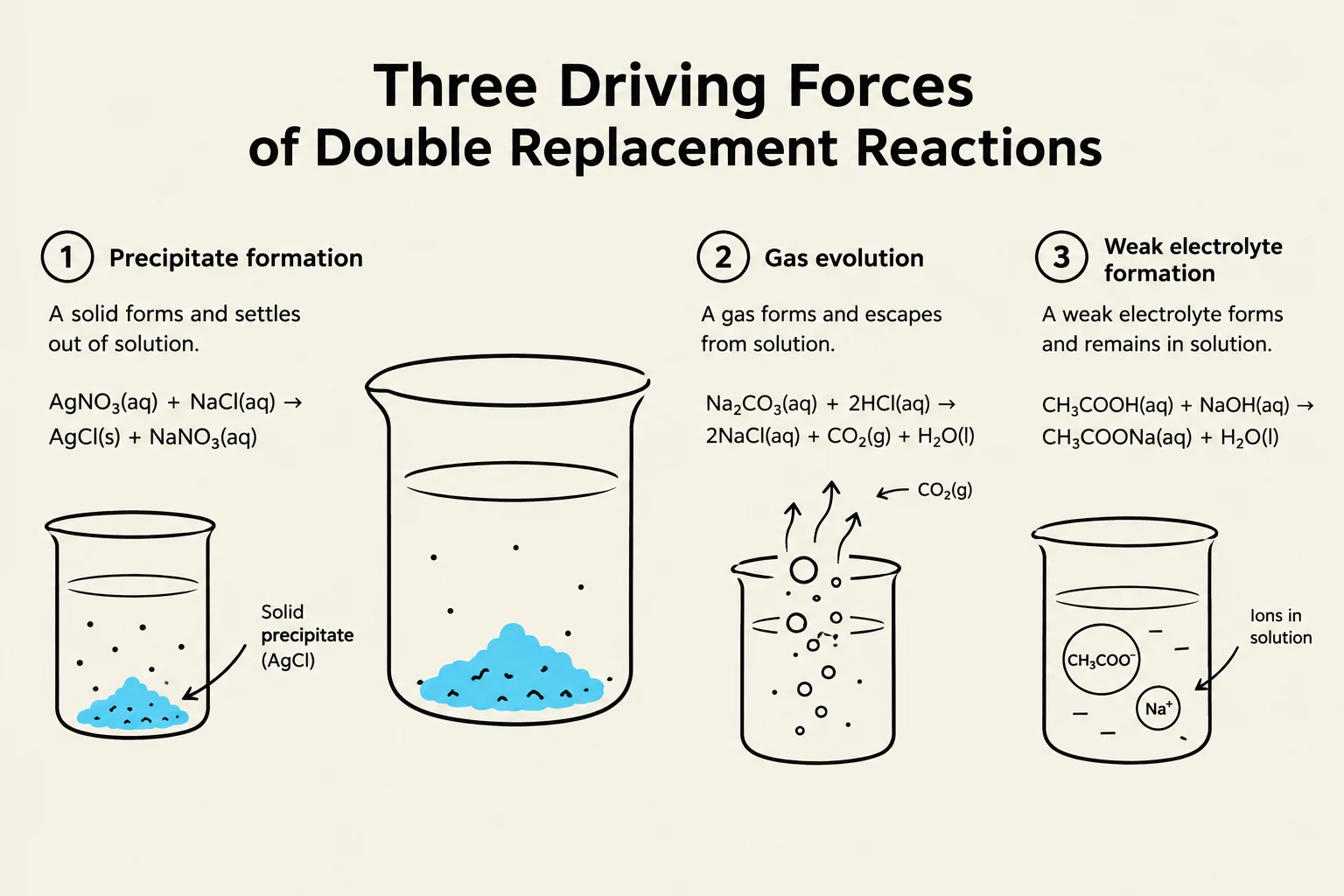
Single and Double Replacement Reactions
In a single replacement reaction, an element reacts with a compound, and the element "kicks out" another component of that compound. For example, a metal might replace a hydrogen atom in an acid.
Keep reading for free.
Create an account to finish this reading and make it part of your study routine.
Continue reading freeAlready have an account? Log in
Updated