Understanding Chemical Bonds: Ions, Covalent Bonds, and Molecular Orbitals
Explore the fundamental forces of chemical bonding, including ionic and covalent bonds, Lewis structures, molecular polarity, and the advanced concepts of Molecular Orbital theory and hybridization.
Chemical bonding is the fundamental force that holds matter together, transforming isolated atoms into stable molecules and compounds. This process is driven by the behavior of electrons, which act as matter waves that can be shared, transferred, or reorganized into new orbital shapes. Understanding how these electrons interact requires us to look at everything from simple electrostatic attractions to complex quantum mechanical wave interferences.
Ions and Ionic Bonding
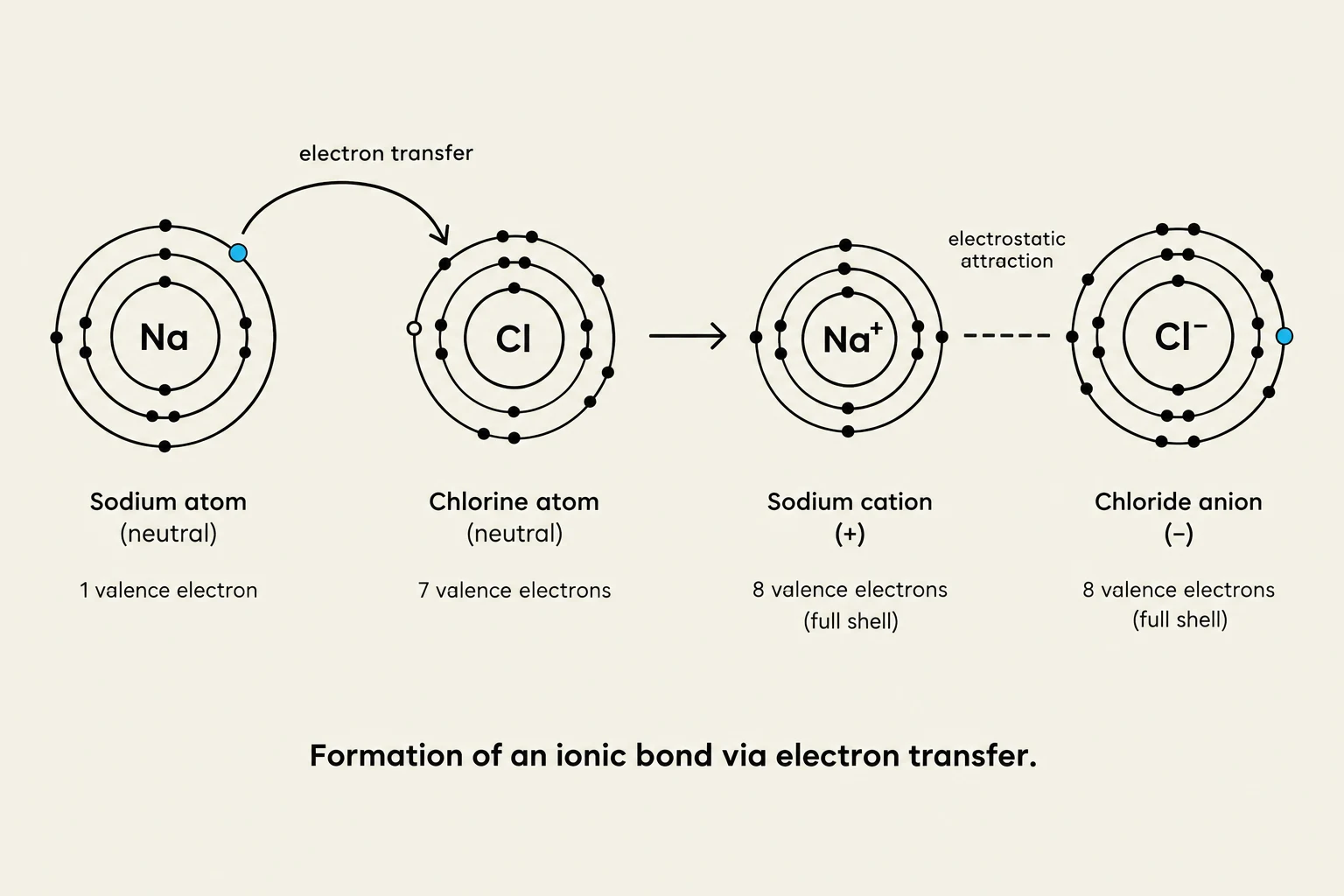
Formation of an ionic bond via electron transfer.
At the most basic level, atoms seek stability by adjusting their electron count. When an atom loses or gains electrons, it becomes an ion. The type of ion formed depends heavily on the element's position in the periodic table.
Cations are positively charged ions formed when metals lose electrons. For instance, alkali metals (Group 1) typically lose one electron, while alkaline earth metals (Group 2) lose two. Transition metals are more complex, often losing varying numbers of s and d electrons.
Conversely, non-metals tend to gain electrons to form anions, which carry a negative charge. The energy required to remove an electron is known as ionization energy, while the energy released when an electron is added to an atom is the electron affinity.
When a cation and an anion meet, they form an ionic bond through electrostatic attraction. The stability of the resulting ionic compound is further enhanced by the lattice energy, which is the energy released when these gaseous ions combine into a solid structure.
Covalent Bonding and Lewis Structures
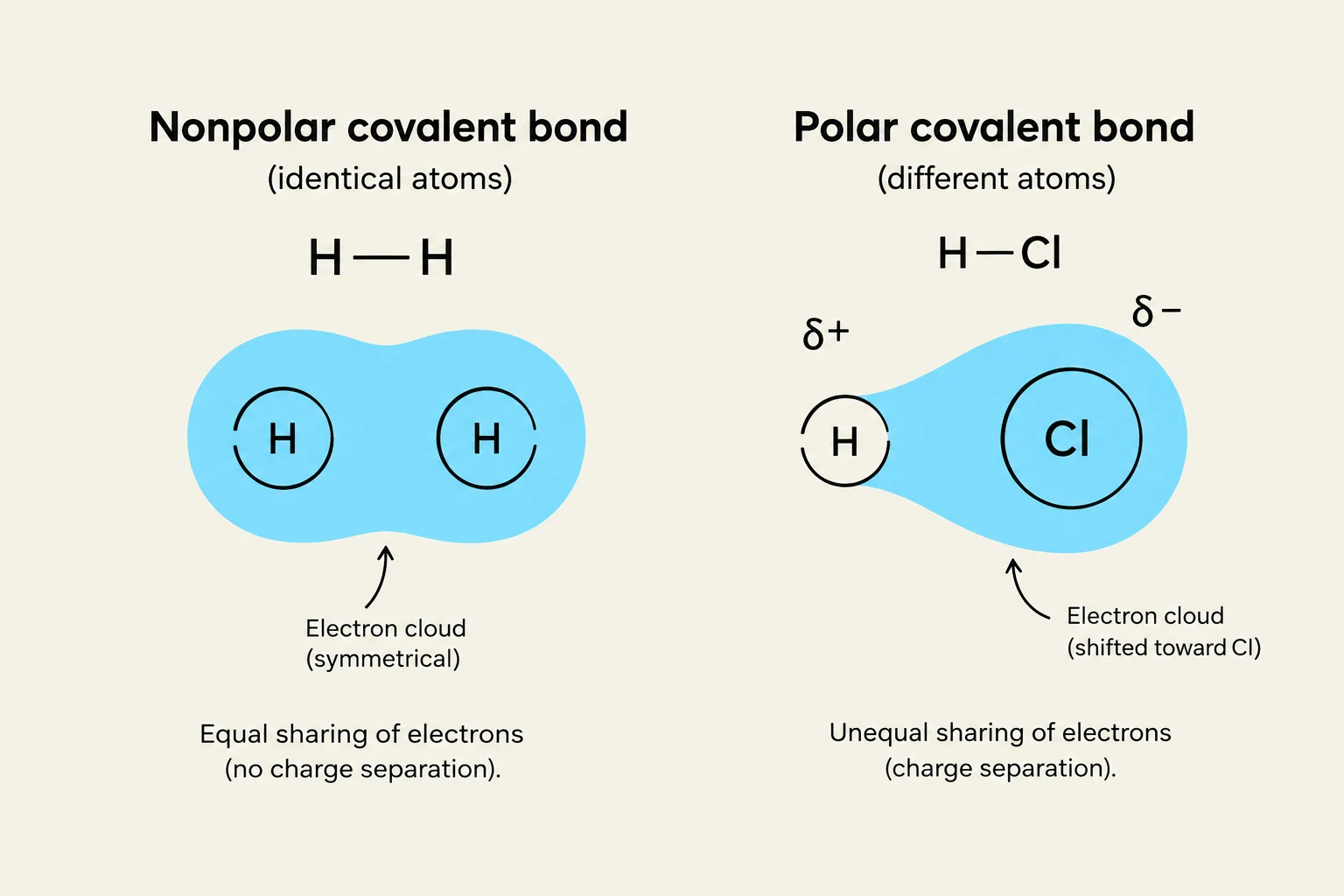
This illustration compares nonpolar and polar covalent bonds. A nonpolar covalent bond, like H-H, involves equal sharing of electrons between identical atoms, resulting in no charge separation. A polar covalent bond, like H-Cl, involves unequal sharing of electrons between different atoms, leading to charge separation with a partial positive charge on one atom (H) and a partial negative charge on the other (Cl), indicated by the electron cloud being shifted toward Cl.
While ionic bonds involve the transfer of electrons, covalent bonds occur when atoms share electron density. This sharing allows atoms to approach the octet rule, a tendency to achieve a full valence shell of eight electrons.
Drawing Molecules: Lewis Structures
To visualize these bonds, we use Lewis structures. When constructing these, keep several key concepts in mind:
Bond Order (BO): This represents the number of shared electron pairs between two atoms. A higher bond order (like a triple bond) results in a stronger and shorter bond.
Formal Charge (FC): This is a bookkeeping tool used to determine the most likely distribution of electrons in a molecule. It is calculated as:
FC=(Valence e−)−(Actual e−)
Resonance: Sometimes, a single Lewis structure cannot accurately represent a molecule. In these cases, we use multiple resonance forms to describe the delocalized electron density. The actual molecule is a weighted average of these forms.
Exceptions to the Octet: Some atoms are hypovalent (like Boron or Beryllium) and may have fewer than eight electrons, while elements in Period 3 and below can possess expanded octets, holding more than eight electrons.
Polarity and Molecular Shape
The distribution of electrons is rarely perfectly equal. This is driven by electronegativity (χ), an empirical measure of an atom's ability to pull electron density toward itself.
If there is a large difference in electronegativity between two atoms, they form a polar covalent bond. If the difference is negligible, they form a nonpolar covalent bond. However, a molecule's overall molecular dipole (polarity) depends on both the polarity of individual bonds and the overall molecular shape.
Exam Tip: Steric Number
To determine molecular shape, calculate the steric number. This is the sum of the number of atoms bonded to the central atom and the number of lone pairs on that central atom.
Molecular Orbital (MO) Theory
This diagram illustrates the concept of Molecular Orbital Theory, showing the formation of bonding and antibonding molecular orbitals from atomic orbitals through constructive and destructive interference.
While Lewis structures are useful, they treat electrons as localized between atoms. Molecular Orbital (MO) theory provides a more advanced view, treating electrons as waves that combine atomic orbitals (AOs) to form new molecular orbitals.
When atomic orbitals overlap, their waves interfere:
Constructive Interference: The waves add together to create bonding molecular orbitals, which are lower in energy and stabilize the molecule.
Destructive Interference: The waves cancel each other out, creating antibonding molecular orbitals (denoted with an asterisk, e.g., σ∗). These are higher in energy and destabilize the molecule.
The stability of a molecule in MO theory is determined by the Bond Order, calculated as:
BO=21(bonding e−−antibonding e−)
MO theory also explains magnetism. If a molecule has unpaired electrons, it is paramagnetic (it will respond to a magnetic field). If all electrons are paired, it is diamagnetic.
Hybridization and Orbital Overlap
To explain the specific geometric shapes observed in molecules, we use the concept of hybridization. This involves the mixing of different atomic orbitals (like s and p) to create new hybrid orbitals.
sp3 Hybridization: Occurs when one s and three p orbitals mix, resulting in a tetrahedral shape (e.g., CH4).
Sigma (σ) Bonds: These result from the head-on overlap of orbitals and allow for free rotation.
Pi (π) Bonds: These result from the side-on overlap of unhybridized p orbitals. Pi bonds are found in double and triple bonds and restrict rotation.
By combining these theories—from the electrostatic pull of ions to the wave-like interference of molecular orbitals—chemists can predict the structure, reactivity, and physical properties of almost any substance.
Keep reading for free.
Create an account to finish this reading and make it part of your study routine.