This guide explains Cerebrovascular Accidents (CVAs), commonly known as strokes. It details the different types of strokes, including ischemic and hemorrhagic, their causes, risk factors, and symptoms. It also covers transient ischemic attacks (TIAs) and the critical nursing management and priorities for stroke patient
A Cerebrovascular Accident (CVA), commonly known as a stroke, is a critical medical emergency that occurs when the blood supply to a portion of the brain is interrupted. Because the brain relies on a constant supply of oxygen and nutrients, any disruption in brain perfusion—the process of delivering blood to brain tissue—can lead to rapid cell death and permanent neurological damage. In the United States, stroke is the fourth leading cause of death and a primary cause of adult disability.
Because stroke is a "time-sensitive" emergency, medical professionals often use the acronym BE FAST to identify symptoms and initiate rapid response.
Types of Stroke: Ischemic vs. Hemorrhagic
Strokes are categorized based on the mechanism that causes the interruption of blood flow. Understanding whether a stroke is caused by a blockage or a rupture is the most critical step in determining treatment, as the wrong intervention can be fatal.
Ischemic Stroke (The "Blocked" Vessel)
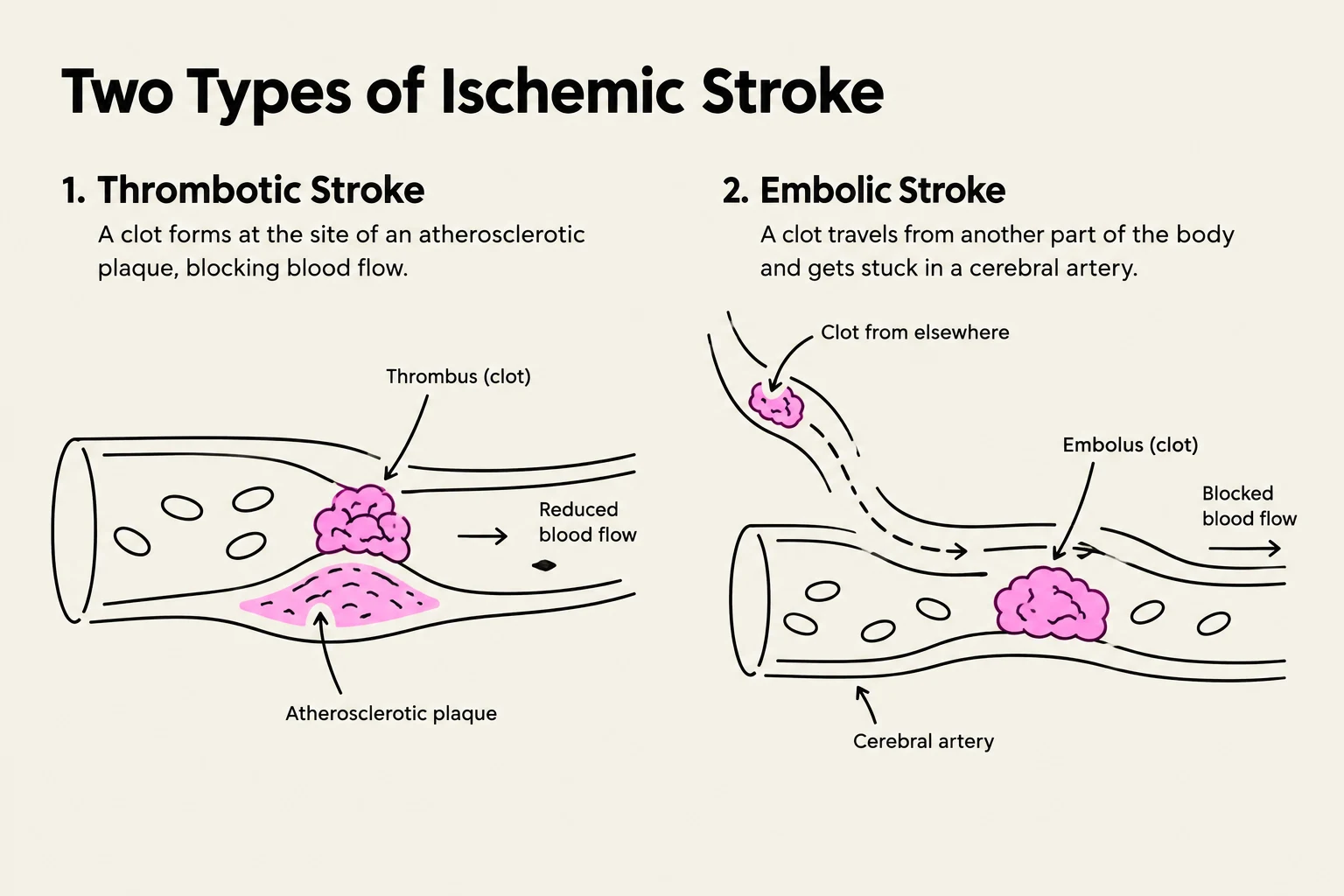
An ischemic stroke occurs when a cerebral artery becomes blocked, preventing oxygenated blood from reaching brain tissue. This is the most common type of stroke. There are two primary mechanisms for an ischemic stroke:
Thrombotic Stroke: A blood clot (thrombus) forms directly within a cerebral artery, often due to underlying atherosclerosis (hardening of the arteries).
Embolic Stroke: A clot or debris travels from another part of the body (such as the heart) and becomes lodged in a cerebral vessel. Atrial fibrillation is a significant risk factor for this type of stroke.
The result of either mechanism is ischemia, which leads to brain injury if blood flow is not restored quickly.
Diagram illustrating two types of ischemic stroke: thrombotic stroke caused by a clot forming at an atherosclerotic plaque, and embolic stroke caused by a clot traveling from elsewhere and blocking a cerebral artery.
Hemorrhagic Stroke (The "Ruptured" Vessel)
A hemorrhagic stroke occurs when a blood vessel in or around the brain ruptures. Unlike ischemic strokes, where the goal is to open a vessel, the primary concern here is the bleeding itself.
When a vessel ruptures, blood accumulates in the brain tissue or the surrounding space (subarachnoid space). This accumulation triggers a dangerous physiological cascade:
Cerebral Edema: The accumulation of blood and subsequent inflammatory response causes the brain tissue to swell.
Increased Intracranial Pressure (ICP): Because the skull is a rigid container, swelling and blood accumulation increase the pressure inside the cranium.
Decreased Perfusion: As ICP rises, it can compress healthy brain tissue and blood vessels, further reducing the brain's ability to receive blood, creating a lethal cycle.
Exam Tip: If a patient is suspected of having an ischemic stroke, never administer thrombolytic therapy (clot-busters) until a noncontrast CT scan has ruled out a hemorrhage. Giving thrombolytics to a patient with a hemorrhagic stroke will worsen the bleeding and likely cause death.
Transient Ischemic Attack (TIA)
A Transient Ischemic Attack (TIA) is often referred to as a "mini-stroke." It involves a temporary interruption of blood flow to the brain caused by small clots, plaque fragments, or vessel spasms. While a TIA does not result in permanent brain damage, it serves as a critical warning sign of an impending full-scale stroke. Any patient experiencing TIA symptoms must receive medical evaluation within 24 hours.
Risk Factors
Stroke risk is determined by a combination of factors that a patient can change and factors they cannot.
Non-Modifiable Risk Factors
These are inherent characteristics that cannot be altered by medical or lifestyle interventions:
Age
Race
Gender
Family History
Previous history of stroke
Modifiable Risk Factors
These are lifestyle or medical conditions that can be managed to reduce stroke risk:
Pathologic: Hypertension (the most significant), cardiac disease, and diabetes.
Lifestyle: Obesity, sedentary lifestyle, cigarette smoking, alcohol use, drug abuse, and poor diet.
Clinical Manifestations: Location and Deficits
The specific symptoms a patient exhibits depend entirely on where in the brain the stroke occurs and how much tissue is affected.
Left-Sided Brain Stroke
Because the brain controls the opposite side of the body, a stroke in the left hemisphere typically results in deficits on the right side of the body. Common findings include:
Right-sided weakness or paralysis (hemiplegia).
Right-sided sensory loss.
Aphasia: A language problem that affects the ability to speak, understand, read, or write.
Right-Sided Brain Stroke
A stroke in the right hemisphere typically results in deficits on the left side of the body. Common findings include:
Left-sided weakness or paralysis.
Unilateral Neglect: The patient may be unaware of the left side of their body or the environment around them.
Spatial/perceptual problems, poor judgment, and impulsivity.
Safety Alert: Patients with right-sided strokes often suffer from "decreased awareness of deficits." They may overestimate their abilities and attempt to walk or move without assistance, significantly increasing their risk for falls.
This diagram illustrates the effects of left-sided and right-sided brain strokes, detailing resulting body deficits, aphasia, and neglect.
Nursing Management and Priorities
Acute Assessment and Diagnosis
When a stroke is suspected (e.g., facial droop, arm weakness, slurred speech), the priority is to activate the emergency stroke response and determine the "last known well" time.
The priority diagnostic test is a noncontrast CT of the head. This imaging is essential to differentiate between an ischemic and a hemorrhagic stroke, which dictates whether the patient receives thrombolytic therapy (like Alteplase) or blood pressure management and surgery.
Critical Nursing Interventions
Airway and Swallowing (Dysphagia): Stroke patients are at high risk for dysphagia (impaired swallowing). To prevent aspiration pneumonia, patients must remain NPO (nothing by mouth) until a formal swallowing safety assessment is completed.
Neurological Monitoring: Frequent assessments of the patient's level of consciousness (LOC) and neurologic status are vital. Any sudden worsening (e.g., severe headache, vomiting, or decreased LOC) may indicate an intracranial hemorrhage.
Safety and Mobility:
Hemiplegia: Support the weak or paralyzed extremity and maintain proper body alignment to prevent injury.
Neglect: For patients with unilateral neglect, remind them to "scan" their environment and approach them in a way that acknowledges their sensory deficits.
Falls: Implement strict fall precautions due to dizziness, loss of coordination, or hemiparesis.
Communication Strategies
If a patient has aphasia (language impairment), it does not mean their intelligence is impaired. Nurses should:
Face the patient and reduce distractions.
Speak slowly and use short, simple sentences.
Ask one question at a time and use yes/no questions when possible.
Keep reading for free.
Create an account to finish this reading and make it part of your study routine.