Understanding Canadian Treasury Bills and Promissory Notes
This content explains Canadian Treasury bills (T-bills) as short-term, government-backed securities. It details their function as non-interest-bearing promissory notes, the mechanics of their discount mechanism, and essential terminology. The guide includes calculations for present value and discusses the rate of retur
In the world of finance, government-backed securities are often viewed as the bedrock of stability. Among these, Canadian Treasury bills (T-bills) stand out as a primary tool for short-term investment. While they may seem complex at first glance, they are fundamentally based on the concept of a promissory note—a simple agreement to pay a specific amount of money at a future date.
What are Treasury Bills?
Treasury bills, or T-bills, are specialized promissory notes issued by the federal government and most provincial governments in Canada. They are used by the government to manage cash flow and by investors to park money safely for short periods.
Unlike many other types of loans or bonds, T-bills do not carry a stated interest rate. Instead, they operate on a "discount" mechanism. When you buy a T-bill, you aren't paying the full value upfront; rather, you are buying it at a price lower than what it will be worth when it matures.
Key Fact: Government of Canada T-bills are typically issued for specific terms: 91 days, 182 days, or 364 days.
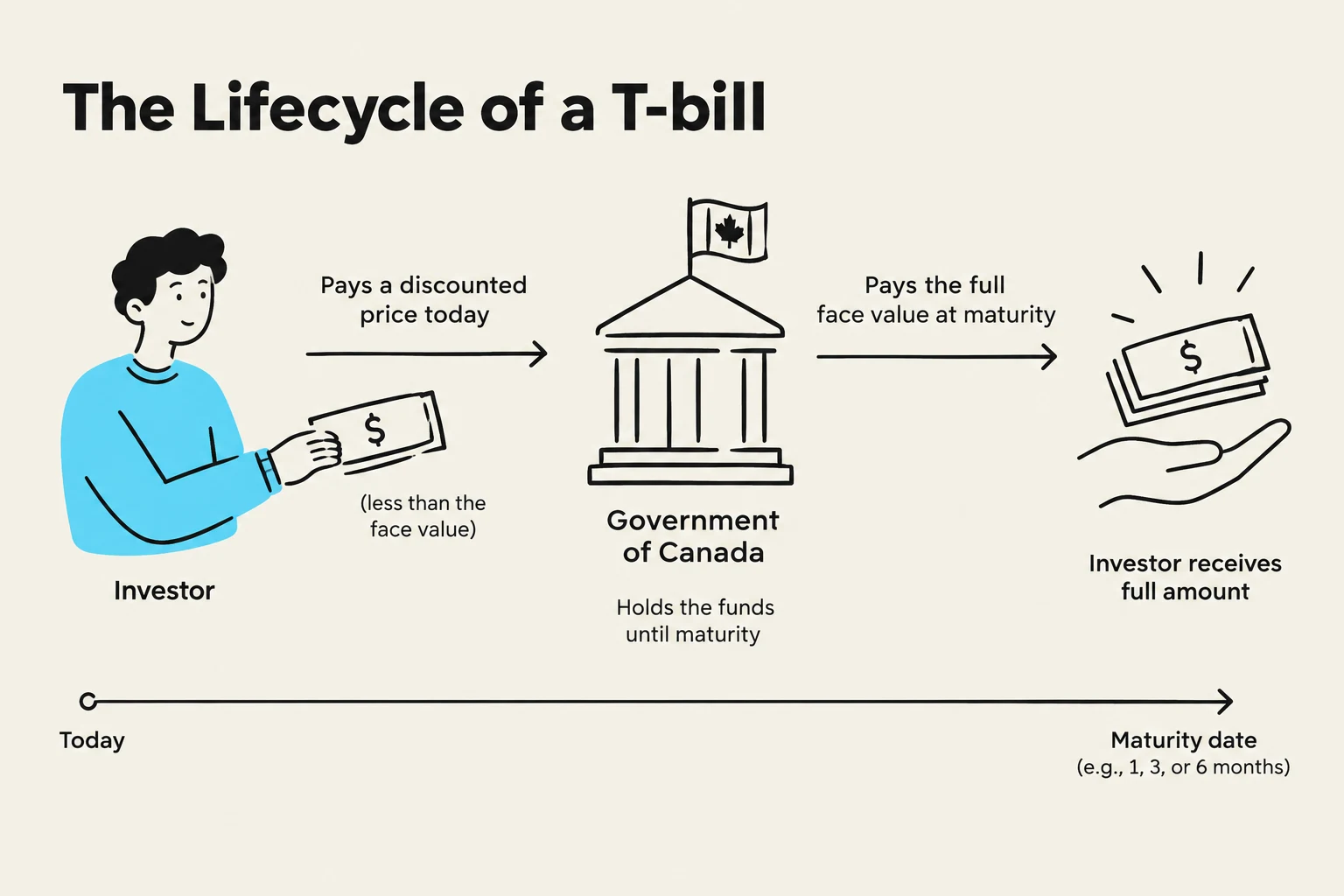
This diagram illustrates the lifecycle of a Treasury bill (T-bill), showing how an investor buys it at a discounted price from the Government of Canada, which holds the funds until maturity, at which point the investor receives the full face value.
The Mechanics of Promissory Notes
To understand T-bills, one must first understand the broader category of promissory notes. A promissory note is a written promise by one party (the maker) to pay a certain sum of money to another party (the payee) at a specific date or on demand.
There are two main types of promissory notes:
Interest-bearing notes: These specify a rate of interest. The borrower pays back the original amount (the face value) plus the interest accrued over the term.
Non-interest-bearing notes: These do not state an interest rate. Instead, the interest is "implied" by the difference between the purchase price and the amount repaid at maturity.
Because T-bills do not state an interest rate, they are classified as non-interest-bearing promissory notes.
Essential Terminology
When working with these financial instruments, you will encounter several standard terms:
Face Value: The sum of money specified to be paid at the end of the term (the principal).
Term: The length of time before the note matures and becomes payable.
Maturity (Due Date): The specific date on which the note must be paid in full.
Maturity Value: In interest-bearing notes, this is the face value plus the interest; in T-bills, the maturity value is simply the face value.
Calculating Value: Discounted Price and Present Value
Since T-bills are non-interest-bearing, the "profit" for the investor is the difference between the discounted price (what you pay now) and the face value (what you receive at maturity).
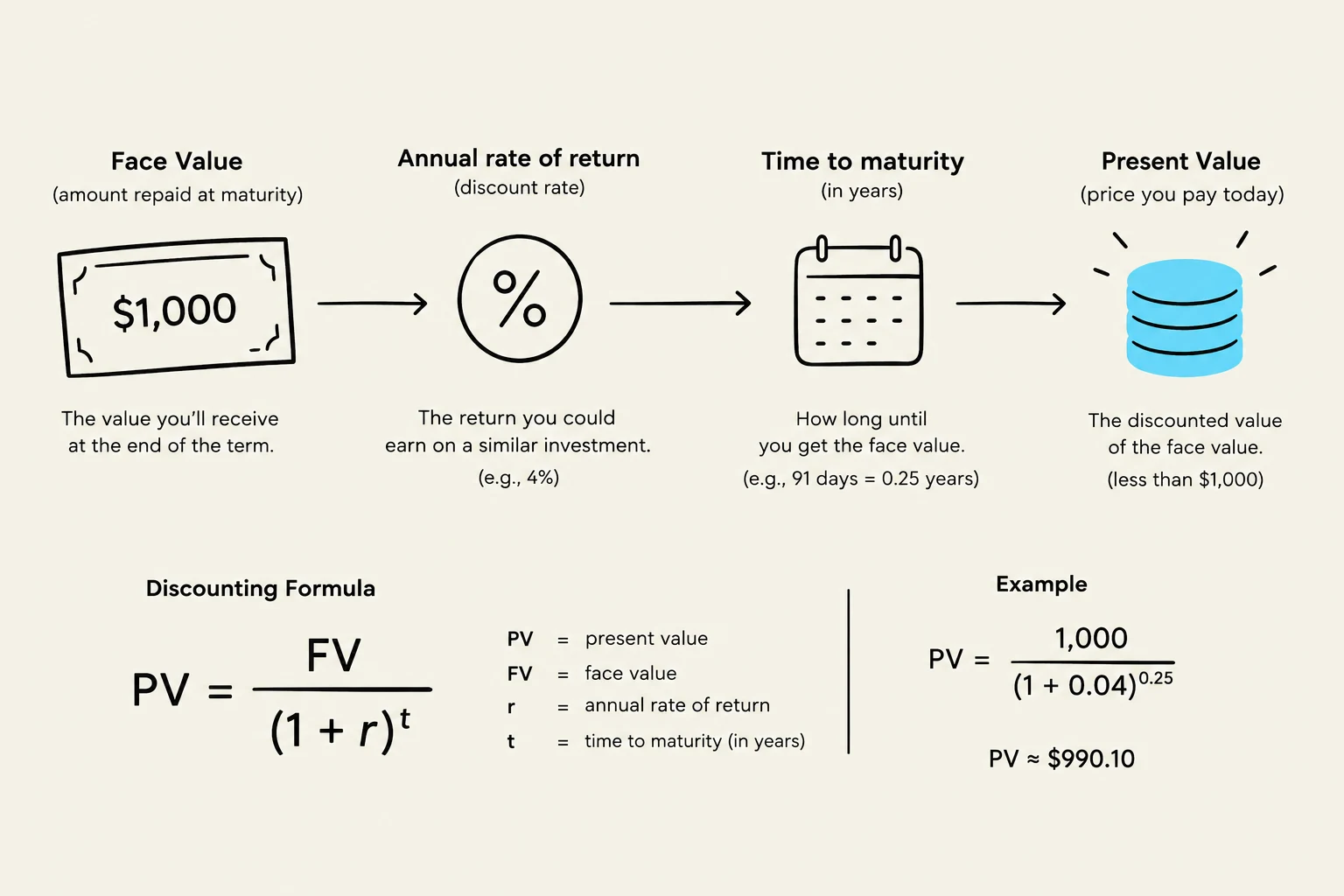
To find the correct purchase price for a T-bill, we use a present value calculation. In finance, the present value is the current worth of a future sum of money, given a specific rate of return.
This illustration explains the concept of present value in finance, detailing its relationship with face value, annual rate of return, and time to maturity. It includes the discounting formula and a practical example.
The formula used to determine the purchase price (Present Value) of a T-bill is:
P=1+rtS
Where:
P = The purchase price (Present Value)
S = The face value (Maturity Value)
r = The annual rate of return (expressed as a decimal)
t = The time period (expressed in years, usually 365days)
Worked Example: Finding the Purchase Price
Suppose an investment dealer wants to buy a 182-day Canadian T-bill with a face value of $$100,000$. The current market yield (annual return) is $2.33%$. What is the purchase price?
Step 1: Identify the variables
$S = 100,000$
r=0.0233
t=365182
Step 2: Plug into the formulaPPPP=1+(0.0233⋅365182)100,000=1+0.01165100,000=1.01165100,000≈$98,848.31
The investor pays $$98,848.31$ today to receive $$100,000$ in 182 days.
Rate of Return and Market Fluctuations
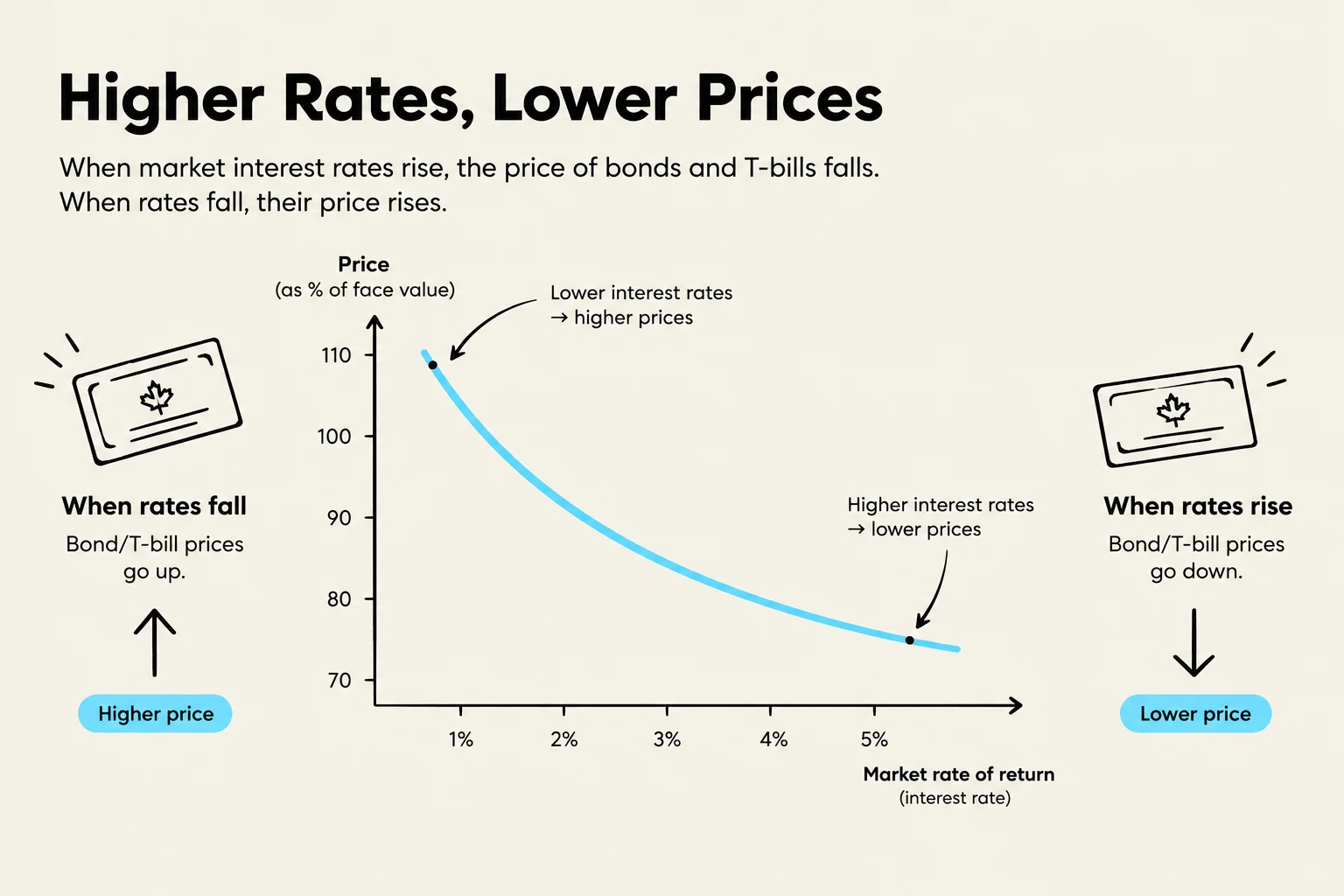
The rate of return on a T-bill is not fixed at the time of issuance; rather, it is determined by current market conditions. This means that if you hold a T-bill and decide to sell it to another investor before it reaches its maturity date, the price you receive will depend on the prevailing interest rates at that time.
Exam Tip: If you are asked to calculate the value of a note at a specific date before its maturity, you must first calculate the full maturity value, and then discount that value back to your specific date using the new prevailing rate.
This graph illustrates the inverse relationship between market interest rates and the price of bonds and T-bills. As interest rates rise, bond prices fall, and conversely, as interest rates fall, bond prices rise.
Understanding these relationships—between time, interest rates, and present value—is essential for anyone looking to navigate the Canadian money markets effectively.
Keep reading for free.
Create an account to finish this reading and make it part of your study routine.