Understanding Canadian Government and Law: Structure, Powers, and Conventions
A guide to the Canadian legal system, focusing on the Constitution, the branches of government (Legislative and Executive), responsible government, and the distinction between legislation and regulation. It also covers limits on executive power and study strategies for legal exams.
Preparing for a law exam requires more than just memorizing definitions; it demands an understanding of how different legal concepts interact within a complex system. This article serves as a comprehensive study guide for the upcoming examination, detailing both the structural requirements of the test and the core constitutional principles you must master. By understanding the relationship between the branches of government and the supremacy of the Constitution, you can approach the exam with clarity and confidence.
Understanding the Test Structure
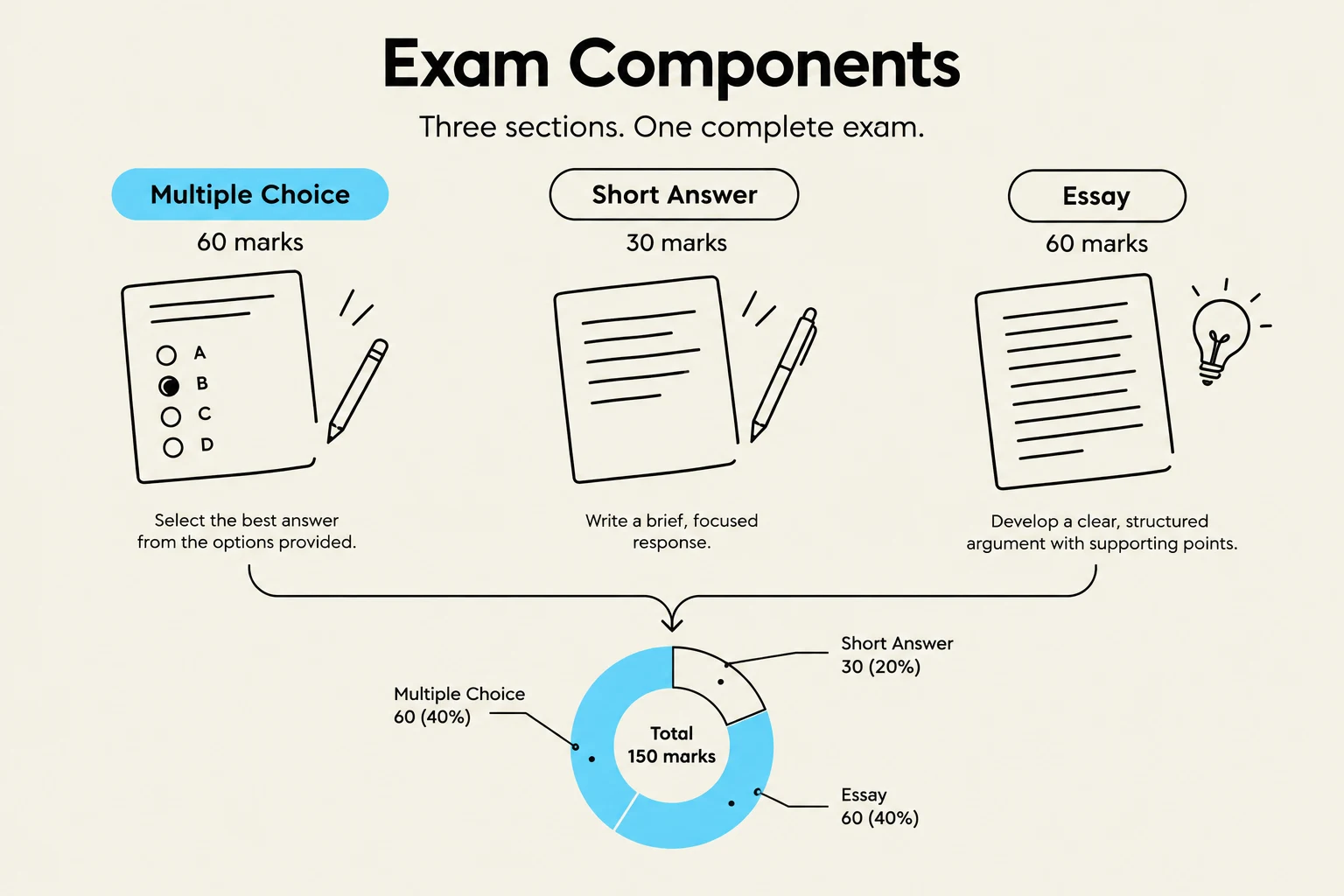
The examination is designed to test both your factual recall and your ability to perform analytical reasoning. It is divided into three distinct components:
Multiple Choice: These questions are straightforward, with each correct answer worth one mark.
Short Answer: Worth three marks each, these questions require you to write in complete sentences.
Essay Question: This is a high-stakes section worth five marks. You will be presented with two statements and must choose one to analyze in depth.
[!IMPORTANT]
Watch the Instructions! In the short answer section, you will often be given a choice (e.g., "Answer two out of three questions"). If you answer more than the required number, you risk being penalized. Always read the prompt carefully before writing.
This diagram illustrates the components of an exam, detailing the types of questions, their respective marks, and their contribution to the total score. It includes Multiple Choice, Short Answer, and Essay sections, presented both visually and in a pie chart format.
Permitted Materials and Preparation
You are permitted to bring one handwritten, single-sided study sheet (8.5 x 11 inches) to the exam. While you may use multiple colors or highlighting to organize your notes, the sheet must be your own original work; professionally printed or published documents are strictly prohibited. Additionally, an exam booklet containing the Constitution will be provided, which you should use as a reference throughout the test.
The Foundation: The Constitution and Legal Systems
At the heart of Canadian law is the Constitution. Specifically, the Constitution Act establishes itself as the supreme law of Canada. This means that any other law or government action that contradicts the Constitution can be found invalid.
To understand how this works in practice, you must be familiar with the distinction between the Common Law system and the Civil Law system. While the Civil Law system is used in certain jurisdictions (like Quebec for private law), Canada operates primarily under a Common Law system, where judicial decisions and precedents play a significant role in interpreting the law.
When studying, pay close attention to the division of powers between the federal and provincial governments. You should specifically review Section 91 and Section 92 of the Constitution, as these sections define the specific jurisdictions of the federal and provincial governments, respectively.
The Branches of Government and the Nature of Power
A central theme of the exam is the "separation of powers." In a common law system, power is generally divided into three branches: the Legislative, the Executive, and the Judicial. Note that for this specific exam, the Judicial branch is not included in the subject matter, as it has not yet been covered in class.
The Legislative Branch
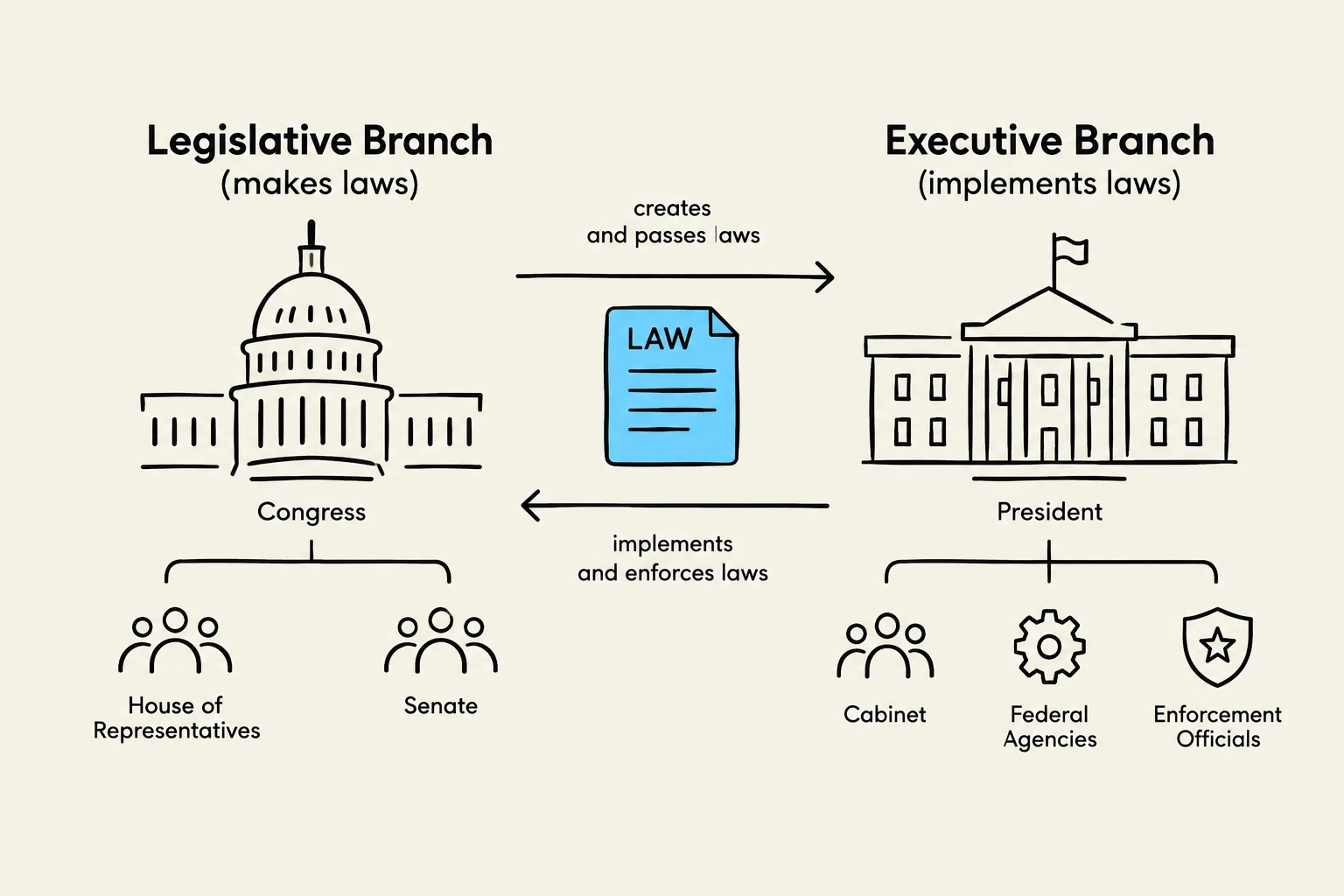
The Legislative branch is responsible for passing legislation—the formal laws of the land. In the Canadian federal system, this includes the House of Commons and the Senate. Members of Parliament (MPs) are elected to represent constituencies and propose, review, and pass bills. Once a bill is passed by both houses, it requires Royal Assent from the executive (the Governor General at the federal level) to officially become law.
The Executive Branch
While the legislature makes the law, the Executive branch is responsible for administering and implementing those laws. This is often what people mean when they refer to "the government".
The Executive is characterized by a unique concept known as Responsible Government. This involves a "dual executive": a formal head of state (the King, represented by the Governor General or Lieutenant Governor) and a political head of state (the Prime Minister or Premier).
This diagram illustrates the separation of powers in a government, showing the Legislative Branch (Congress) creating laws and the Executive Branch (President and agencies) implementing and enforcing them.
[!TIP]
The Role of Convention: Much of how the Executive branch actually functions is not written in the Constitution but is governed by convention—customary practices and traditions that are widely accepted as law. For example, the Prime Minister's specific powers are largely a matter of convention rather than explicit constitutional text.
Regulation vs. Legislation
It is vital to distinguish between these two terms for the exam:
Legislation: The primary laws passed by the legislative branch (e.g., an "Act").
Regulation: These are more specific rules created by the Executive branch (often through a Minister or Lieutenant Governor) to implement the broader legislation. Unlike legislation, regulations do not always require the full legislative process to be updated.
Limits on Executive Power
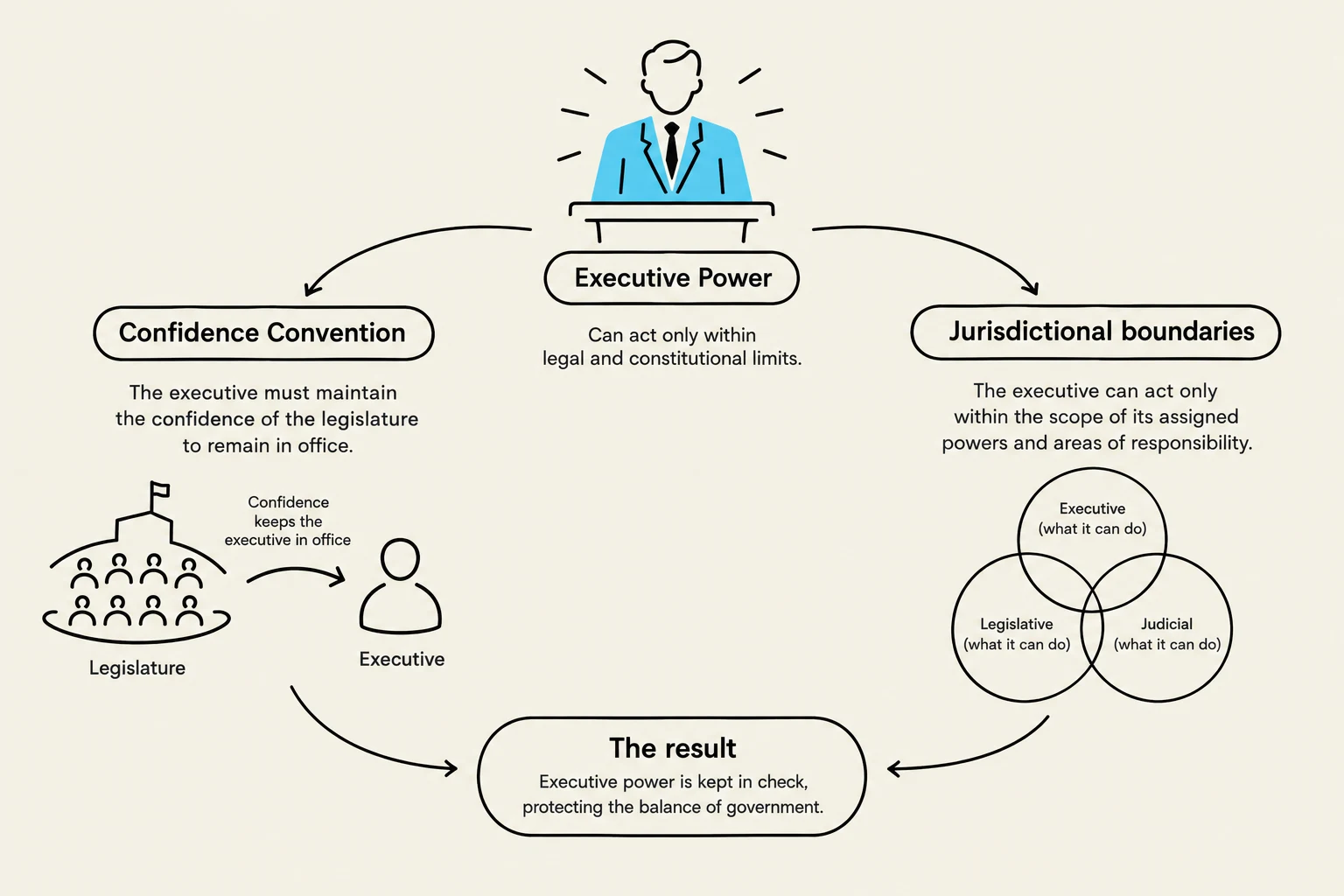
Although the Executive branch holds significant power, it is not absolute. There are several critical limits you should understand:
The Confidence Convention: The Executive must maintain the "confidence" of the legislature. If the government loses a major vote (such as a budget bill), it may be forced to resign or call an election.
Jurisdictional Limits: Ministers are limited to the specific "portfolio" or area of responsibility assigned to them by the Constitution and statute.
The Charter of Rights and Freedoms: The Executive cannot enact policies or actions that infringe upon the civil liberties protected by the Charter, which is part of the supreme law of Canada.
Non-Interference with the Judiciary: To maintain the separation of powers, the Executive is prohibited from interfering in active court cases or communicating with members of the judiciary regarding their judicial duties.
This diagram illustrates the concept of executive power within a government, detailing its limitations, the confidence convention with the legislature, and jurisdictional boundaries between executive, legislative, and judicial branches.
Study Strategy: Self-Assessment
To prepare effectively, use the "non-exhaustive" list of terms provided in your course materials. Do not just memorize the definitions; try to explain the relationships between them. For example, instead of just knowing what "legislation" is, ask yourself: How does the Executive branch use regulation to implement the legislation passed by the Legislative branch?.
If you can answer the following questions, you are on the right track:
Can I explain the difference between the formal head of state and the political head of state?
Do I understand why the Constitution is called the "supreme law"?
Can I identify the difference between a statute and a regulation?
Am I able to explain how a Minister's power is limited by both the Constitution and the Charter?
Keep reading for free.
Create an account to finish this reading and make it part of your study routine.