Understanding Bureaucracy and the Principal-Agent Problem in Governance
This content explains the concept of bureaucracy, its dual nature as both essential machinery and potential obstacle, and delves into the Principal-Agent Problem in governance. It explores how information asymmetry between principals (elected officials) and agents (bureaucrats) can lead to unintended consequences, usin
Bureaucracy is often viewed through two conflicting lenses: as the essential machinery that keeps a modern state running, and as a cumbersome obstacle to progress. At its core, a bureaucracy is a system of administration characterized by specialized functions, a hierarchy of authority, and a set of formal rules. While these structures are designed to ensure consistency and fairness, they often create complex challenges for the citizens they serve and the leaders who oversee them.
To understand why bureaucracy can be so impactful—and sometimes problematic—we must look at the relationship between those who make the laws and those who implement them. This relationship is often defined by the "Principal-Agent Problem," a concept that explains why even the best-intentioned regulations can lead to unintended consequences.
The Principal-Agent Problem in Governance
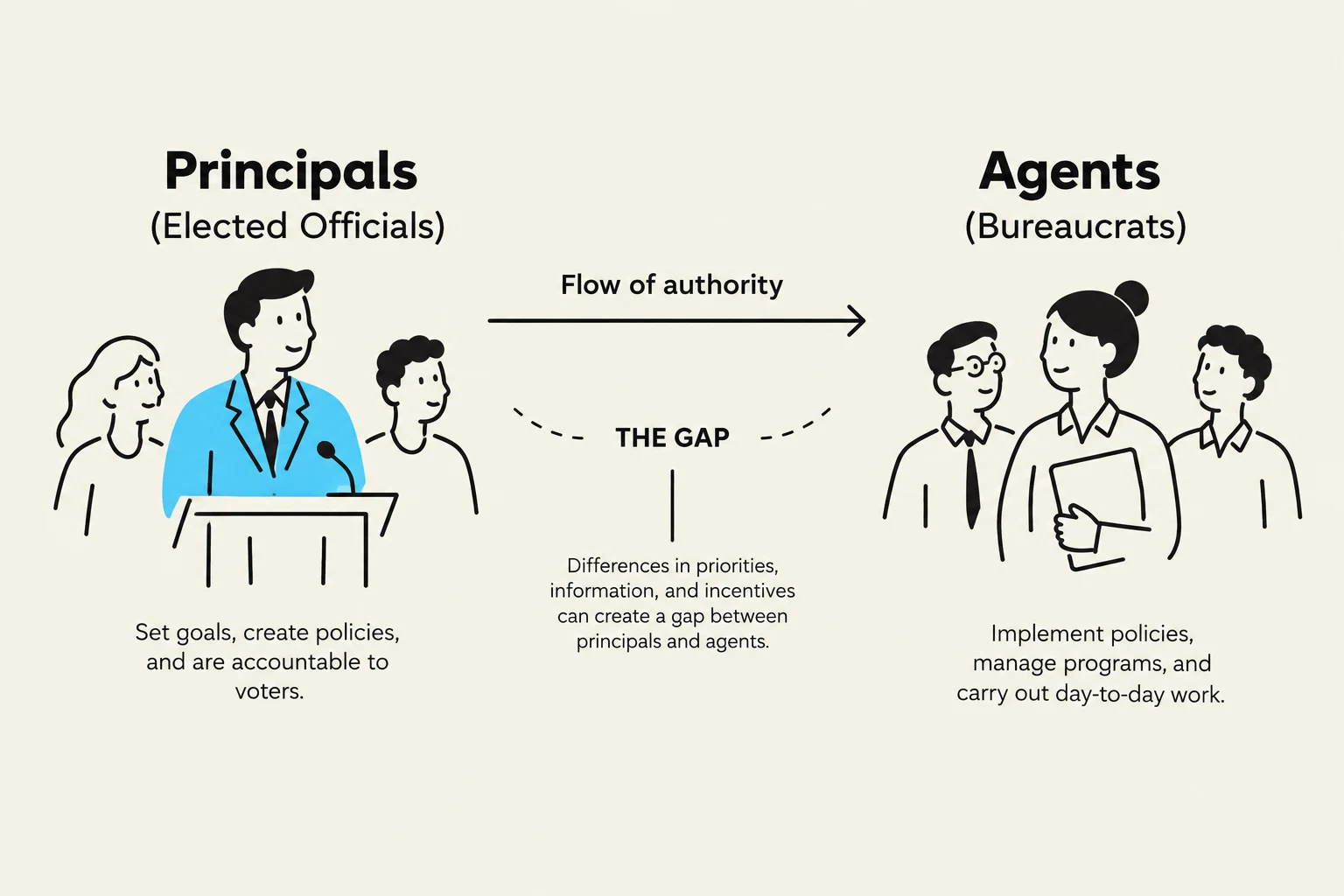
In a democratic system, the "Principals" are the elected officials (such as Congress or the President) who create policy and set goals. The "Agents" are the bureaucrats within executive agencies who are tasked with carrying out those policies.
The problem arises because the interests of the Agent do not always perfectly align with the interests of the Principal. Agents possess "information asymmetry," meaning they know more about the day-to-day technical details of their work than the politicians do. This allows bureaucrats to potentially prioritize their own agency's growth, budget, or stability over the actual goals set by the legislature.
This diagram illustrates the principal-agent problem in governance, showing how elected officials (principals) set goals and policies, while bureaucrats (agents) implement them, with a potential gap arising from differing priorities, information, and incentives.
Exam Tip: When discussing the Principal-Agent problem, always emphasize information asymmetry. It is the primary reason why oversight is difficult; the person in charge cannot see everything the person implementing the rule is doing.
Bureaucracy in Action: Four Key Sectors
The impact of these administrative structures can be felt across vastly different areas of public life, from environmental protection to international security.
1. National Parks and Environmental Regulation
In the realm of national parks, bureaucracy serves as a guardian of natural resources. Regulations are designed to prevent over-tourism, protect endangered species, and manage land use. However, the same rules that protect a forest can also create "red tape" that prevents local communities from accessing resources or prevents scientists from conducting necessary research quickly. The tension here lies between the mandate to conserve and the mandate to provide access.
2. Student Loans and Financial Administration
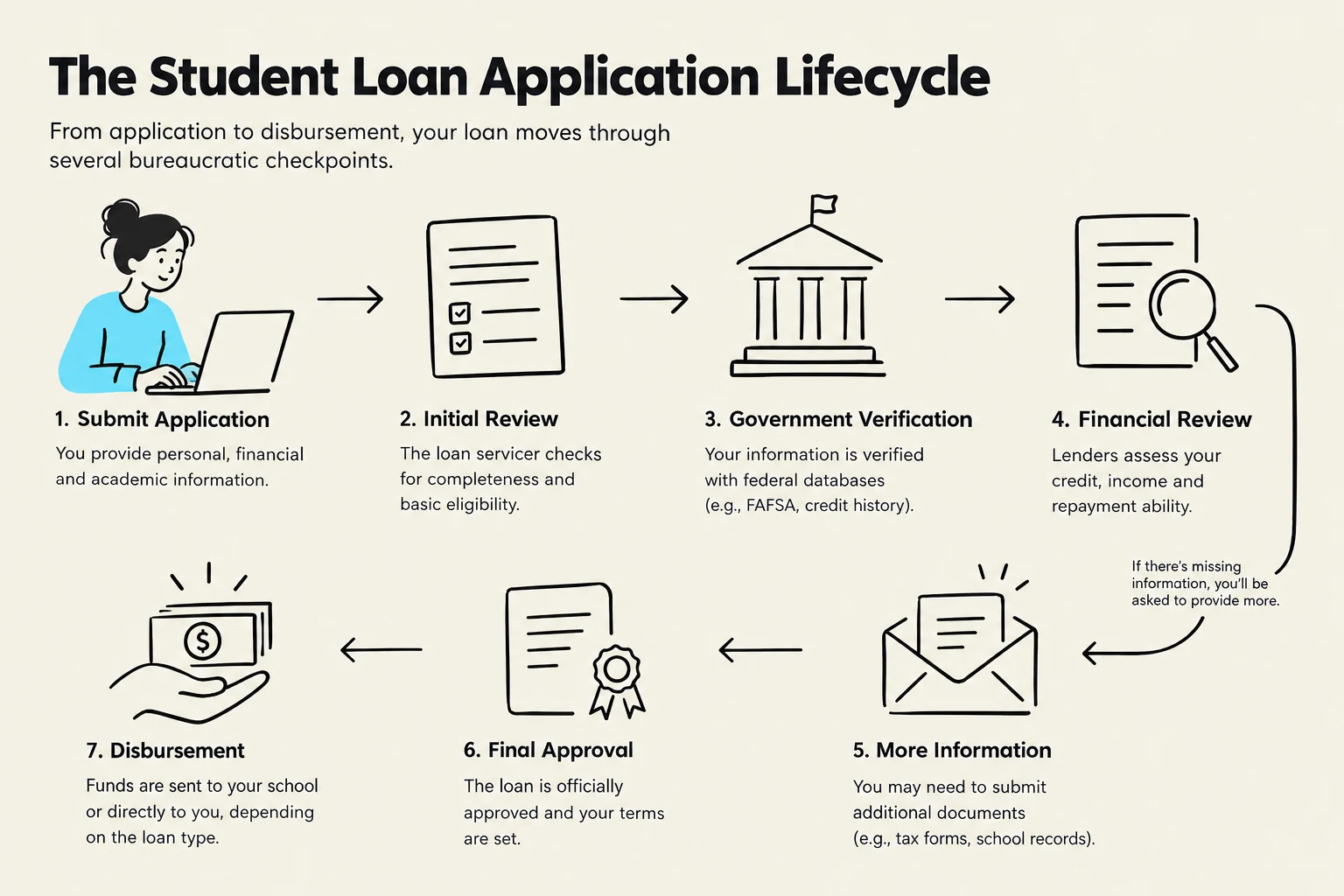
The administration of student loans is a massive bureaucratic undertaking involving complex eligibility rules, repayment schedules, and interest calculations. For students, the impact is felt in the ease (or difficulty) of navigating the system. When bureaucratic processes are efficient, they provide a pathway to education; when they are overly rigid or poorly communicated, they can lead to debt crises or missed opportunities for those who most need financial aid.
This diagram illustrates the lifecycle of a student loan application, from submission to disbursement, detailing key stages such as initial review, government verification, financial review, and final approval.
3. Diplomacy and Foreign Affairs
In diplomacy, bureaucracy provides the "institutional memory" of a nation. While politicians change with every election, the career diplomats in the State Department provide continuity in international relations. However, a large diplomatic bureaucracy can also lead to "slow-motion" foreign policy, where the need for inter-agency coordination and strict adherence to protocol prevents a nation from responding swiftly to sudden international crises.
4. National Security and Defense
National security is perhaps where the impact of bureaucracy is most high-stakes. Agencies like the Department of Defense or intelligence services rely on strict hierarchies and protocols to ensure that information is handled securely and that commands are executed precisely. Yet, the complexity of these organizations can lead to "siloing," where different agencies fail to share critical information with one another, potentially creating blind spots that affect national safety.
Balancing Efficiency and Accountability
The fundamental challenge of modern governance is finding the "Goldilocks zone" of bureaucracy: a system that is robust enough to ensure accountability and fairness, but flexible enough to be efficient.
If a system has too little bureaucracy, it risks corruption, inconsistency, and the arbitrary application of power. If it has too much, it suffers from paralysis, where the cost of following the rules outweighs the benefit of the service being provided.
To manage this balance, governments use several tools:
Oversight Committees: Legislative bodies that monitor agency performance.
Transparency Laws: Such as the Freedom of Information Act (FOIA), which reduces information asymmetry by allowing the public to see how decisions are made.
Performance Metrics: Using data to measure whether an agency is actually achieving its stated goals.
In conclusion, bureaucracy is not inherently "bad" or "good." It is a tool of scale. As societies grow more complex, the need for specialized, rule-based administration grows with them. The goal of effective governance is not to eliminate the bureaucracy, but to ensure that the Agents are working in true alignment with the Principals and the public interest.
Keep reading for free.
Create an account to finish this reading and make it part of your study routine.