Understanding Bottom-Up and Top-Down Processing in Perception
Explore the two primary ways our brains process information: bottom-up processing (data-driven) and top-down processing (concept-driven). Learn how sensory input and prior knowledge interact to shape our perception of the world.
Have you ever tried to read a sentence where the letters were scrambled, yet you could still understand the meaning perfectly? Or have you ever seen a shape in the clouds that looked exactly like a dragon? These experiences highlight a fundamental truth in psychology: perception is not just a passive recording of the world like a camera. Instead, it is an active, complex process of construction.
To understand how we experience reality, we must distinguish between the two primary ways our brains process information: bottom-up processing and top-down processing. While one provides the raw data, the other provides the meaning.
Bottom-Up Processing: The Data-Driven Approach
Bottom-up processing is often referred to as "data-driven" processing. In this model, perception begins with the physical stimuli in our environment. The process moves from the smallest pieces of sensory information upward toward a complete mental representation.
This process follows a strict biological sequence:
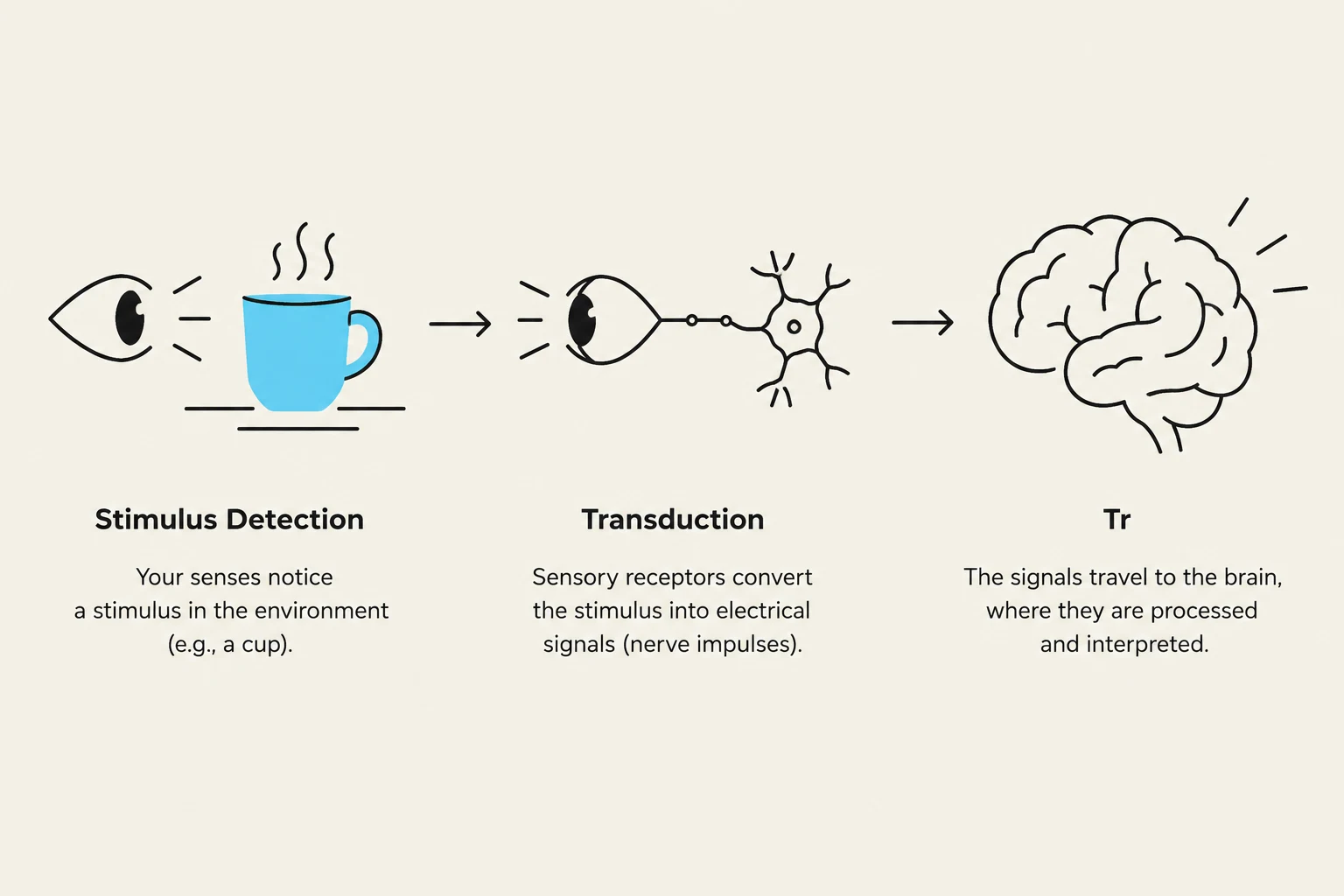
Stimulus Detection: The process begins when our sensory organs detect a physical stimulus, such as a photon of light hitting the retina or a sound wave vibrating the eardrum.
Transduction: This is a critical step where sensory receptors convert physical energy (like light or sound) into neural impulses, also known as action potentials. For example, in the eye, rods and cones change light stimuli into neural signals that travel along the optic nerve.
Transmission: Once the information has been converted into electrical signals, it is transmitted through the nervous system to the brain for processing.
This diagram illustrates the process of stimulus detection, transduction, and interpretation by the brain.
Exam Tip: If a question asks about "data-driven" perception or the conversion of physical energy into neural signals, it is referring to bottom-up processing and transduction, respectively.
Top-Down Processing: The Concept-Driven Approach
While bottom-up processing builds the "bricks" of perception, top-down processing provides the "blueprint". This is a "concept-driven" approach where our perception is shaped by our prior experiences, knowledge, and expectations.
Instead of waiting for every single detail to arrive from the senses, the brain uses what it already knows to "fill in the blanks" and interpret new stimuli quickly. This is why you can read a sentence with misspelled words; your brain uses its knowledge of language to predict what the words should be.
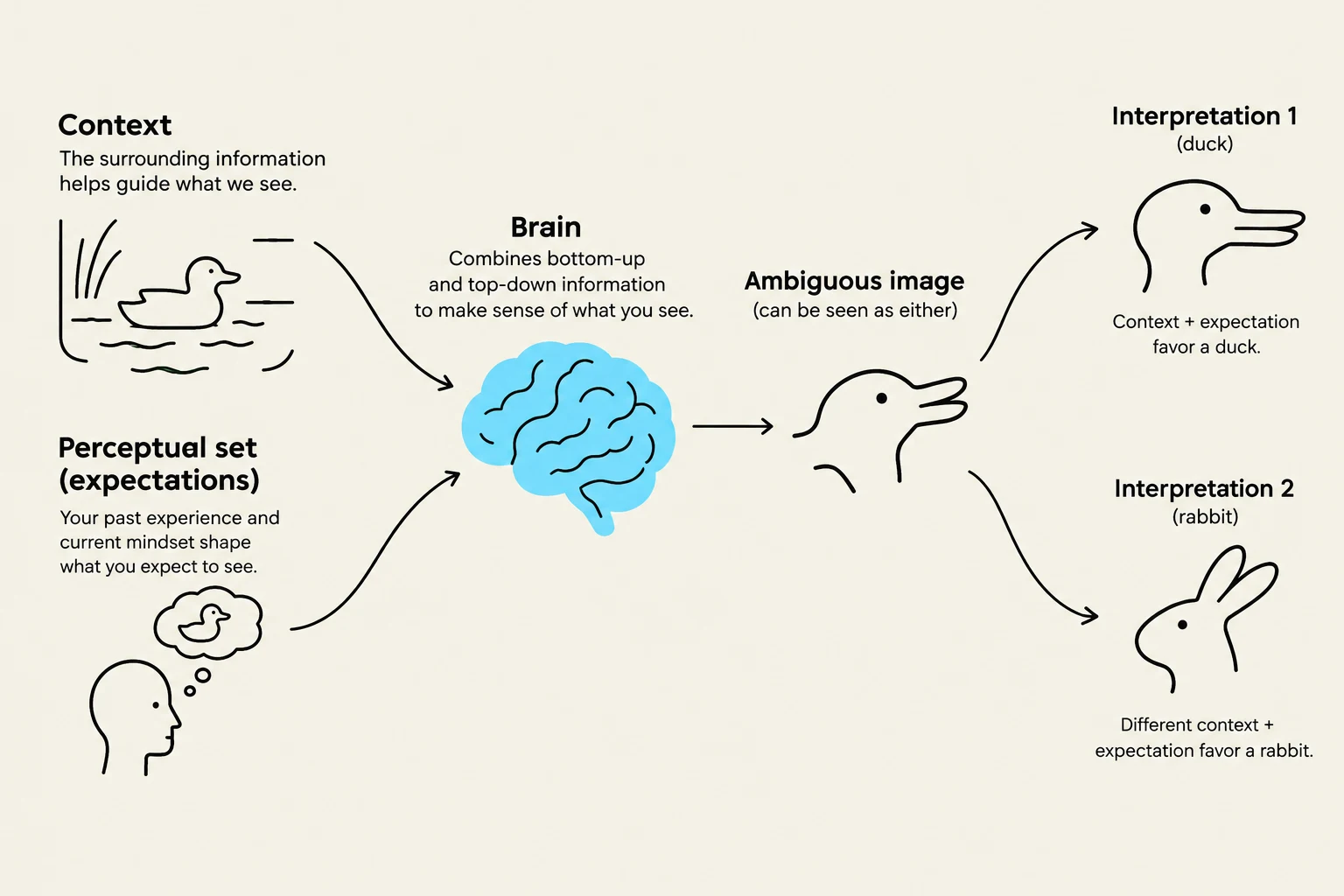
Top-down processing is primarily driven by two factors: context and perceptual sets.
The Power of Context
Context refers to the surrounding information or environment that influences how we interpret a specific stimulus. A single word or sound can change meaning entirely depending on what else is present.
Linguistic Context: Consider the word "peel." If the surrounding sentence is "The ___ was on the orange," your brain interprets it as "peel." However, if the sentence is "The ___ was on the axle," you interpret it as "wheel".
Emotional Context: Our internal state or the atmosphere can change perception. For instance, listening to happy music versus sad music can change how we interpret homophones like "morning" versus "mourning".
Perceptual Sets: Mental Predispositions
A perceptual set is a tendency to perceive things in a specific way based on past experiences, emotions, cultural influences, and expectations. It acts as a mental predisposition that primes us to see what we expect to see.
A classic research example involves food perception: children reportedly enjoyed French fries more when they were served in a McDonald's bag compared to a plain white bag. In this case, the "McDonald's" brand triggered a perceptual set—an expectation of a certain quality—which influenced their actual sensory enjoyment.
This diagram illustrates how context and perceptual set (expectations) influence the brain's interpretation of an ambiguous image, leading to different perceptions such as a duck or a rabbit.
The Interaction: When Senses and Mind Collide
In reality, we rarely use just one process. Our perception is a constant negotiation between the raw data coming in (bottom-up) and the mental frameworks we apply to it (top-down). When these two processes interact, they can produce fascinating and sometimes confusing phenomena.
One striking example is the McGurk Effect. This phenomenon demonstrates how visual information can actually override or alter what we hear. When we see one mouth movement but hear a different sound, our brain attempts to reconcile the conflict by creating a third, "blended" perception.
The McGurk Effect illustrates how visual lip movements can alter the perceived auditory sound, demonstrating that the brain integrates both auditory and visual signals.
Summary Table: Bottom-Up vs. Top-Down
Feature
Bottom-Up Processing
Top-Down Processing
Nature
Data-driven
Concept-driven
Starting Point
Physical stimuli (sensation)
Prior knowledge/expectations
Key Steps
Detection → Transduction → Transmission
Contextualizing → Interpreting
Role
Provides the raw sensory building blocks
Provides the framework to make sense of the world
By understanding these two processes, we can better appreciate the incredible feat our brains perform every second: transforming a chaotic stream of light, sound, and touch into the coherent, meaningful world we inhabit.
Keep reading for free.
Create an account to finish this reading and make it part of your study routine.