Understanding Attention: Interference, Advantage, and Perception
Explore the active and selective nature of attention, examining phenomena like the Stroop Effect, same-object advantage, and perceptual enhancement. Learn how attention influences cognitive processing, performance, and perception.
Attention is not a passive window through which we view the world; rather, it is an active, selective process that determines what information reaches our conscious awareness. Because our cognitive resources are finite, we cannot process every single stimulus in our environment simultaneously. Instead, our brain employs various mechanisms to prioritize certain inputs while suppressing others. This article explores the fascinating ways in which attention influences our performance and perception, specifically through the lens of cognitive interference and the advantages gained through focused selection.
The Stroop Effect: When Attention Conflicts
The Stroop Effect illustrates how the brain processes information, showing that naming the color of a word is slower when the word itself is a different color (incongruent) compared to when the word's color matches its text (congruent).
One of the most famous demonstrations of how attention works is the Stroop Effect. This phenomenon reveals a fundamental conflict between different types of cognitive processing: automatic versus controlled processing.
In a typical Stroop task, a participant is shown words that name colors (e.g., "RED," "BLUE," "GREEN"). However, the ink used to print the words does not match the word itself—for example, the word "RED" might be printed in blue ink. The participant is then asked to name the color of the ink as quickly as possible, ignoring the written word.
Why does this happen?
The delay in response time occurs because reading is an automatic process for most adults. We have practiced reading so extensively that we cannot help but process the meaning of the word, even when we are trying to focus solely on the color. This creates "interference."
Congruent Condition: The word "RED" is printed in red ink. Response time is fast.
Incongruent Condition: The word "RED" is printed in blue ink. Response time slows down significantly as the brain struggles to suppress the automatic impulse to read the word.
Exam Tip: When discussing the Stroop Effect, always distinguish between automaticity (reading) and controlled processing (naming the ink color). The interference is a direct result of the automatic process competing for cognitive resources with the task-relevant process.
The Same-Object Advantage
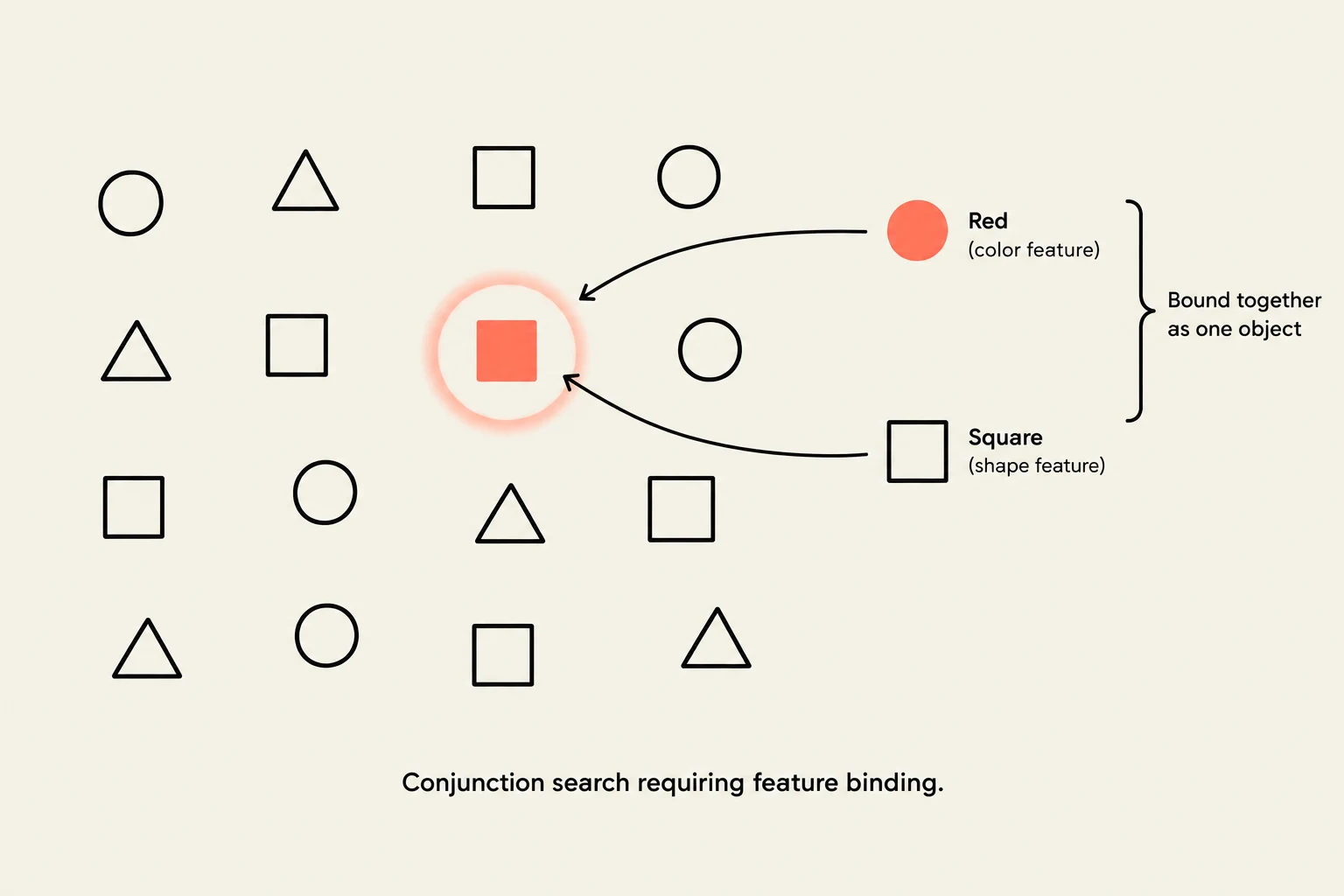
This diagram illustrates conjunction search and feature binding, showing how distinct features like color and shape are combined to form a single object.
While the Stroop effect highlights how attention can be hindered by conflicting information, other phenomena show how attention can be used to enhance our ability to process information. One such phenomenon is the same-object advantage.
In visual search tasks, we often look for a specific target among many distractors. Research indicates that if the target and the distractors share certain object properties, or if we are looking for multiple instances of the same object, our ability to process them changes based on how attention is distributed.
The same-object advantage suggests that when we attend to a single object, we gain access to its various features (such as color, shape, and orientation) more efficiently than if we were trying to process those same features across multiple different objects. This is because attention acts as a "glue" that binds these features together into a coherent perceptual unit.
Worked Example: Visual Search
Imagine you are looking for a red square in a field of blue circles.
Feature Search: If you only need to find the "redness," your brain can quickly spot the target because red stands out from blue.
Conjunction Search: If you are looking for a red square among red circles and blue squares, you must attend to both color and shape. Here, the "same-object advantage" becomes relevant; once your attention locks onto an object, you can rapidly integrate its features to confirm if it matches your target.
How Attended Objects are Perceived Differently
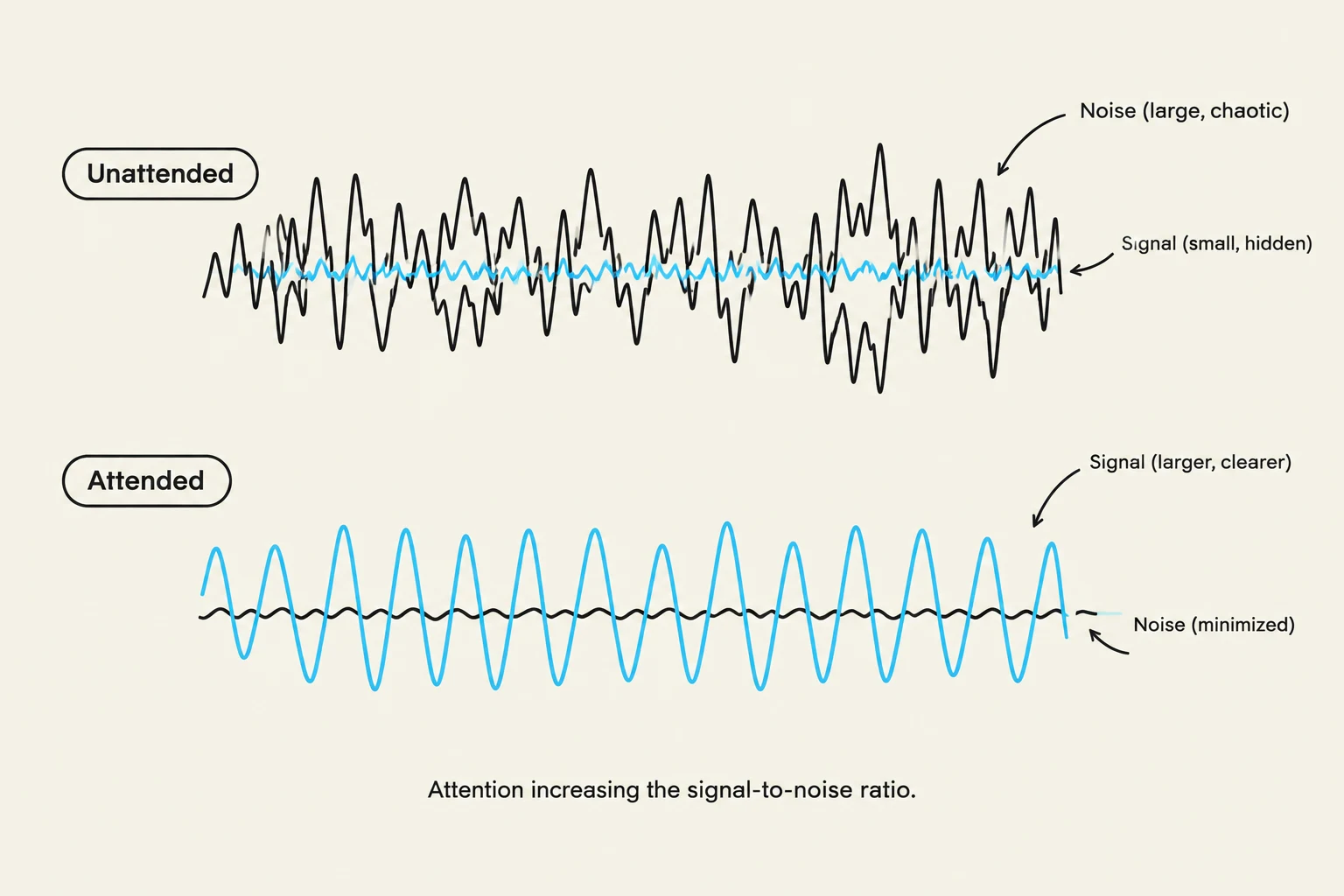
This illustration demonstrates how attention can increase the signal-to-noise ratio, making a signal clearer and noise less prominent.
Attention does more than just speed up or slow down our reactions; it fundamentally alters the quality of our perception. When we direct our attention to a specific object, that object undergoes a "perceptual boost."
1. Enhanced Signal-to-Noise Ratio
Think of your perception like a radio. Unattended stimuli are like static or background noise. When you attend to an object, your brain effectively "turns up the volume" on that specific signal while "turning down" the noise of the surroundings. This makes the attended object appear sharper, more distinct, and easier to identify.
2. Feature Binding
As mentioned in the context of the same-object advantage, attention is crucial for feature binding. Without attention, we might perceive the world as a disjointed collection of colors and shapes. Attention allows the brain to bind the color "red" to the shape "square" so that we perceive a "red square" rather than just seeing red and seeing a square separately.
3. Perceptual Blindness
Conversely, the intense focus on an attended object can lead to what is known as inattentional blindness. Because our attentional resources are finite, if we are heavily focused on one specific task or object, we may become completely "blind" to other unexpected stimuli in our field of vision.
Summary Table: Attention Effects
Phenomenon
Mechanism
Primary Outcome
Stroop Effect
Interference between automatic and controlled processes
Increased reaction time and errors
Same-Object Advantage
Feature binding and efficient resource allocation
Faster processing of integrated object features
Perceptual Enhancement
Increased signal-to-noise ratio
Sharper, more distinct perception of attended stimuli
In conclusion, attention is the gatekeeper of our cognitive experience. It can create obstacles through interference, as seen in the Stroop effect, but it also provides the necessary tools for efficient object recognition and high-fidelity perception through feature binding and signal enhancement.
Keep reading for free.
Create an account to finish this reading and make it part of your study routine.