


In the early 20th century, the scientific community faced a crisis: classical physics could not explain the stability of atoms. The Bohr model, which depicted electrons orbiting a nucleus like planets, suggested that charged particles moving in circles should lose energy and spiral inward. This led to the birth of quantum mechanics, centered around the Schrödinger equation:
In this equation, represents the wave function, which contains all the information about the electrons. Because electrons exhibit wave-particle duality, their behavior is described by these wave functions, which are anchored in space and lead to the quantization of energy levels. To fully understand the "shape" and "location" of an electron, we must break the wave function down into two distinct components: the angular wavefunction and the radial wavefunction.
The Angular Wavefunction and Orbital Shapes
The angular part of the wave function, denoted as , describes the angular distribution of the electron density in three-dimensional space. This component is responsible for the specific shapes we associate with different atomic orbitals.
The shape of an orbital is determined by the angular momentum quantum number, . The value of can range from up to . Different values of correspond to different orbital types:
- s orbitals (): These are spherical in shape.
- p orbitals (): These typically have a dumbbell shape.
- d orbitals (): These have more complex shapes.
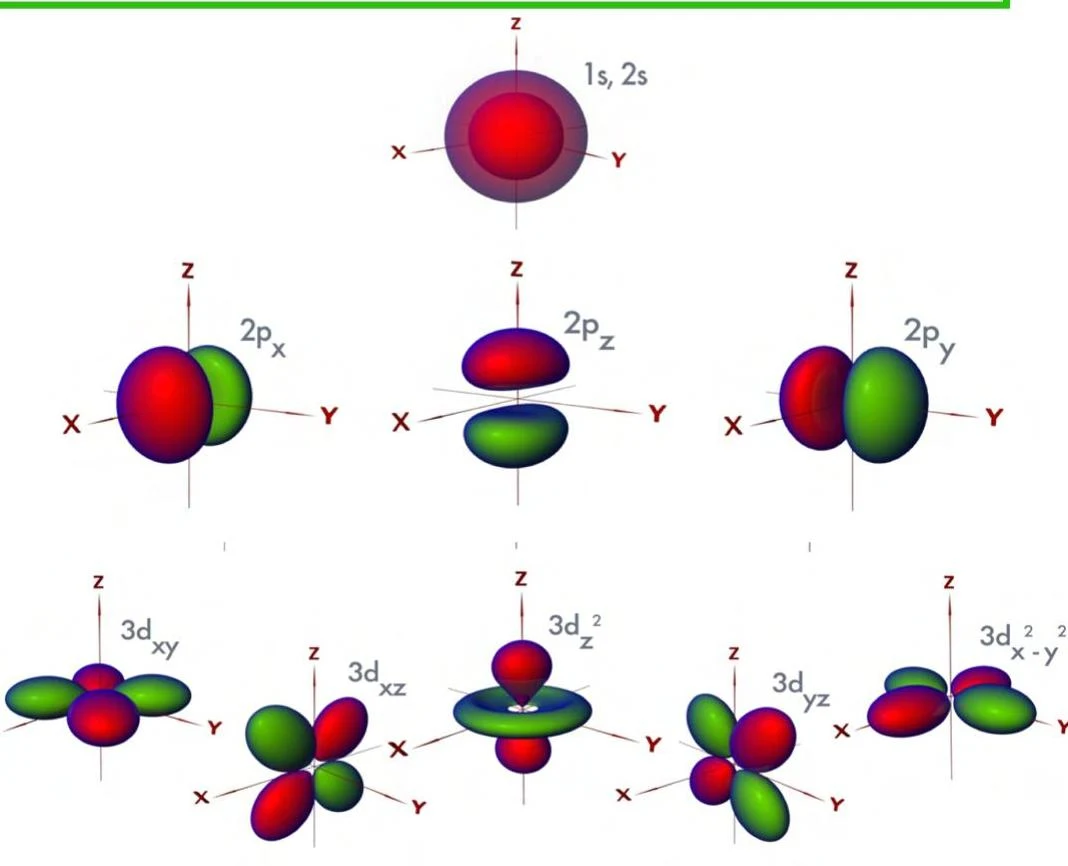
Angular Nodes
An angular node is a region in space where the probability of finding an electron is zero, specifically occurring due to the angular component of the wave function. The number of angular nodes in an orbital is exactly equal to the value of the angular momentum quantum number, .


Keep reading for free.
Create an account to finish this reading and make it part of your study routine.
Continue reading freeAlready have an account? Log in
Updated