Understanding Anxiety, OCD, and Schizophrenia Spectrum Disorders
This content provides a comprehensive overview of anxiety, its spectrum, and related disorders, including panic disorder, social anxiety, and OCD. It also details the schizophrenia spectrum and psychotic disorders, covering their phases, symptom domains, etiology, and nursing management strategies.
Anxiety is a fundamental human emotion that serves as a universal experience. While it is often viewed negatively, it functions as a necessary survival mechanism in its normal form. However, when anxiety becomes excessive, persistent, or interferes with a person's ability to function, it transitions into a pathological state that requires clinical intervention.
The Spectrum of Anxiety
Anxiety is not a monolithic experience; it exists on a continuum of severity and duration.
Normal Anxiety: Acts as a healthy life force necessary for survival.
Acute Anxiety: Precipitated by an imminent threat or loss.
Pathological Anxiety: Distinguished by its intensity and the degree to which it impairs functional ability.
Chronic Anxiety: A long-term state that often begins at a young age and is associated with increased risks for cardiovascular morbidity and mortality.
Exam Tip: When differentiating between anxiety types, look for the "functional impairment" marker. If the patient can no longer perform daily tasks or social roles, the anxiety has likely moved from normal/acute to pathological.
Defense Mechanisms
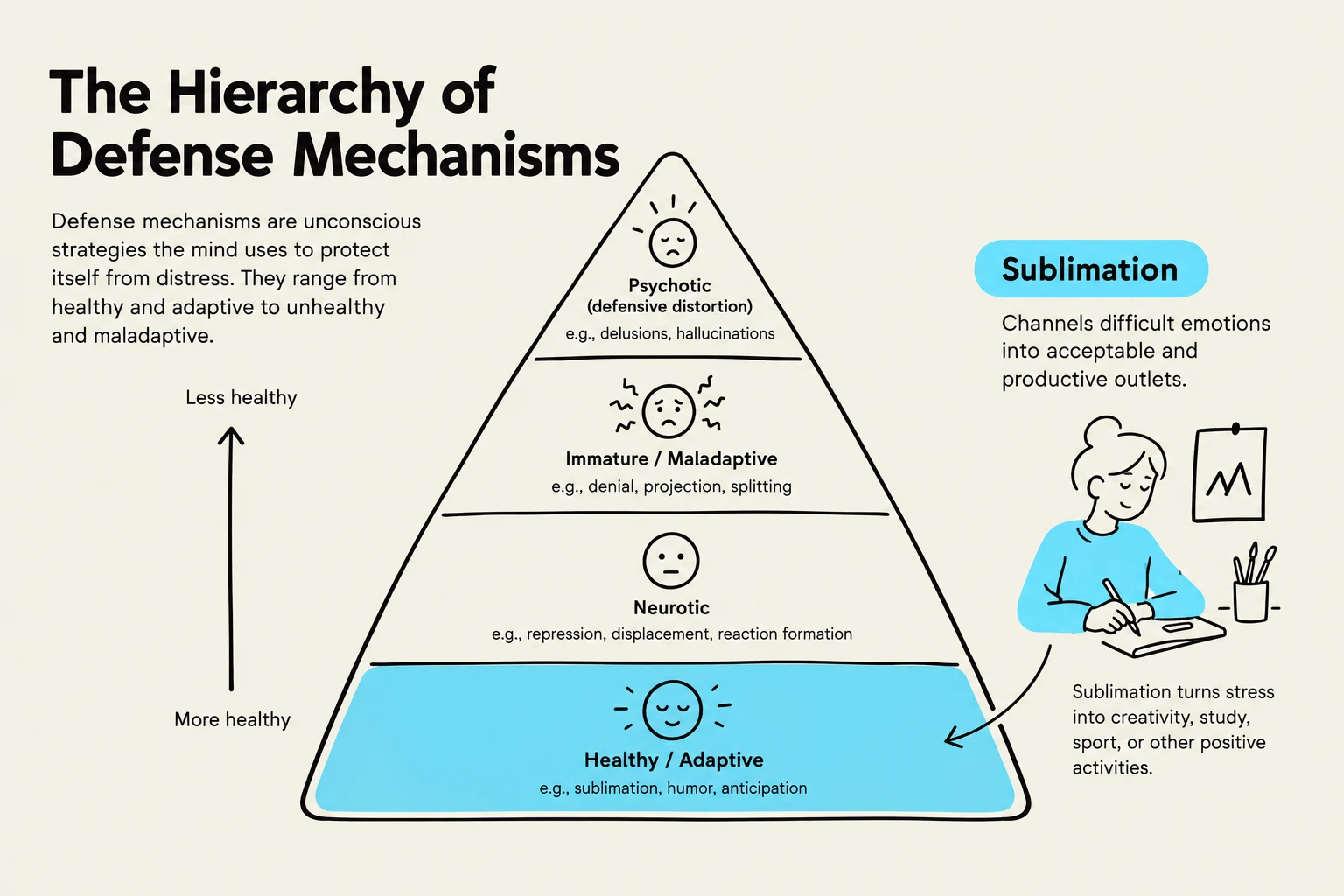
To manage unconscious conflicts arising from anxiety, individuals utilize defense mechanisms. These are largely unconscious processes that can be either adaptive (healthy) or maladaptive (immature).
Healthy Defenses include:
Altruism: Helping others to manage one's own stress.
Sublimation: Channeling unacceptable impulses into productive activities.
Humor: Using comedy to diffuse tension.
Suppression: Consciously deciding to delay thinking about a stressor.
Immature Defenses include:
Denial: Refusing to acknowledge reality.
Projection: Attributing one's own unacceptable feelings to others.
Splitting: Viewing people or situations as "all good" or "all bad".
Dissociation: Disconnecting from one's sense of self or reality.
A diagram illustrating the hierarchy of defense mechanisms, ranging from less healthy (psychotic) to more healthy (healthy/adaptive) levels, with sublimation as an example of a healthy adaptive mechanism.
Anxiety Disorders
When anxiety becomes a primary driver of dysfunction, it manifests in specific clinical disorders.
Panic Disorder and Agoraphobia
Panic Disorder is characterized by sudden, intense panic attacks involving terror and physical symptoms such as palpitations, chest pain, hyperventilation, and nausea. These attacks may occur without an obvious stressor. Agoraphobia often co-occurs with panic disorder; it involves an intense fear of being in places or situations where escape might be difficult, leading to debilitating avoidance behaviors.
Social Anxiety Disorder (SAD)
SAD involves severe anxiety triggered by social or performance situations. The most common trigger is public speaking, driven by a fear of being judged or saying something foolish.
Anxiety Caused by Medical Conditions
Anxiety can also be a direct physiological result of an underlying medical issue. Nurses must assess for conditions involving the:
Respiratory system
Cardiovascular system
Endocrine system
Neurologic or Metabolic systems
Obsessive-Compulsive and Related Disorders
Obsessive-Compulsive Disorder (OCD) is defined by two distinct components:
Obsessions: Unwanted, intrusive, and persistent thoughts, impulses, or images that cause distress.
Compulsions: Ritualistic behaviors performed to alleviate the anxiety caused by the obsessions.
Symptoms exist on a continuum. Mild compulsions may be seen as valued traits in some societies, but severe OCD often centers on themes of contamination, germs, or even violence and death.
Related Disorders:
Body Dysmorphic Disorder: A preoccupation with imagined physical defects.
Compulsive Hoarding: The excessive collection of items considered worthless, leading to social isolation and unsafe living conditions.
Schizophrenia Spectrum and Psychotic Disorders
Psychotic disorders affect how an individual thinks, feels, and behaves. These can be primary (resulting from internal brain dysfunction) or secondary (arising from brain tumors, dementia, or substance misuse).
The Four Phases of Schizophrenia
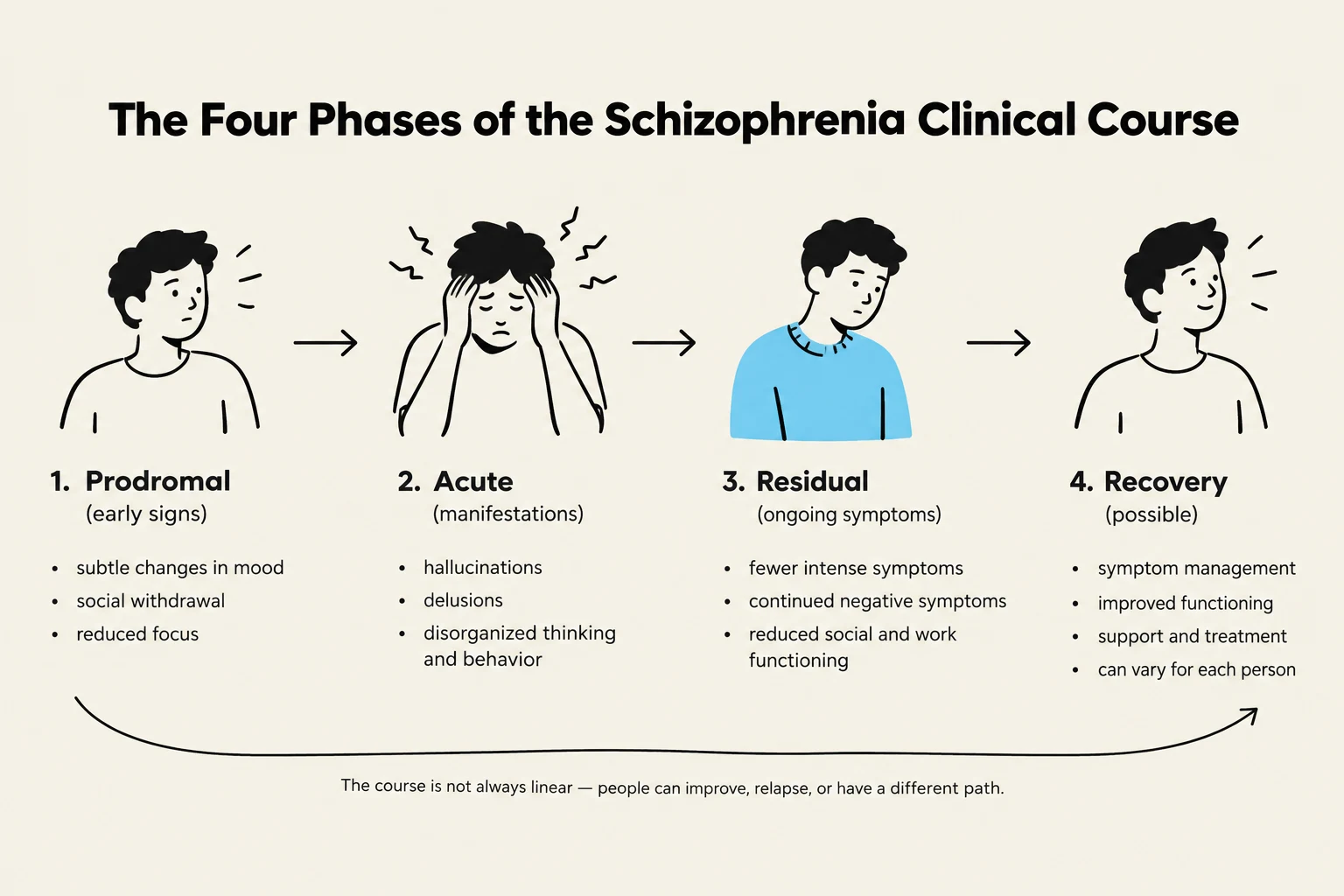
The clinical course of schizophrenia typically follows four stages:
Prodromal Phase: Early signs that precede acute symptoms.
Acute Phase: Fully manifested symptoms.
Stabilization Phase: A reduction in the severity of positive symptoms.
Maintenance Phase: Remission, though residual symptoms may persist.
Symptom Domains in the Acute Phase
During the acute phase, symptoms are categorized into four domains:
Positive Symptoms (Additions to behavior): Hallucinations, delusions, magical thinking, echolalia (repeating words), echopraxia (repeating movements), and word salad.
Negative Symptoms (Deficits in behavior): Anhedonia (inability to feel pleasure), avolition (lack of motivation), affect (blunted emotion), and apathy.
Cognitive Symptoms: Impairment in memory, reasoning, and attention.
Mood Symptoms: Depression, anxiety, or suicidality.
This diagram illustrates the four phases of the schizophrenia clinical course: Prodromal (early signs), Acute (manifestations), Residual (ongoing symptoms), and Recovery (possible). It also notes that the course is not always linear, with individuals potentially improving, relapsing, or following a different path.
Etiology and Risk Factors
The development of schizophrenia involves complex interactions between genetics and neurochemistry.
Genetics: Factors include specific gene clusters and the process of synaptic pruning.
Neurochemistry: Dysregulation of dopamine, serotonin, glutamate, and NMDA receptors plays a critical role.
Neuroanatomy: Observed markers include decreased brain volume, frontal lobe atrophy, and enlarged ventricles.
Nursing Process and Clinical Management
Nursing care must be tailored to the specific phase of the illness and the severity of the symptoms.
Assessment Guidelines
Rule out medical causes: Ensure anxiety or psychosis is not secondary to a medical condition.
Safety First: Always assess for command hallucinations (voices telling the patient to do something) and the risk of suicide or harm to others.
Psychosocial Assessment: Evaluate the patient's cultural background and support systems.
Nursing Interventions and Outcomes
Nursing goals transition based on the patient's clinical state:
Phase
Primary Nursing Goal
Key Interventions
Acute
Safety & Medical Stabilization
Crisis intervention, medication adherence, and maintaining a safe milieu
Stabilization & Maintenance
Functional Improvement & Relapse Prevention
Social skills training, vocational training, and family psychoeducation
Outcome Criteria: For any intervention to be successful, outcomes must be measurable, include a time estimate, and be culturally appropriate.
Clinical Note for Hallucinations: When a patient is experiencing hallucinations, do not argue with their reality. Instead, acknowledge that the experience is real to them, but calmly state that you do not hear the voices.
Communication Strategies
When interacting with patients in an acute psychotic state, use the following techniques:
Use shorter phrases and concrete language.
Allow extra time for the patient to process questions.
If the patient is experiencing "associative looseness" (disorganized speech), tell them you are having difficulty understanding rather than blaming them.
For paranoid patients, avoid direct eye contact and place yourself beside them rather than face-to-face.
Keep reading for free.
Create an account to finish this reading and make it part of your study routine.